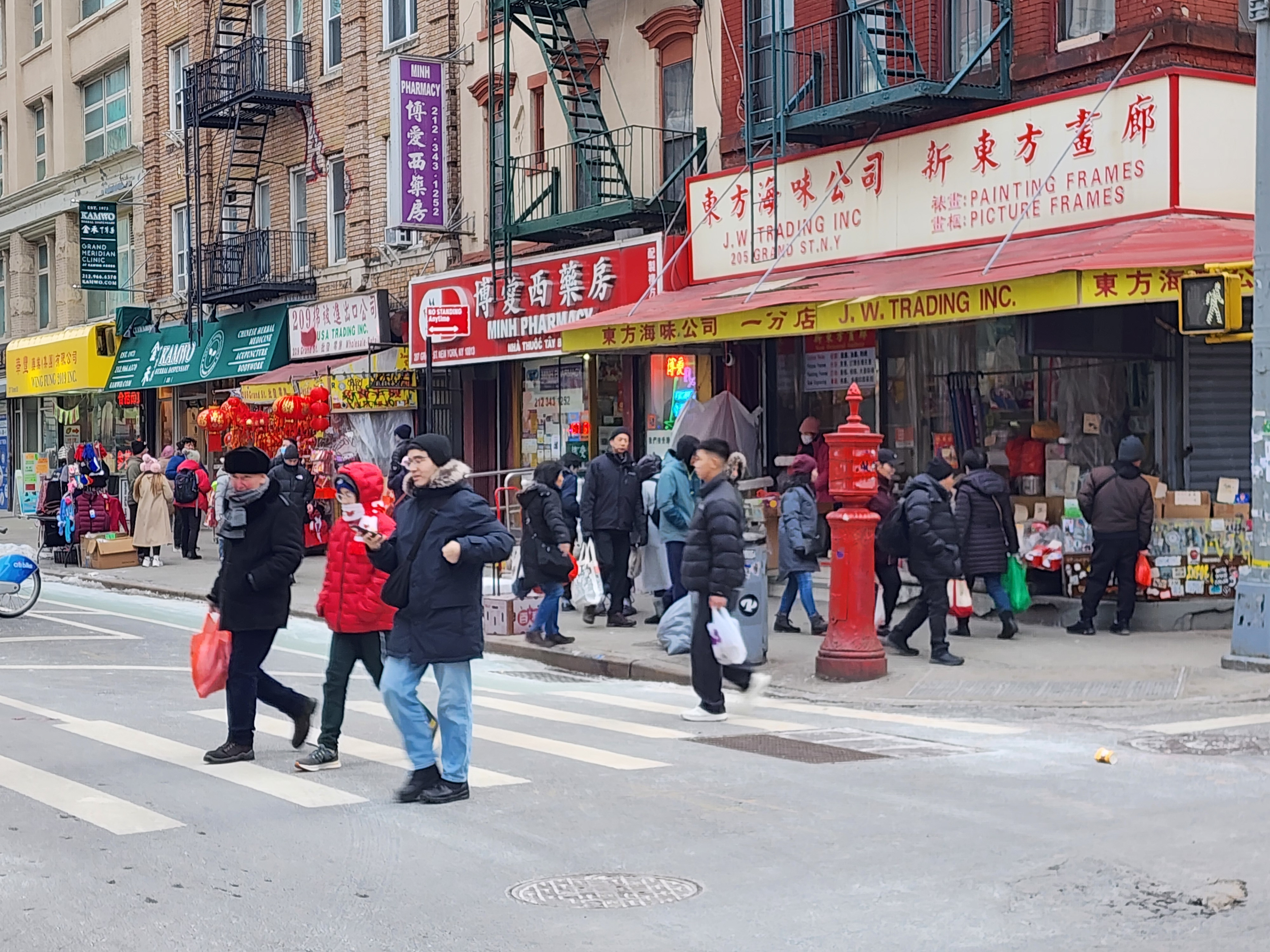
The scene feels busy in that very specific New York way where movement never quite becomes chaos, just a steady, practiced flow of bodies, bags, and glances. The crosswalk cuts through the frame like a pause line, a place where everyone is briefly equal, mid-step, mid-thought. People are bundled up, thick winter jackets zipped to the chin, hats pulled down low, hands wrapped around plastic bags and phones and nothing at all. The air looks cold, the kind that sits in your lungs for a second before warming, and you can almost feel it from the image alone, especially in the way people lean forward slightly as they walk, shoulders rounded, conserving heat without thinking about it.
Behind them, the street is stacked vertically with stories. Old brick buildings rise up with metal fire escapes zigzagging like drawn lines, practical and a little ugly and completely perfect for this neighborhood. The storefronts form a dense strip of color and language, Chinese characters in red and gold, English names squeezed in wherever they fit, pharmacy signs, trading companies, picture frames, groceries, everything pressed together as if space itself is negotiable. Red lanterns hang in a cluster to the left, festive but also everyday, the kind of decoration that never really leaves once it arrives. A bright red fire hydrant stands near the corner, absurdly vivid against the muted winter palette, like it insists on being seen no matter how many people pass it a day without noticing.
What makes the image work is how ordinary it is. No single person is posing, no one is aware of the camera, and yet every figure adds something to the rhythm. A man in a black coat checks his phone while walking, a child in a red jacket looks half-lost, half-excited, a woman carries a bag that’s clearly heavier than she expected. The shop windows spill light onto the sidewalk, a soft glow that contrasts with the grey street and the pale sky you can’t see but somehow know is there. It’s a moment of transition, literally and figuratively, people crossing from one side to another, from inside to outside, from errand to errand, from one small purpose to the next.
This is Chinatown doing what it does best: not performing, not explaining itself, just continuing. The signs are layered, the businesses practical, the crowd mixed, the pace steady. It’s not nostalgia, not spectacle, not a postcard. It’s the daily machinery of the city, exposed for a split second when the light changes and everyone steps forward together, and then it’s gone again, replaced by the next wave, the next crossing, the next version of the same street that somehow never feels exactly the same twice.
Related