Title: Finding the Story Inside a Street Dance Moment
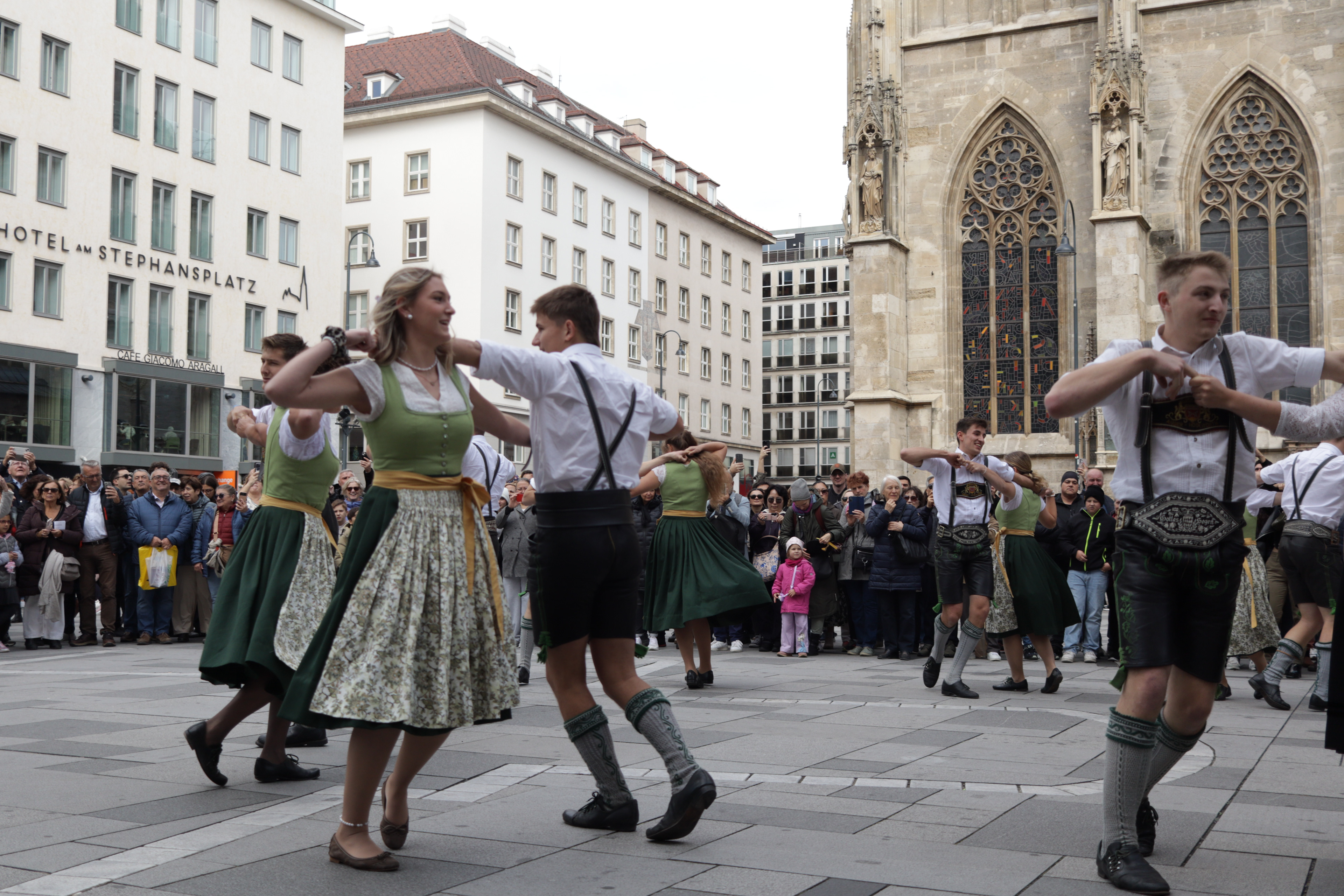
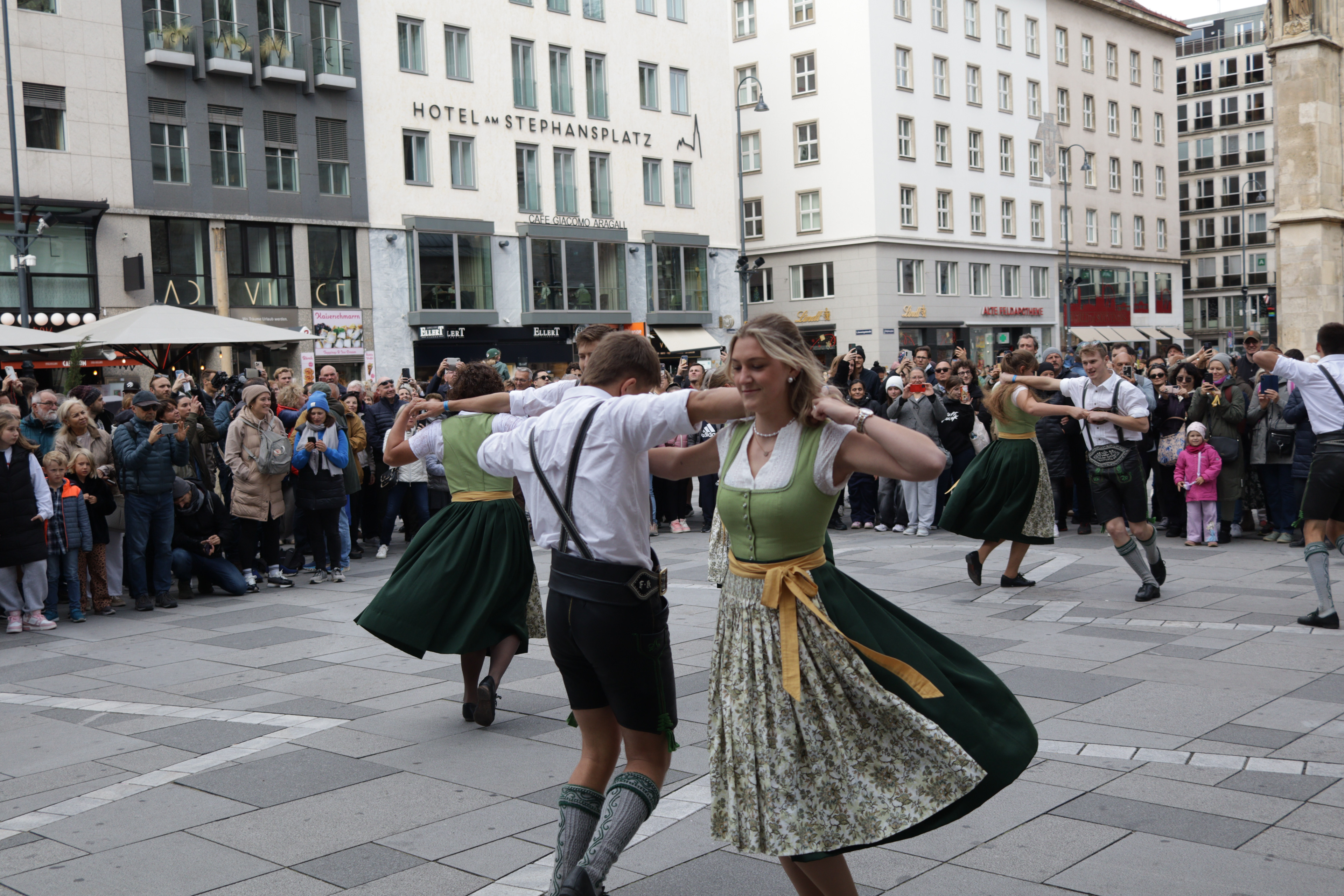
A circle of motion, mid-step, almost like the city paused just enough to let tradition take over for a few minutes—that’s what this frame leans into. The dancers in green and white, the rhythm implied in their posture, and the stillness of the crowd behind them all hint at something larger than a performance. It’s not staged in a sterile way; it feels dropped into everyday life, right between a hotel facade and a Gothic wall that has probably watched centuries of very different gatherings. That contrast alone opens up a surprising number of directions.
You could take this as a post about tradition colliding with modern urban life—how folk culture survives not in museums but in active, lived spaces, right in front of tourists holding smartphones. Another angle leans into tourism itself, not the polished brochure version, but the accidental discovery kind, where someone turns a corner and suddenly finds a full cultural performance unfolding in real time.
There’s also a strong visual narrative around movement versus stillness. The dancers are all energy—skirts mid-swing, legs stepping, arms raised—while the crowd forms a dense, almost static backdrop. A post could explore that tension, how culture is performed for an audience that consumes it differently now, often through screens even while standing a few meters away.
A more fashion-oriented angle works surprisingly well here too. Traditional attire isn’t costume in this context—it’s functional, expressive, and deeply coded. The dirndls, lederhosen, the textures, the muted greens and whites, even the socks and shoes—they tell a story about identity, regional pride, and continuity. You could turn this into a street-style analysis that just happens to be rooted in heritage rather than trends.
Another direction slips into the idea of choreography in public space. Cities aren’t designed for dancing, yet here the stone pavement becomes a stage. There’s something slightly rebellious about that—taking a rigid, historical square and turning it into a living, moving thing. A post could explore how spontaneous or semi-organized performances reshape how we experience urban environments.
There’s also a subtle generational layer. The dancers look young, energetic, while the crowd is mixed—older spectators, families, kids in bright jackets. That dynamic suggests transmission, not just performance. Culture being passed down, reinterpreted, maybe even slightly modernized with each iteration. It’s not frozen; it’s evolving in plain sight.
You could even pivot into a photography-focused piece. The composition itself is rich: leading lines from the pavement, layered depth with dancers in the foreground and architecture rising behind, the soft overcast light flattening shadows just enough to keep detail in clothing and faces. A post could break down how to capture motion in a crowded environment without losing context—or how to shoot cultural events without making them feel staged or detached.
Another angle—slightly more abstract—is about rhythm without sound. Looking at the image, you can almost hear the music, but it’s not present. The body language carries it. A post could explore how visual cues—posture, spacing, repetition—translate into an implied soundtrack.
And then there’s the geopolitical-cultural layer, if you want to stretch it a bit. European identity often gets discussed in terms of policy, borders, economics. But here it’s something much simpler: shared rituals, local expressions, public celebration. A grounded, almost quiet counterpoint to the bigger narratives.
Finally, you could treat it as a moment of interruption. People going about their day, and suddenly the day bends—traffic pauses, attention shifts, a square becomes a stage. That fleeting disruption is actually the story. Not the dance itself, but the way it briefly reshapes everything around it.