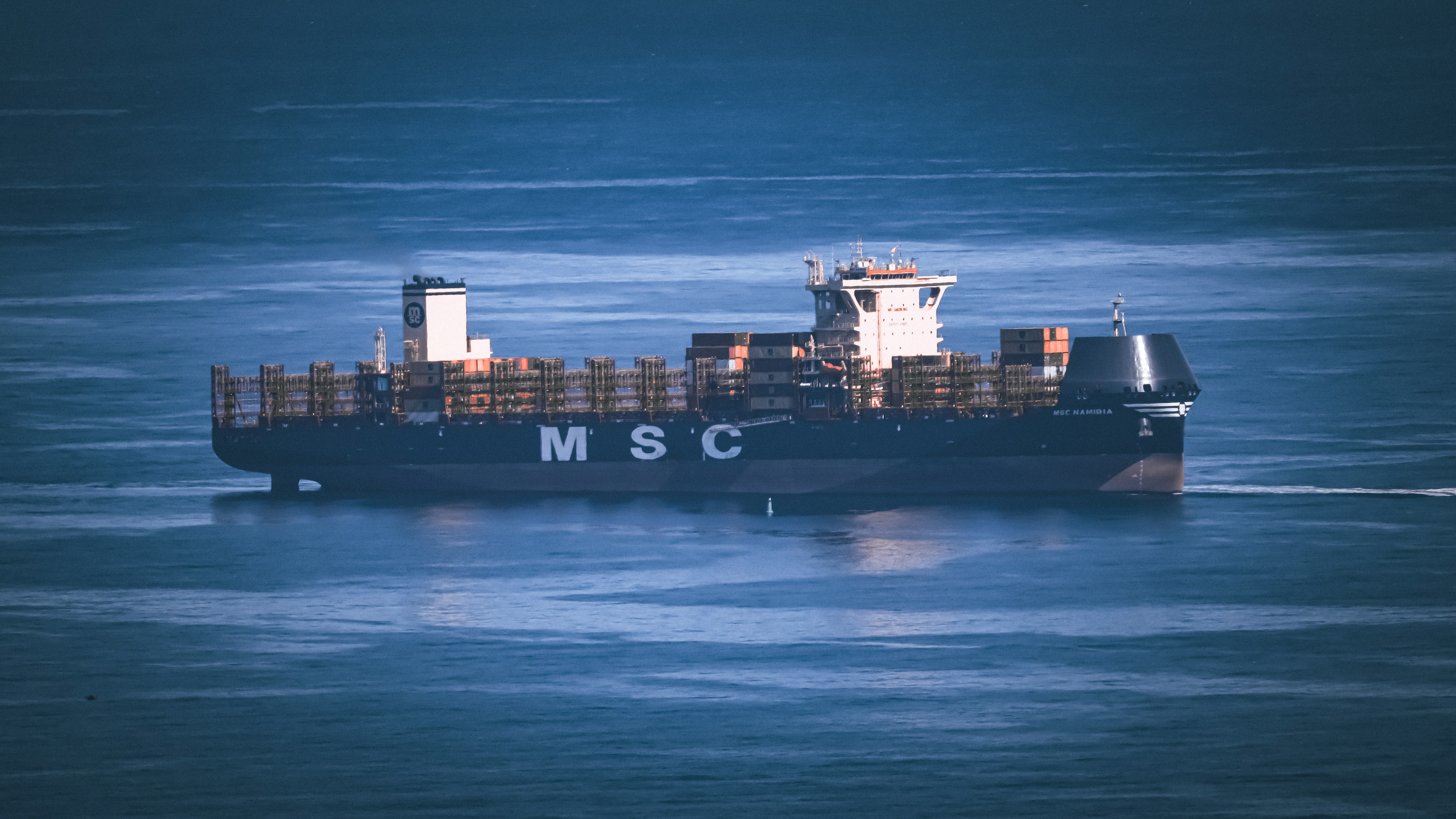
A long, steel silhouette moves across a field of deep blue water, almost as if it has been cut from the horizon itself and set gently in motion. The container ship dominates the middle of the frame, stretched horizontally like a floating industrial city, its dark hull slicing a pale wake behind it. Large white letters—M S C—stand boldly along the side of the vessel, unmistakable and stark against the matte-black steel. Toward the bow, the name MSC Namibia is faintly visible, painted in white near the forward structure, a small detail that feels almost intimate compared to the massive scale of the ship itself.
Rows of containers form a tight geometric landscape across the deck. Their colors—muted oranges, dull greens, faded browns—appear subdued in the cool lighting, as if the atmosphere has washed everything in a blue filter. They are stacked with precise discipline, each box part of a global puzzle of logistics and supply chains. From a distance they resemble tiny bricks forming a floating industrial skyline. Between them rises the ship’s superstructure: the tall white bridge tower with antennas, railings, and windows clustered together like the control room of a mobile city.
The sea itself becomes a character in the scene. Its surface is smooth yet subtly textured, brushed with streaks of lighter blue where sunlight grazes the waves. The water reflects the sky in broad gradients—from darker navy tones in the foreground to softer, silvery blue patches behind the ship. A thin white trail curls outward from the stern, marking the vessel’s path like a signature across the ocean.
One small buoy floats in the foreground, almost comically tiny compared to the massive container carrier passing behind it. That scale contrast says a lot without needing words: global commerce gliding past the quiet markers of maritime navigation.
The photograph carries an almost cinematic calm. The color palette leans heavily into cool blues, giving the entire scene a slightly dreamlike quality, as if the ship were drifting through a painted seascape rather than an active shipping lane. It feels distant yet precise—the kind of moment captured with a long lens, compressing space so the ship and the ocean seem layered closely together.
For someone interested in maritime photography—or shipping in general—the image tells a quiet story about scale and movement. Container ships like this one operate as the arteries of global trade, moving thousands of containers across oceans with steady, almost indifferent rhythm. Yet when isolated in a frame like this, they become something more visual: monumental objects traveling through vast empty space.
And oddly enough, the scene doesn’t feel rushed. The ship is moving, yes, but the moment itself feels suspended—steel, water, and horizon balanced in a calm blue corridor stretching endlessly in both directions.