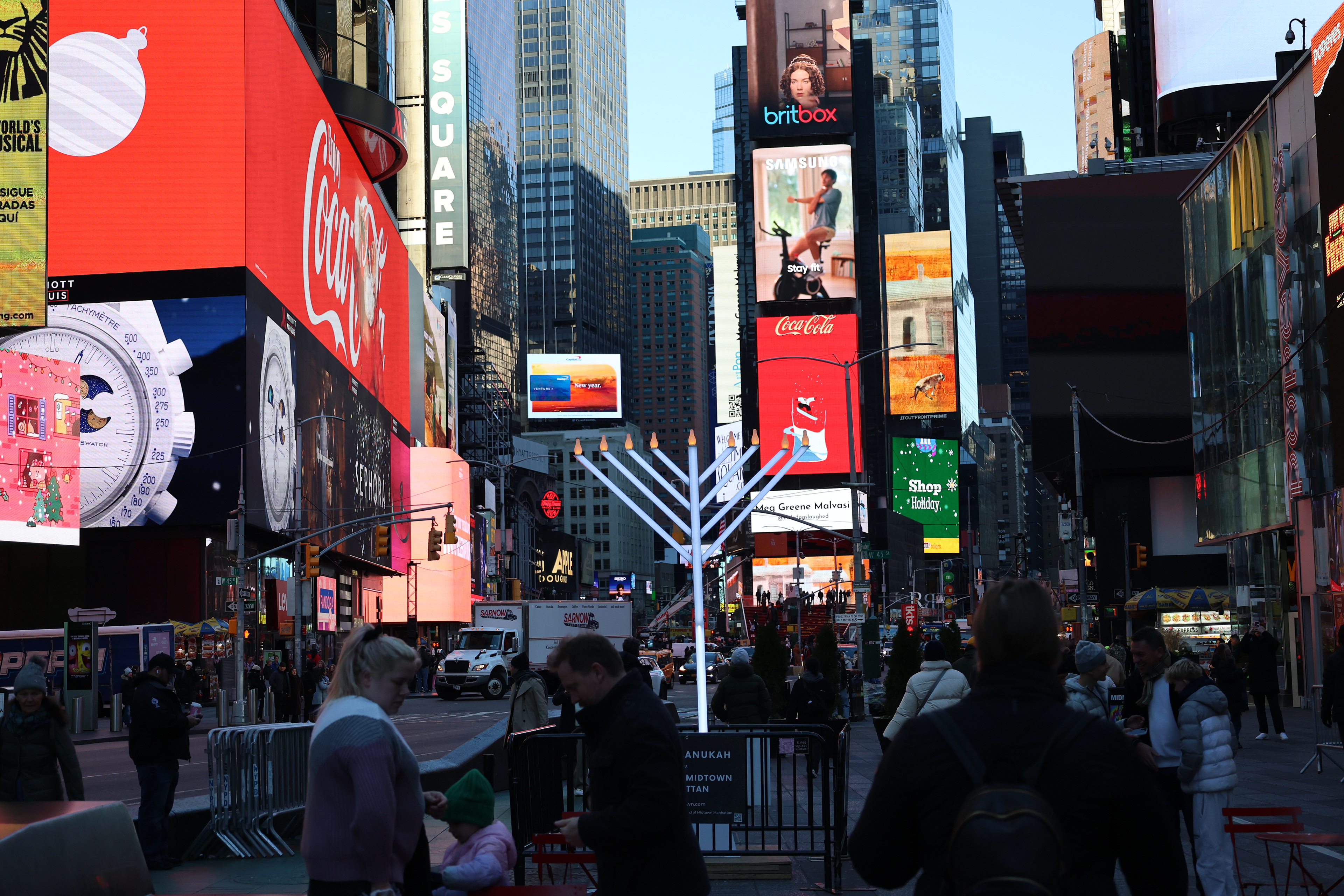
A narrow canyon of glass and steel pulls the eye upward while the street below hums with movement, a familiar tension between human scale and media scale playing out in real time. The scene unfolds at that in-between hour—late afternoon slipping into evening—when the sky is still pale blue but the city has already surrendered to artificial light. Massive LED billboards dominate everything, stacked and layered like a vertical feed: Coca-Cola glowing in saturated red, a Samsung ad mid-motion, a BritBox panel hovering above like a digital window into another narrative. Each screen competes not just for attention, but for emotional tone—warmth, urgency, aspiration—creating a kind of ambient storytelling that never quite resolves.
At street level, the mood shifts. People move through colder shadows, bundled in winter jackets, some pausing, some drifting, none really looking up for long. There’s a small, almost understated holiday installation in the center—a modern, geometric menorah-like structure lit in white, standing quietly (well, as quietly as anything can here) amid barricades and traffic signals. It feels temporary, almost fragile against the permanence of the towering displays behind it. A delivery truck edges through the intersection, headlights cutting across the scene, while pedestrians cluster near the curb, their faces intermittently illuminated by passing light.
What makes the frame work as a media digest hero image is this layered contradiction: hyper-commercial spectacle above, ordinary human rhythm below. The screens suggest scale, capital, and narrative control; the street reveals fragmentation, distraction, and flow. Nothing is centered in a traditional sense—the eye keeps bouncing, from billboard to building edge to moving figure—mirroring how modern media consumption actually feels. It’s not a single story, it’s simultaneous streams.
And then there’s the color—deep reds, cold blues, the occasional green panel tucked into the vertical stack—almost too vivid, slightly unreal, like the city has been tuned for maximum contrast. It gives the whole image that faintly cinematic edge, as if this isn’t just documentation but a frame pulled from an ongoing broadcast. Which, in a way, it is.
Media Digest: