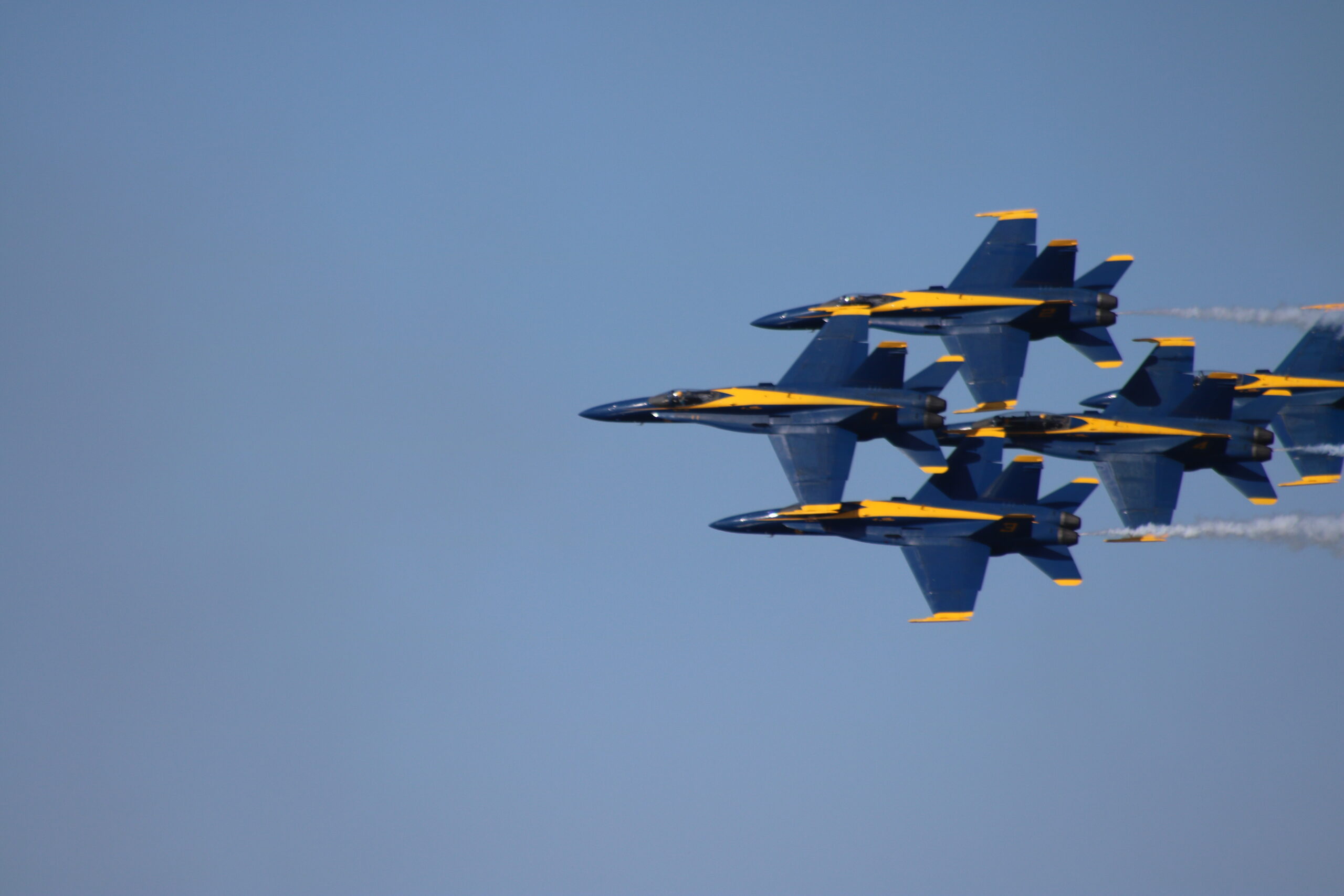
Four blue and yellow F/A-18 Super Hornets of the US Navy Blue Angels fly in their diamond, tilted toward the lens so you see the tops of the wings and straight into the canopies. Numbers 1 through 4 are all readable on the fuselages. A fifth jet pushes in from the right edge, mostly cut off, and white smoke streams back off three of them. The left half of the picture is nothing but sky. That emptiness does more work than any of the jets.
Room to fly into
The usual instinct with a formation pass is to fill the frame. Crop tight, get the jets big, lose the sky. This one goes the other way. The jets sit on the right and point left, into a wide field of plain blue, so the eye lands on the lead jet’s nose and then keeps going.
Photographers call it lead room. Give a moving subject space ahead of it and the picture feels like it’s still moving. Push the same four jets to the left edge, noses nearly touching the border, and they’d look like they were about to hit a wall.
The sky helps. No clouds, no horizon, no contrails from anything else. Just a soft gradient, a touch paler toward the bottom where it gets closer to the haze. There’s nothing to measure scale or speed against, which is odd for an air show photo, and it makes the formation read almost like a graphic.
Why the bank matters
Most formation shots from the crowd line catch the jets flat and level, side on or from underneath. You get bellies and silhouettes. Here the whole diamond has rolled toward the viewer, likely early in a turn, and that changes everything about how the airplanes look.
You can see into the cockpits. You get the full yellow stripe running down each spine, the yellow tips on the wings and tail fins, the paired exhausts. The twin tails splay out like they’re meant to. And because the jets are stacked in depth, their wings overlap in the picture: the lead’s wing tucks under number 2, number 3 slides beneath the lead, the slot jet sits right behind and between them. On paper the diamond is four points. In this frame it’s one knotted shape.
What the smoke gives away
The smoke trails run off to the right and out of frame, and they’re uneven. Heavy from number 2, lighter from the slot, a thick band from the jet cut off at the edge. The lead isn’t trailing much at all. It’s a small detail, but it pins the moment down as a real pass, mid-maneuver, rather than a posed publicity plate where everything is symmetrical.
That half-visible fifth jet is the frame’s one flaw and its one bit of drama. Somebody’s joining up. You only get a wing, a tail, a canopy edge and a stripe.
The sky to the left stays empty.