Outside the Musée d’Orsay in Paris, the museum queue keeps moving while armed soldiers cross the square. Visitors wait beneath the broad glass-and-metal canopy, somebody raises a camera, and a street vendor stands beside his bottles of water. A patrol passes through the same space. This is how heightened security becomes routine: people carry on with the small business of their day while the machinery of protection operates a few metres away.
The photograph gives that coexistence room to reveal itself. The museum’s pale stone facade stretches across the background, its carved ornament, tall arched windows and dark mansard roof softened by an overcast sky. Below it, a long line of visitors in summer clothes gathers behind the entrance barriers. Three soldiers in camouflage occupy different depths of the broad grey forecourt, with one close to the camera on the left, another walking near the queue and a third standing farther right. In the foreground, a man in a blue cap and light grey shirt stands beside bottled water and a handwritten one-euro sign. At the right edge, a large display reproducing a crowded painting adds another gathering of faces to the scene. There is plenty happening, yet no visible rush or disruption.
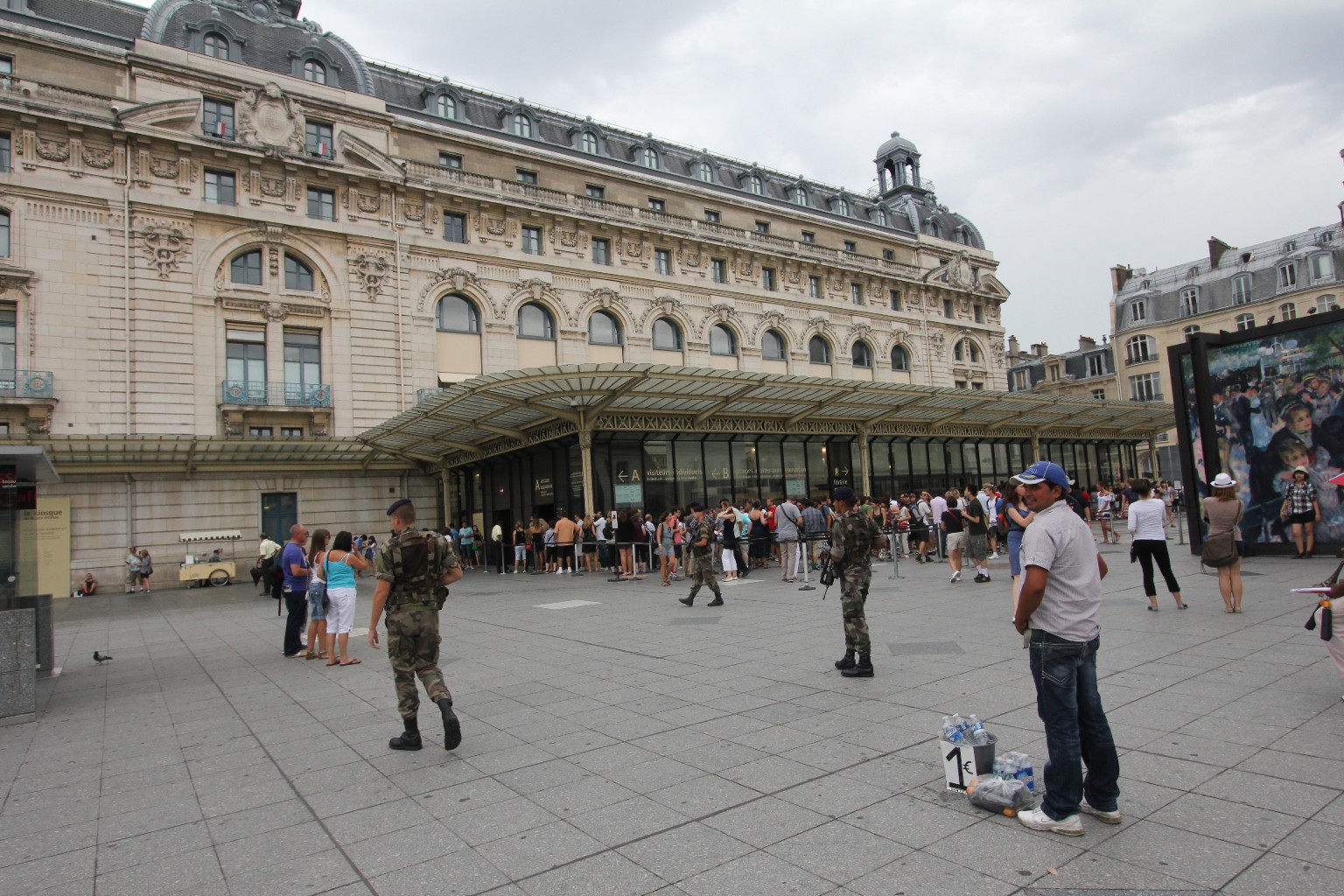
A single photograph cannot tell us what everyone in that square is thinking. Some visitors may find the patrol reassuring; others may barely register it. What it does show is how little physical separation there is between a cultural outing and an armed security presence. The soldiers share the paving with people deciding where to stand, where to look and what to photograph. Nobody has to abandon the museum visit for security to become part of its experience. It is already there, in the viewfinder.
There is a distinction between this everyday sense of high alert and the formal designation of a national security posture. France’s revised Vigipirate framework took effect on June 22, 2026, with three stages. The summer-autumn 2026 posture is vigilance renforcée, the intermediate stage; alerte attentat is the highest. Protection of tourist sites and crowded public spaces remains a priority. Those distinctions matter, because a familiar patrol does not establish that the country is permanently at its maximum alert level. Nor does this photograph, whose date is not established here, document the current deployment outside the museum.
The preparations for October 31, 2026 give that wider atmosphere of vigilance a fresh context. France is entering a third consecutive weekend of protests, with Paris again braced for possible disorder. Across the country, 70,000 police officers and gendarmes are being mobilised, matching the deployment the previous Saturday. The figure is nationwide, rather than a count for the capital alone. Interior Minister Laurent Nuñez has warned of a very high risk of public disorder, with particular concern about gatherings continuing into Halloween night.
The security response also focuses on evening gatherings, including calls circulating online for assemblies after 8 p.m. Authorities have announced bans on gatherings they identify as inciting violence. This public-order operation is separate from the military patrol in the photograph, and the image should not be read as a record of the Halloween deployment. But the connection at street level is plain: residents, shopkeepers and visitors must once again organise an ordinary weekend around the possibility of disruption. An exceptional mobilisation can become a recurring feature of the calendar without becoming any less exceptional in scale.
The broader observation still holds. Sustained vigilance changes the texture of public life even when the day feels ordinary. Visitors learn to allow for security checks, follow entrance barriers and share prominent public places with armed personnel. After enough repetition, these arrangements can become as familiar as the queue itself. That familiarity is useful in one sense: a city needs to keep living. It also makes an unusual settlement easier to stop examining. A museum forecourt remains a place to meet, wait and look at art, with weapons now part of the scene.
The most telling detail here is the water for sale. Beside a major cultural institution and within sight of the patrol, someone is trying to earn a few euros from thirsty visitors. That small transaction brings the whole scene back to street level. France carries on, and heightened security carries on with it.