France has developed a peculiar talent for turning economic frustration into a national spectacle of self-destruction. When the economy struggles, people take to the streets. When the government proposes reforms, people take to the streets. When living standards stagnate, taxes rise or public services deteriorate, the response is familiar: demonstrations, strikes, barricades and another round of political confrontation. France is a country with an extraordinary cultural heritage, a highly educated population, world-class infrastructure and enormous economic potential. Yet it repeatedly finds itself trapped in a cycle in which dissatisfaction with economic conditions produces actions that risk making those conditions even worse.
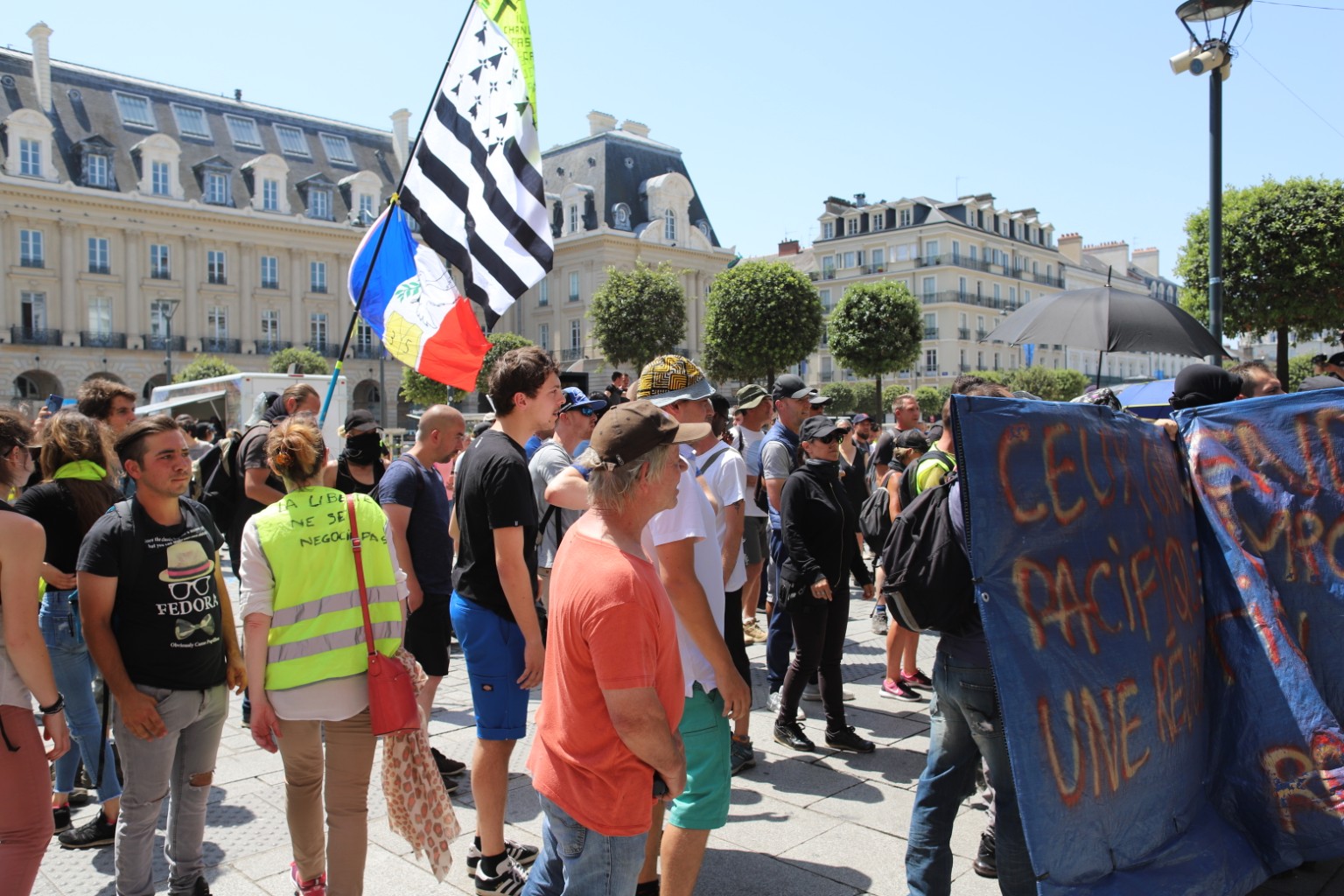
The photograph captures this contradiction rather well. In a handsome French square, surrounded by elegant pale stone buildings, mansard roofs, dormer windows and neatly trimmed trees, a crowd of demonstrators gathers beneath the bright summer sun. The black-and-white Breton flag flies prominently beside a French tricolor, while a large blue protest banner carries the words “LEUR RÉPRESSION” and “UNE …,” with the remaining message partly obscured. A participant wears a fluorescent yellow vest with handwritten lettering, recalling the visual language of France’s Yellow Vest movement. Others stand in casual summer clothing, some with their faces covered, while a black umbrella offers shade in the middle of the gathering. The architecture speaks of continuity, prosperity and centuries of accumulated achievement. The scene below speaks of anger, distrust and a society seemingly unable to agree on how to move forward.
There is something almost theatrical about the contrast. The buildings are magnificent, the public square is attractive, and the urban environment represents precisely the sort of quality of life that millions of people elsewhere would envy. Yet the political atmosphere is one of permanent grievance. France has become exceptionally good at defending what it already possesses and considerably less successful at agreeing on how to create more. Protest is treated not merely as a democratic right but, at times, as an alternative to the difficult business of compromise, investment, productivity and economic adaptation.
Of course, not every demonstration is pointless, and not every protester is a rebel without a cause. France has genuine economic problems. Public debt is enormous, taxation is heavy, unemployment remains a persistent concern, and many households feel that their purchasing power has failed to keep pace with their expectations. Younger generations face difficulties entering the housing market and establishing financial independence. Small businesses must navigate complicated regulations, labor costs and administrative obligations. These are legitimate grievances, and dismissing them would be foolish. But identifying a problem is not the same as offering a workable solution. Too often, French political confrontation seems better equipped to prevent an unpopular change than to produce a credible alternative.
Consider the economic consequences of repeated disruption. Strikes interrupt transportation, demonstrations discourage commercial activity, and violent confrontations can damage shops, public infrastructure and the reputation of entire neighborhoods. Businesses already uncertain about future taxation and regulation must also account for unpredictable interruptions. Investors looking for stable operating conditions have alternatives elsewhere in Europe and beyond. Tourism, one of France’s great economic strengths, depends heavily on the country’s international image. A nation cannot endlessly advertise its beautiful cities, celebrated cuisine and exceptional cultural attractions while treating recurrent disruption as an unavoidable feature of everyday life.
The deeper problem is political. France has cultivated an expectation that the state should guarantee an extraordinary range of economic and social protections, while public debate frequently resists the compromises required to finance them. Governments promise security, generous services and economic competitiveness simultaneously. Voters demand lower costs, better benefits and stronger public finances. Politicians discover that almost every serious reform creates an organized constituency determined to stop it. The result is paralysis, followed by frustration, followed by another protest. Around and around it goes.
And here is the uncomfortable part: France is not a poor country struggling to escape underdevelopment. It is a wealthy, technologically capable nation with major industrial companies, sophisticated research institutions, excellent agricultural production and some of the world’s most recognizable brands. Its aerospace, luxury goods, energy and transportation industries demonstrate what French engineering and entrepreneurship can accomplish. The tragedy is not a shortage of talent or resources. It is the persistent difficulty of translating those advantages into broader economic confidence and sustainable public finances.
The culture of protest also carries a historical burden. The French Revolution established popular rebellion as a central element of the national political imagination, and subsequent generations have repeatedly returned to the streets to challenge authority. There is dignity in that tradition when governments abuse their power or ignore legitimate demands. But history can become a trap when the symbolism of resistance overshadows the practical question of what happens afterward. Overthrowing a proposal is easier than constructing a replacement. Blocking a reform can deliver an immediate political victory while leaving the underlying economic problem untouched.
Perhaps the most frustrating aspect is the absence of a convincing national consensus about economic growth. France needs more productive investment, stronger incentives for entrepreneurship, more opportunities for younger workers and a credible approach to its public debt. It also needs to preserve the social protections that make French society distinctive. These objectives are not necessarily incompatible, but reconciling them requires negotiation and a willingness to accept that resources are finite. Neither slogans nor barricades can repeal arithmetic.
The photograph, then, is more than a record of a demonstration. It is an image of a country caught between its magnificent inheritance and its uncertain economic future. The flags, banners and protesters occupy the foreground, while the beautiful buildings stand behind them almost indifferently, reminders of what earlier generations managed to build. One cannot determine the legitimacy of this particular protest from a photograph alone, and the demonstrators may have had entirely reasonable demands. But the image provides a fitting illustration of a much larger French dilemma: a society exceptionally skilled at expressing discontent and far less successful at converting that energy into durable economic progress.
France does not need to abandon protest, suppress dissent or surrender its social model. It needs to rediscover the distinction between defending legitimate interests and making necessary change impossible. A prosperous future cannot be built solely by opposing the present. Until that lesson becomes politically acceptable, France risks continuing its familiar routine: another grievance, another confrontation, another disrupted working day, and another opportunity to shoot itself in the foot. Again and again.