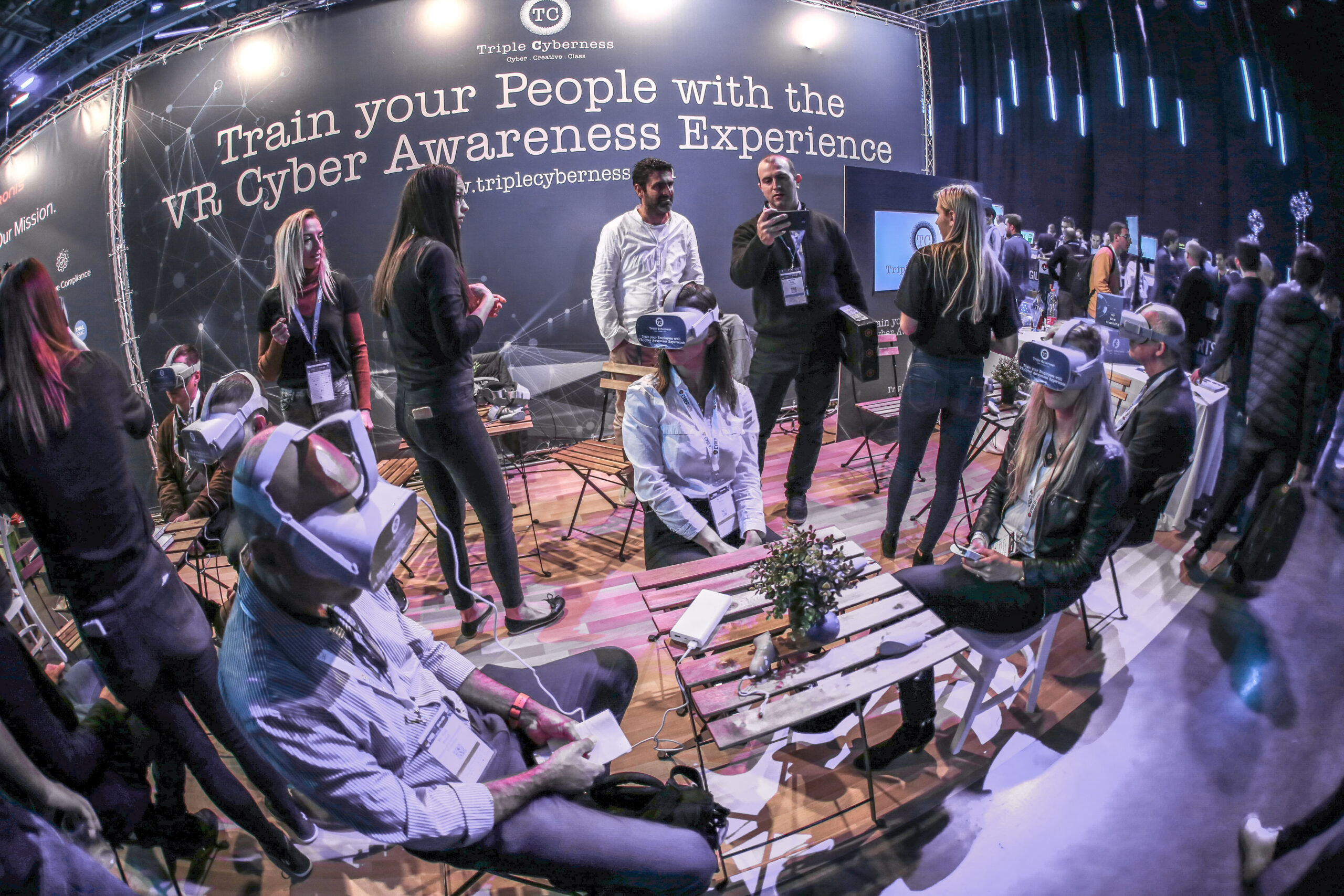
Folding bistro chairs around a slatted café table. On the table, a potted plant and a white power bank, its cable running up into somebody’s headset. Half a dozen grown professionals sit with white headsets strapped to their faces, heads cocked at odd angles, while the booth staff stand over them and watch. One man films the whole thing on his phone. The banner behind them says “Train your People with the VR Cyber Awareness Experience.” From the outside, this is what VR training looks like: people sitting very still while other people look at them. Whatever matters is going on inside the headset.
So what’s going on in there, and is it worth the hardware? A few years and one metaverse boom-and-bust later, the honest answer is sometimes. VR training pays off when the real event can’t be scheduled, or shouldn’t be. Outside that zone it’s a pricey way to watch a video.
The Best Cases Are the Ones Nobody Can Stage
Walmart is still the example everyone reaches for. In 2018 it sent about 17,000 headsets to its U.S. stores (four to every supercenter), loaded with modules on everything from new equipment to compliance. The ones people remember were something else. Store managers walked through a Black Friday crush before they ever ran one. Staff rehearsed an active-shooter response, which no store can drill for real with shoppers in the aisles; after the 2019 shooting at the El Paso store, Walmart’s chief executive said the VR training had helped the team there act fast.
Helicopter pilots can now log real training credit in a headset. Loft Dynamics’ H125 simulator (a full-size cockpit on a motion platform, with the outside world drawn inside the headset) was qualified by Europe’s aviation regulator in 2021 and by the FAA in 2024. The approval covers engine failures and sling-load work, the kind of flying where a practice mistake in a real aircraft can be fatal.
Notice what these have in common. The real version either can’t be booked or would be dangerous to try. That’s the whole business case. Hard conversations fit it too, which is why soft-skills VR outlived the hype; you can’t schedule a furious customer for practice. The most-quoted figure in VR training, from a 2020 PwC study, is a confidence score. Look at what that measures. A feeling.
A Headset Is the Wrong Room for Phishing
Back to the booth in the photo. Cyber awareness is an odd fit for VR, because most of the attacks it’s supposed to stop arrive in an ordinary inbox, usually between two meetings.
The standard way of training for that is barely working, and there’s hard data on it. A UC San Diego team tracked more than 19,500 employees of the university’s health system through eight months and ten fake phishing campaigns. Whether someone had recently finished the annual training made no measurable difference to whether they clicked. The warning pages shown right after a click cut the failure rate by about 2 percent. Three in four people spent a minute or less on those pages; a third closed them without reading anything. By month eight, more than half the staff had clicked at least once.
VR vendors read that as an engagement problem, and they’re half right. People aren’t paying attention, and a headset holds attention for ten minutes better than any e-learning module. It doesn’t touch where the habit forms, though. Clicking is a desk reflex, built hundreds of times a week in a real inbox. Pulling people out of that setting once a year to teach them about it puts the lesson in the wrong room. The humble phishing simulator at least lives in the right one, even if it hardly moves the numbers.
Pressure Is the Part a Headset Can Train
Take the expensive cases. In early 2024 a finance employee in Arup’s Hong Kong office got an email about a secret transaction and suspected phishing. His instincts worked. Then he joined a video call where the CFO and several colleagues looked and sounded right, and every one of them was a deepfake. He made 15 transfers adding up to about $25 million.
What beat him was a screen full of familiar faces and a boss in a hurry. That’s a social moment under time pressure, and a headset can put exactly that in front of someone, again and again, with no money on the line.
The same goes for the attacks that happen in corridors. The courier who follows you through the badge door with his arms full. The “IT contractor” at reception who only needs five minutes at an empty desk. Phishing simulators can’t reach any of that, and nobody runs a live tailgating test on every employee every quarter. In a headset you can, and people get to fail where failing is free.
What’s changed since the booth in the photo is that the people inside the headset can argue back. A lot of early VR awareness content was a scripted tour: walk through a virtual office and spot the password on the sticky note. With AI-driven characters, the fake CFO can get irritated when you insist on calling him back, and the fake courier can get snippy when you ask for ID. Saying no to someone who outranks you, or who’s standing right in front of you, is the whole skill. It’s also the one no multiple-choice quiz can teach.
None of it counts if nobody checks whether behavior changed. Orange’s VR module, where staff play a hacker prowling the company’s own offices, is a fair example of how results get reported: the case study counts sessions and asks how people felt. Almost 80 percent said they were comfortable with the subject afterward, and about seven in ten would recommend it to a colleague. Nice numbers. They say nothing about whether anyone held a door for a stranger the next week.
So ask the vendor two things. What can people practice in the headset that they can’t on a laptop? And how will you know it changed what they do?
Buying the hardware changed this year too. Meta stopped selling business editions of the Quest in February, along with its paid device-management service, which now runs free until support ends in 2030. Companies buy the same consumer headset gamers do. The metaverse pitch has gone quiet. The training work carried on without it.
Where the real thing can’t be staged, buy the headset.
Everywhere else, it’s ten nice minutes on a folding chair.
Cybersecurity Market:
- Continuum AI Pushes Autonomous Cybersecurity From Vulnerability Discovery Toward Tested Repairs
- Japan’s Cybersecurity Warning Gains Urgency as Disclosed Incidents Surpass Last Year’s Total
- Lattice Brings Post-Quantum Security to the Firmware Beneath AI Infrastructure
- An AI-Cloned CEO Voice Exposes the Security Risk of Obeying the Boss
- Billington Critical Infrastructure CyberSecurity Summit, Nov. 17–18, 2026, San Antonio, Texas
- CrowdStrike Faces Another Stock Split, but This Time It Is the Canadian Depositary Receipt
- IonQ to Acquire Cybersecurity Firm Elisity in $1.3 Billion All-Stock Deal, Expanding Beyond Quantum Computing
- Hadrian Raises $40 Million to Fight the Emerging AI Hacking Crisis
- Cybersecurity Weekly: Zero-Days Hit the Internet’s Defensive Edge as AI Starts Changing the Attack Cycle
- Trust Only Software That Can Explain Itself
- Zenity AI Agent Security Summit New York 2026, October 21, Pier Sixty, New York
- Zenity AI Agent Security Summit London 2026, October 8, 8 Bishopsgate, London
- SecTor 2026, October 6–8, Metro Toronto Convention Centre, Toronto
- Cyera Takes $400 Million From Goldman Sachs, Pushing Its 2026 Funding to $1.4 Billion
- Visa Buys BioCatch, Munich Re Buys At-Bay: The Biggest Cybersecurity Buyers Aren’t Security Companies
- Flock Safety Cameras Run Android 8.1 With Hardcoded API Keys, Researchers Find
- Brevo Supply Chain Attack Pushed ClickFix Malware to 100,000 Sites Through One Hardcoded Cloudflare Key
- FBI and Coast Guard Boarded Hacked Oil Tankers, and Maritime OT Security Became a Budget Line
- IDScan Breach Exposes 153 Million Driver’s License Scans and the ID Verification Market Pays for It
- Cisco ISE Zero-Day CVE-2026-76460 Hits CVSS 10.0 and CISA Gives Agencies Three Days to Patch