• Skip to main content
  • Skip to secondary menu
  • Skip to footer

Media Gallery

A media gallery and media digest in one.

  • Sponsored Post
  • About
  • Contact
    • GDPR

When Code Labs Used to Be Human

October 12, 2026 By admin

There was a time when a code lab was a room full of people, not a browser window waiting for an AI assistant to generate the next thousand lines of software. Programmers arrived carrying laptops, found an empty chair, connected to the Wi-Fi, and started working. Some came to learn, others to solve a particularly stubborn problem, and a few simply enjoyed being surrounded by people who spoke the same technical language. The code mattered, of course, but so did the conversations, the occasional frustration, the spontaneous explanations, and the satisfaction of finally making something work.
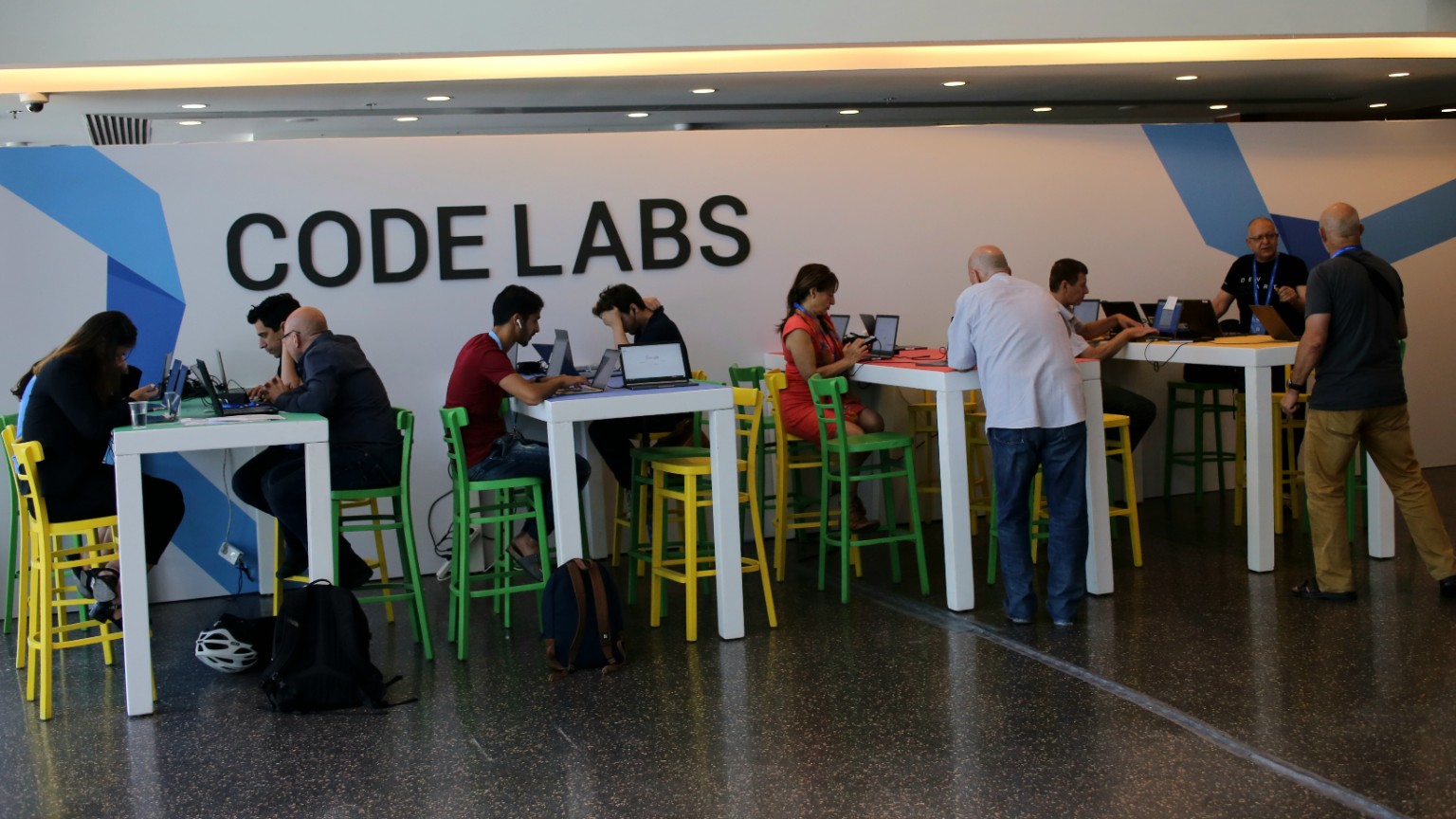
People working on laptops and talking around tables under a large CODE LABS sign, with colorful green and yellow chairs.
A code lab as a shared physical space: laptops, conversations, colorful chairs, and people learning together.

The photograph captures that atmosphere rather beautifully. Beneath the enormous black letters spelling CODE LABS, a collection of programmers and visitors occupies tall white tables surrounded by bright green and yellow chairs. The setting is unmistakably modern, yet the activity belongs to a different chapter of computing history. On the left, several participants lean toward their laptop screens, absorbed in their work. At the central table, a young man in a red shirt concentrates on his computer while another participant sits nearby, apparently wrestling with a problem of his own. A woman in a red dress checks her phone, and farther to the right, a small group gathers around computers, talking and working. Backpacks rest on the floor, cables cross the tables, and a bicycle helmet lies beside someone’s belongings. It is an ordinary scene, almost unremarkable, and that is precisely what makes it interesting today.

These code labs represented a particular culture of technological collaboration. Learning happened through proximity. Someone would notice an error on a neighboring screen and offer a suggestion. A more experienced developer might explain an unfamiliar framework, demonstrate a debugging technique, or recommend a library that could save hours of work. There was no guarantee that the person sitting next to you knew the answer, but asking was part of the experience. Sometimes the conversation was more valuable than the code itself.

Today, much of that interaction has migrated to AI-powered development environments. A programmer can describe a problem in natural language and receive a proposed solution almost immediately. AI assistants can generate functions, explain unfamiliar code, identify bugs, write tests, and even construct entire applications. Tasks that once required searching documentation, consulting colleagues, and experimenting for hours can sometimes be completed in minutes. The productivity gains are real, and it would be foolish to pretend otherwise.

But something has changed beyond the speed of programming. The human exchange that accompanied the development process is becoming less necessary. Instead of turning toward another person and asking why a program refuses to compile, a developer turns toward an AI assistant. Instead of explaining an algorithm to a newcomer, an experienced programmer may simply suggest asking the model. The answer might arrive faster and be technically better. Yet the conversation that would have accompanied it, including the unexpected ideas and personal connections, never happens.

The old code lab was also a social environment. It brought together people of different ages, backgrounds, and levels of experience around a shared interest. The photograph illustrates this diversity without making a spectacle of it. Some participants are deeply immersed in their screens, others are standing, talking, or observing. Nobody appears to be following a rigid classroom structure. The atmosphere is informal, somewhere between a workshop, a temporary office, and a gathering of enthusiasts. Technology provides the reason for being there, but people give the place its character.

There is an irony in the evolution of programming. The tools have become increasingly conversational just as programming itself has become less dependent on conversations between people. We now interact with machines using ordinary language, asking questions and receiving explanations in a style that resembles human dialogue. Meanwhile, the physical spaces where developers once exchanged knowledge are no longer essential to getting the work done.

This does not mean that code labs, hackathons, and developer gatherings have disappeared, or that AI has made human collaboration obsolete. They still exist, and many remain vibrant. But their purpose is changing. The practical necessity of gathering in one room to learn a framework or solve a technical problem is weaker than it used to be. Increasingly, the value of meeting in person lies in exchanging ideas, building relationships, questioning assumptions, and discovering problems worth solving in the first place.

Looking at this photograph now, the colorful chairs and rows of open laptops evoke a modest nostalgia. Not necessarily for slower computers or more difficult programming, but for a period when writing software was so visibly a human activity. People sat together, struggled together, learned from one another, and occasionally celebrated a successful result.

Perhaps the next generation of code labs will be even more interesting, with AI handling much of the mechanical work while people concentrate on creativity, architecture, and experimentation. That would be a welcome development. Still, there is something worth preserving from the scene in this photograph: the simple idea that a room full of curious people can produce something that no individual, however well equipped with software, would have imagined alone.

The machines were always supposed to help us work together, not make working together unnecessary.

Filed Under: Media

Footer

Recent Posts

  • Rebels Without a Cause: How France Keeps Shooting Itself in the Foot
  • Fire at the Marché des Enfants Rouges: Another Piece of Old Paris at Risk
  • Cloudflare Clef-omni and the Future of AI-Powered Media Libraries
  • When Code Labs Used to Be Human
  • Why I Love Visiting Photography Stores
  • The Fascinating World of Photography
  • Almond Blossom Photo: A Selfie in the Yellow Wildflowers Between the Orchard Rows
  • Pride Parade Photos: The Photographer in the Mohawk Wig and the Woman With the White Fan
  • Sunset vs Dusk vs Twilight: Why Photographers Should Stay After the Sun Goes Down
  • VR Training Earns Its Keep Where the Real Thing Can’t Be Rehearsed

Media Partners

  • k4i.com
  • OSINT.org
  • Technologies.org
Venture and M&A Digest: Valon Raises $150M at $2.3B, C.H. Robinson to Acquire RXO
Tech News Digest, October 3, 2026: Supabase Buys Turso, Broadcom's $60B AI Chip Financing, Flock Ruling, Plus Five Infrastructure Projects
Borsa Istanbul Fund Scandal: Turkey's Regulator Is Prosecuting the Collapse Its Own Rule Set Off
Fed Hikes Rates for the First Time Since 2023 and the 10-Year Treasury Yield Falls Back Below 5%
Chip Stocks Sell Off on Amodei's Pacing Call While 2026 Capex Forecasts Keep Rising
Saudi Arabia Loses Both Export Routes as the Houthis Reach Bab el-Mandeb
Micron (MU) Slips as Intel-Backed Kepler Computing Takes Aim at Memory With 2,000 Wafers to Its Name
Palantir (PLTR) Gave Back Half of a 9.1% Rally While Snowflake Kept 21%
DFEN Fell 33% in a Month While Its Index Fell Only 11%
Why Marvell and Memory Stocks Are Down After Nvidia Guided FY28 Growth to 70%
Vexcel Opens Plain-Language Search of 15.1 Million km² of Aerial Imagery to AI Agents
On-Device Models Turn Eyewear Into a HUMINT Collection Platform
Houthis Fire on Riyadh and Yanbu While Iran Says Hormuz Stays Closed: OSINT Screening, September 20, 2026
OSINT Digest: Taiwan Coercion Moves From Air to Water, and NATO Absorbs 144 Incursions Without Article 4
Pixxel Raises $100M Series C as Hyperspectral Imagery Moves Closer to the Collection Stack
Why European Governments Are Dropping Palantir, and Which Companies Want the Contracts
Qatari and Turkish Funding of European Islamist Networks: An Open-Source Assessment of the Protest Link
RT’s Mirror Domains Outlasted the EU Ban: How OSINT Researchers Map the Network
Room 3603: British Intelligence Ran Its Largest Wartime Station Out of Rockefeller Center
Intel’s $20 Billion Upsize and Cloudflare’s Zero-Coupon Converts Say the AI Boom Is Strengthening
Texas Instruments Targets the Tiny Power Faults That Can Disrupt AI Data Centers
d-Matrix Begins Shipping Large AI Inference Clusters as Specialized Compute Gains Ground
Cisco and NVIDIA Target the Optical Bottleneck in Growing AI Networks
AI’s Next Infrastructure Challenge Runs From Power Conversion to Liquid Cooling
Microsoft’s New AI Chip Arrives as Financial Anxiety Clouds the AI Infrastructure Boom
Penguin Solutions (PENG) Posts Record FY26 on Memory, Bets FY27 on AI Infrastructure
Boost Run (BRUN) Signs $525.6M GPU Deal as Liquid Compute Opens $250M Facility to Finance Compute Before Delivery
Vinci Hits $1.5B Valuation Ten Months Out of Stealth With $250M Round for Chip Physics Simulation
Matic Becomes First Home Robot Cleared From the FCC Covered List as Security Rules Reshape Robot Vacuums
Precomputing: Materializes Dashboard Answers With SQLite Triggers as Data Arrives

Media Parners

  • 3V.org
  • Media Presser
  • Market Analysis
CrossGov's Overlooked Federal Numbers: $13.5 Million Saved on $1 Billion, a 14% Sustain Rate and a 60-Year-Old System Still Running
Press Release Digest: Rubrik Puts Claude Mythos 5 on Code Security, Factory Hits $5 Billion, TeRAM Takes On the AI Memory Wall
Wonderful's $5B Series C: 50x Forward ARR on $154,000 of Revenue Per Employee
Nvidia (NVDA) Buys Hugging Face for $12.9B, Under the $13B Floor Hugging Face Floated Three Days Earlier
Apple's Chinese Memory Push Is a Precedent Problem for $MU and $SNDK, Not a Volume Problem
NYC Sidewalk Sheds and Local Law 11: Why the Shed Is Cheaper Than the Repair
Robots.txt vs Noindex: Why Blocking Crawlers Does Not Remove Pages From Search
Meta's Hyperion Data Center in Louisiana Was Negotiated With Tax Breaks and Little Public Input
Kimi K3 Weights Released as Washington Debates Banning Chinese AI Models
Enigma Raises $70M for Human-Robot Interaction as Multiverse Raises $570M to Shrink Models
Character.ai Files for Bankruptcy as Disney Bids for Selected AI Assets
CrossGov.com on America's Security State Under Strain: A Half-Size ODNI, an NSC Under 50 Staff and Allies Rationing Intelligence
HyperCrux Review: A Hybrid SQL, Key-Value, Graph and Vector Database Built on SQLite
Conference Keynotes Are Theatre: The Attendee List Is the Product
Press Release Digest, October 3, 2026: Tesla Q3 Deliveries, Thales on Frontier AI Attacks, Cable One Financing, Plus Five Infrastructure Projects
WhiteFiber Launches Continuum, Linking Two Data Centers 83 km Apart Into One GPU Supercluster
Sivers Semiconductors Reshuffles Leadership With Semtech and Amkor Veterans for Its Photonics and Wireless Push
Qunnect Unveils Quantum Security Uses Beyond Encryption Keys, Backed by DARPA and In-Q-Tel Work
PATEO Signs Physical AI MoU With Arm as Its AI Revenue Jumps 589%
New NECK ETF Bets on AI's Bottlenecks: Memory, Optics, Power and Chips
Why China’s Alleged Memory Chip Breakthrough Should Be Taken With a Grain of Salt
EnergyX’s Trafigura Deal Moves Lithium Extraction From Technology Promise Toward Commercial Scale
Marvell’s New Memory Expanders Target the Economics of AI Inference
AI Financing Fears Are Overrated: Hyperscaler Debt and Nvidia’s Vendor Deals Sit on Real Revenue
HyperCrux Market Analysis: Agent Memory and Local AI Drive Demand for a One-File Multi-Model Database
Small Infrastructure Primitives Run the $700 Billion AI Buildout, and Open Source Is How They Get Adopted
Screening Startup and Product Ideas After a Brainstorm: Four Questions, Money First
An AI Lab Is Paying Up Front for Atlas Energy’s (AESI) Generators as Agentic AI Multiplies Token Demand
Oracle’s Force Majeure Notice on Project Jupiter Shows Where AI Data Center Risk Is Landing
AI Infrastructure Credit Costs Rise as CoreWeave-Tied Bonds Price at 9.25% and China Chipmaker Profits Jump 620%

Copyright © 2022 MediaGallery.org

Media Partners:

Analysis · OPINT · App Coding · Hormuz · Taiwan Strait · Media Forum · S3H