One reason I love vertical photography is that it lets a city reveal itself in layers. A horizontal photograph often describes a place from side to side. A vertical one can move from what is happening at street level to what has survived above it for centuries. This picture, taken in Palermo’s Ballarò market, is exactly the kind of scene that makes me turn the camera upright.
At the bottom of the frame, striped fabric awnings stretch over the market passage, while a deep blue canopy and a dark green, almost black cover overlap at different angles. Metal braces cut diagonally through the scene. Rolled fabric hangs from the edge of one awning; cables run across the buildings. These are not decorative architectural details. They are the practical, improvised structures that make a working outdoor market possible, sheltering stalls and customers from sun and rain.
Ballarò is not simply a picturesque stop on a tourist itinerary. In the Albergheria quarter, it remains a place of shopping, conversation and neighborhood life, with fruit and vegetable sellers, fish and meat counters, spices and street-food vendors. Its characteristic calls, the abbanniate, are part of the market’s identity. The marketplace has roots reaching back to the Arab period of Sicily’s history. In my photograph the produce and people are mostly hidden beneath the awnings, but their presence is suggested by the busy construction of the street itself.
Above the awnings, the scene changes dramatically. A patched cream-colored wall gives way to exposed brick, worn limestone and fragments of older plaster. A large abstract mural spreads across the ruined surface: looping green and yellow lines, pale turquoise patches, reddish strokes and areas of white paint. Small dark holes puncture the masonry. It looks less like a polished gallery mural than an intervention on a building that has already lived several lives. This middle section is essential: it connects the temporary market structures with the historic architecture above.
Then, unexpectedly, the great dome of the Chiesa del Carmine Maggiore rises beyond the rough rooftops. This is not just any Palermo church dome. It belongs to the Carmelite church on Piazza del Carmine, at the heart of Ballarò. The present church was rebuilt in the seventeenth century, between 1627 and 1667, and the magnificent Baroque dome was completed in 1681. The Carmelite presence in the area goes back much further.
The dome is covered with glazed majolica tiles arranged in elaborate geometric and ornamental patterns. From this angle, the blue, turquoise and green surfaces catch the light unevenly, with warmer yellow and earthy tones between them. The tiled shell rises above a terracotta-colored band and an extraordinarily elaborate drum. Cream-colored stucco scrollwork curls around the windows and columns, while monumental sculpted male figures, known as telamons or Atlases, appear to support the structure. At the top, a small lantern and metal cross complete the silhouette against the nearly white sky.
What I especially like is the contrast in textures. The market’s fabric awnings are soft, sagging and replaceable. The wall in the middle is rough, chipped and visibly altered. The church above is ceremonial, intricately ornamented and conceived to impress. The tiled dome is not merely an architectural cap; it is a declaration of color and craftsmanship high above the commercial streets. Three very different attitudes toward building and maintaining a city are visible in one photograph.
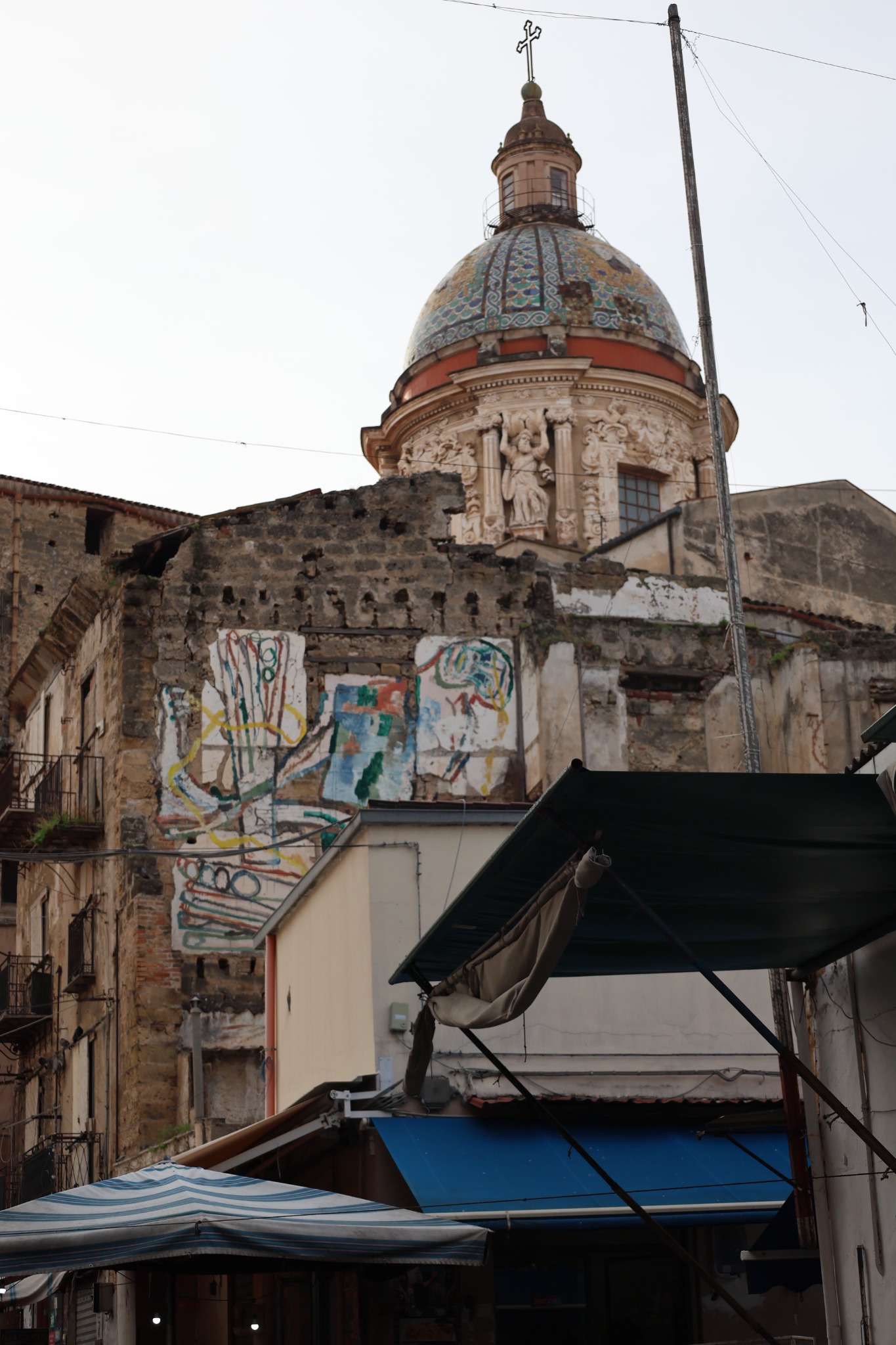
Even the apparent distractions tell us something. A tall utility pole stands uncomfortably close to the dome, wires stretch across the sky, and the roofs and canopies do not line up neatly. I could have tried to isolate the church and exclude all of this. But the result would have been a picture of a monument, not a picture of Palermo. The wires and awnings are part of the contemporary city that surrounds the seventeenth-century masterpiece.
The composition works because it asks the eye to climb. First there is the shadow beneath the awnings. Then the blue shopfront, pale wall and mural. Above that, the broken roofline and the sculptural detail of the church. Finally, the patterned dome, lantern and cross. It is almost a vertical walk through the neighborhood without moving one’s feet. The upper portion is much brighter than the lower one, reinforcing the sensation of emerging from the enclosed market into open sky.
This is also a reminder that Ballarò is not just about food. It is an extraordinary urban environment in which trade, street art, religion and centuries of architectural change coexist within a few steps. The church is not separated from the market by some grand landscaped approach. It rises directly out of the dense fabric of the neighborhood. That proximity is precisely what makes the view memorable.
A horizontal photograph would have given me more of the street to the left and right. It might have shown more stalls or more façades, but the dome would have become smaller, or the lower part of the market would have disappeared. The vertical frame keeps the relationship between foreground and background intact. It makes the everyday market and the grand church equally necessary to the story, even though they occupy very different amounts of space.
I do not think every vertical photograph needs to be perfectly tidy. This one certainly isn’t. It has an almost excessive number of competing lines, textures and colors. Yet those imperfections feel appropriate to Palermo, a city where historical beauty and practical improvisation are constantly rubbing shoulders. What looks messy at first becomes meaningful when you spend a little time following the layers.
That is why I love vertical shots. They can show not just a building or a street, but how a city is assembled: the living marketplace below, the worn and painted walls in the middle, and the spectacular Baroque dome above. In Ballarò, the story of Palermo is not spread neatly across the horizon. It is stacked, one layer on top of another.