A week in Palermo means cathedrals and mosaic ceilings in the morning, street markets at noon, the harbour in the evening, and the odd detail high up on a Baroque facade that you only notice once you look. That’s a lot of focal lengths for one city. The kit laid out here covers all of it with two small Canon mirrorless bodies and four RF lenses, and the whole lot weighs a little over two kilograms.
On the left is the full-frame side: a Canon EOS R8 with the RF 24-105mm F4-7.1 IS STM, the light non-L version of the standard zoom. Above it sits an EOS R100, Canon’s entry APS-C body, fitted with the RF-S 10-18mm ultra-wide and a third-party JJC hood. Next to them are the RF 16mm F2.8 prime, hood attached, and the RF 100-400mm F5.6-8 IS STM telephoto.
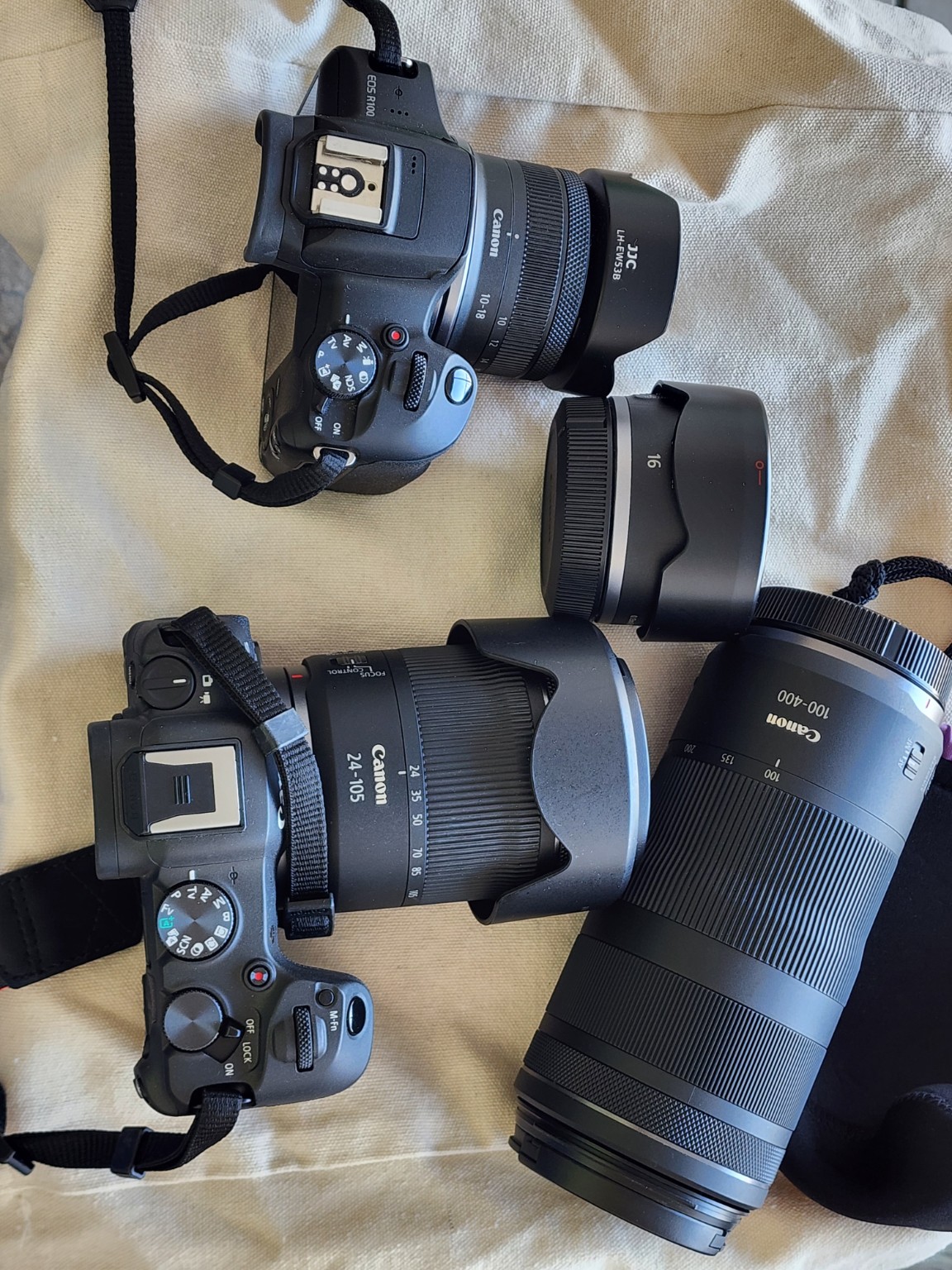
Why two bodies make sense
Changing lenses in a crowded church or at a market stall is how you miss the shot, and how dust gets on the sensor. Two bodies solve that. One stays wide, one stays general, and the telephoto goes on whichever body suits the subject.
The mix of sensor sizes is the clever part. The R100’s APS-C sensor has a 1.6x crop, so the 100-400mm on it frames like a 160-640mm lens on full frame. That’s real reach for rooftop statues, birds over the port or a face in a balcony window, from a lens that weighs 635 grams. Put the same zoom on the R8 and you get a normal 100-400mm with a bit more room to crop in low light. The RF-S 10-18mm only makes sense on the R100, where it works out to roughly 16-29mm equivalent. The RF 16mm on the R8 gives you a true 16mm for interiors, small and fast at F2.8.
There’s a practical bonus too. Both bodies take the same LP-E17 battery, so spares and chargers are shared.
What it weighs
Using Canon’s own figures, the R8 is about 461 g with battery and card and the R100 about 356 g. The 24-105mm is 395 g, the 100-400mm 635 g, the 16mm 165 g and the 10-18mm 150 g. Add it up and you’re at roughly 2.16 kg for two bodies and a 16-640mm equivalent range. A single full-frame body with an L-series 24-105mm F4 on its own would eat a big share of that weight.
The trade-offs
None of this is free. Neither body has in-body stabilisation, so you rely on the optical IS in the zooms. The 16mm prime has no IS at all, which matters in dark interiors where you’ll want a steady hand or a higher ISO. The variable apertures, F7.1 at 105mm and F8 at 400mm, push the ISO up quickly indoors or after sunset. Neither camera is weather-sealed, and battery life is modest on both, so carry spares. And the R100 is a basic camera, with a fixed screen and fewer controls than the R8.
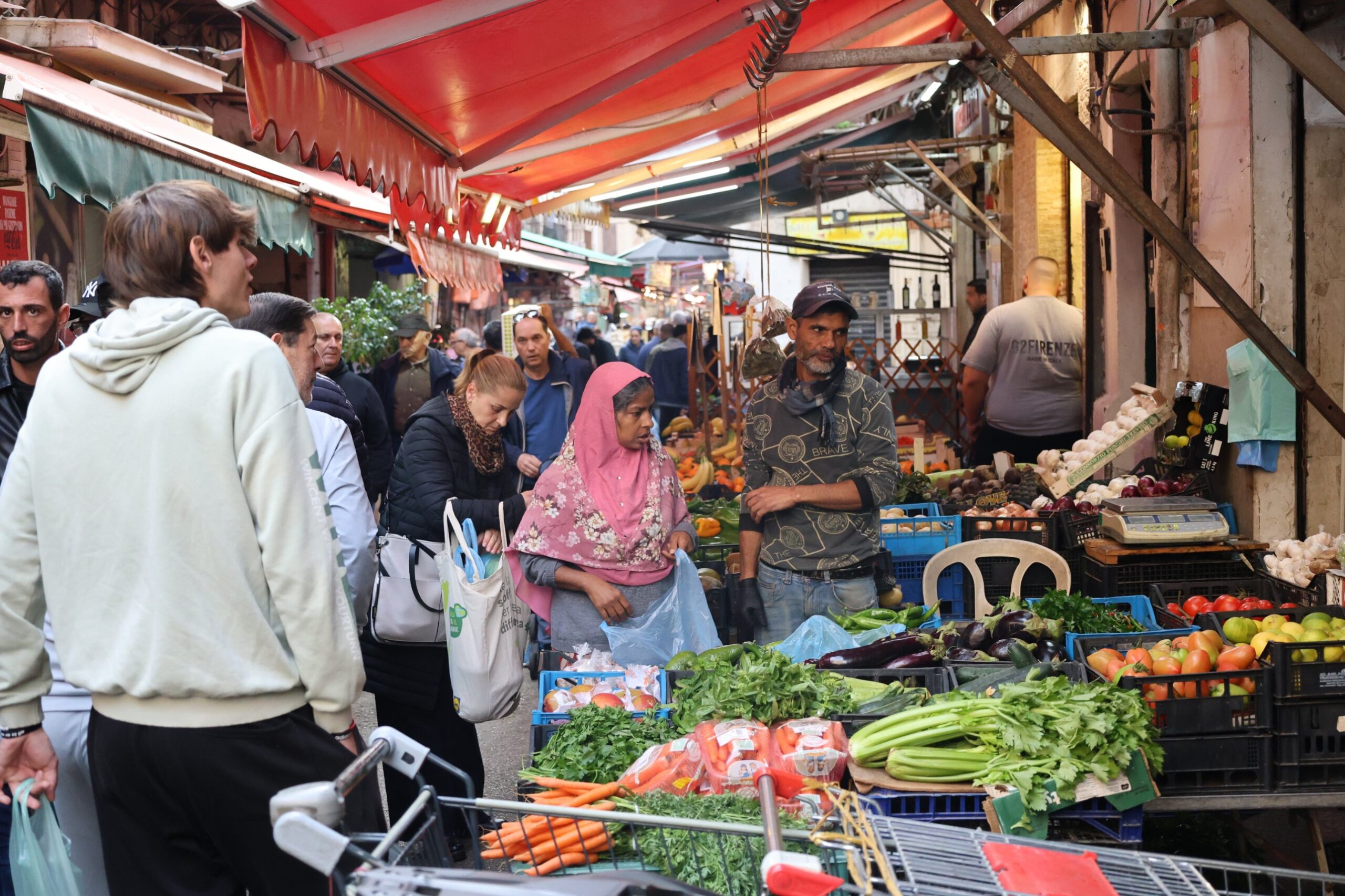
This is the kind of scene the kit is for. A Palermo market lane under red awnings, a vendor and a shopper at a stall of celery, aubergines and lemons, shoppers pushing past behind them. The framing compresses the lane and stacks the crowd into layers, and the red canopy throws a warm cast over everything. It looks like a film still because the street already plays like one.
For a city like Palermo those are fair trades. The light is strong most of the year, the best subjects are outdoors or in big, bright churches, and the weight you don’t carry is energy you spend walking another street. A light kit you carry all day beats a heavy one left at the hotel.