There is something about photography stores that makes me want to walk in even when I have absolutely no intention of buying anything. I can pass dozens of shops without a second glance, but a camera store is different. The sight of cameras arranged behind glass, shelves filled with lenses, tripods, filters, and unfamiliar accessories is enough to interrupt whatever I was doing. Sometimes I have a particular piece of equipment in mind, something I have been researching online. More often, I simply want to look around. I know perfectly well that I don’t need another camera or lens, but that has never been a particularly convincing reason to stay outside.
Photography stores occupy an interesting place between technology shops, specialty workshops, and small museums. They display some of the most sophisticated consumer electronics available, yet much of what they sell is rooted in optical principles that have remained essentially unchanged for generations. A modern mirrorless camera might contain an advanced image processor, sophisticated autofocus algorithms, and an electronic viewfinder capable of displaying millions of pixels. The lens attached to it, however, still relies on carefully shaped pieces of glass to bend light toward a sensor. That combination of old physics and modern engineering fascinates me. I can spend a surprisingly long time examining a lens, looking at its construction, turning its focusing ring, or comparing its dimensions with another model.

One of the pleasures of visiting a camera store is being able to handle equipment that I have previously encountered only through photographs, specifications, and reviews. Online research is useful, and I do plenty of it, but it has obvious limitations. A photograph of a camera does not communicate how comfortably it fits in the hand. Specifications cannot fully describe the resistance of a zoom ring, the balance of a long lens, or the difference between a camera that feels compact and one that feels awkwardly small. Two lenses with similar optical specifications can be remarkably different when mounted on the same body. A few minutes of handling them often reveal things that an hour of reading cannot.
I am particularly drawn to lenses. Camera bodies are interesting, of course, but lenses have a different kind of appeal. A camera is a platform that records an image; a lens determines much of how the world will appear in that image. A wide-angle lens exaggerates spatial relationships and invites the photographer to move closer. A telephoto lens isolates distant subjects and compresses perspective. A fast prime lens offers possibilities for shallow depth of field and low-light photography. Even when I have no practical use for a particular focal length, I enjoy examining the equipment and imagining the pictures it could produce. A large white Canon telephoto lens, for example, immediately brings to mind wildlife, sports, and distant architectural details. A tiny pancake lens suggests something completely different: an afternoon of walking through unfamiliar streets with a camera that attracts almost no attention.
There is also the appeal of comparison. Camera stores allow me to see equipment from Canon, Nikon, Sony, Fujifilm, and other manufacturers side by side, sometimes discovering differences that are less obvious online. Each manufacturer has developed its own approach to ergonomics, menus, controls, and lens design. I find it interesting to observe how different engineering teams solve essentially the same problem. Some cameras emphasize traditional dials and tactile controls, while others favor programmable buttons, touchscreens, and highly configurable electronic interfaces. There is no universal answer to which approach is best. Much depends on the photographer’s habits, experience, and preferences. But comparing these designs is enjoyable in itself, rather like examining different interpretations of the same mechanical idea.
My interest in photography equipment is not entirely rational, and I don’t think it needs to be. I have owned enough cameras and lenses to know that buying another one will not automatically make me a better photographer. I also know that the excitement surrounding a new piece of equipment eventually fades. Nevertheless, there is a genuine pleasure in exploring what is available, particularly when manufacturers introduce something technically unusual. An exceptionally compact wide-angle lens, an affordable super-telephoto zoom, or a new autofocus system can capture my attention even when I have no plans to purchase it. Part of the attraction is simply keeping up with technological progress. Another part is the possibility that an unfamiliar tool might suggest a photographic opportunity I had not previously considered.
I especially enjoy visiting photography stores when traveling. A camera shop in an unfamiliar city offers a small glimpse into the local photographic culture. The brands may be familiar, but the selection, prices, customers, and atmosphere can be quite different. Some stores cater primarily to professional photographers, with expensive lenses and studio lighting equipment dominating the displays. Others concentrate on compact cameras, travel accessories, or secondhand equipment. Occasionally, I find a shop that seems to have changed very little over several decades, with older cameras, obscure adapters, and boxes of accessories occupying every available shelf. These places can be more interesting than the immaculate showrooms of major retailers. They have character, and sometimes a little chaos, which I rather like.
Secondhand camera departments are especially appealing. Unlike many categories of consumer electronics, photographic equipment can remain useful for a very long time. A well-made lens from twenty or thirty years ago may still produce excellent images, and some older cameras retain qualities that newer models have abandoned. Looking through used equipment is therefore a form of technological archaeology. A Canon EF lens recalls the long history of the EOS system, while an older Nikon or Pentax camera represents another stage in the development of photographic technology. Occasionally, an unfamiliar lens catches my attention and sends me into an entirely new line of research. I may not buy it, but I leave knowing something I did not know when I entered.
The accessories are another source of endless curiosity. Camera stores are filled with small inventions designed to solve highly specific problems. Lens adapters, extension tubes, remote shutter releases, quick-release plates, miniature tripods, flash diffusers, cleaning tools, and dozens of other devices occupy shelves that many casual visitors probably overlook. Some are ingenious, others are unnecessary, and a few seem to exist mainly because someone thought photographers might buy them. Yet even the obscure accessories reveal something about the practical challenges of photography. They remind me that making photographs is not always a matter of pointing a camera and pressing a button. Sometimes a small, inexpensive accessory can solve a problem more effectively than a major equipment upgrade.
Conversations with store employees and other customers can be equally rewarding. Photography attracts people with widely different interests, from birdwatchers and sports photographers to portrait specialists, travelers, and collectors of vintage cameras. A discussion that begins with a question about lens compatibility can easily turn into an exchange of experiences about photographing wildlife, working in difficult light, or traveling with limited equipment. Experienced photographers often have strong opinions, sometimes contradictory ones, about what works and what doesn’t. I don’t always agree with them, but that is part of the enjoyment. There is something refreshing about discussing equipment with people who have actually used it in the field rather than relying entirely on online reviews.
Of course, photography stores also encourage a familiar temptation: the belief that the next camera or lens might finally be the missing piece. I have learned to be skeptical of that feeling. A new lens may offer a useful focal length, better autofocus, or improved optical performance, but it cannot supply interesting subjects, good light, or the patience required to recognize a worthwhile composition. There is always something newer, faster, sharper, or more expensive. The trick is to enjoy the technology without becoming convinced that every improvement is essential. I can admire an expensive professional lens while being perfectly satisfied with a smaller, lighter alternative that I am more likely to carry.
In fact, the more experience I gain, the more I appreciate compact equipment. A camera that stays at home because it is too heavy is not particularly useful, regardless of its technical superiority. This is one reason I find smaller mirrorless cameras and lightweight lenses so interesting. They represent a practical compromise between image quality, portability, and convenience. When examining equipment in a store, I increasingly find myself asking not simply how good it is, but whether I would enjoy carrying it for several hours. That question can eliminate some otherwise very attractive purchases. It is a lesson learned through experience rather than specifications.
Photography stores also stimulate the imagination in a way that ordinary electronics retailers rarely do. Looking at a telephoto lens makes me think about distant subjects I might photograph. A wide-angle lens suggests architecture, interiors, and dramatic perspectives. A fast portrait lens brings to mind faces illuminated by window light, while a small travel camera suggests unfamiliar streets and spontaneous encounters. The equipment is interesting not merely because of what it is, but because of what it might allow me to see. Every camera and lens seems to contain a collection of photographs that have not yet been taken.
There is a nostalgic dimension as well. Photography has undergone enormous changes during my lifetime. Film cameras gave way to digital SLRs, which are increasingly being replaced by mirrorless systems. Darkrooms became software applications, and photographs that once required specialized equipment can now be produced with smartphones. Camera stores provide a physical connection between these generations of technology. Older equipment reminds me of how photography used to work, while the latest cameras demonstrate how far it has progressed. The underlying fascination remains the same, even as the tools become almost unrecognizable.
Perhaps what I enjoy most is that a visit to a photography store has no obligation attached to it. I can examine a camera, compare a few lenses, ask a question, and leave without buying anything. Sometimes I discover that a product I had been considering is not particularly appealing in person. Sometimes I encounter something unexpected that changes my thinking. And occasionally, yes, I leave with a new piece of equipment. But the purchase is not the essential part of the experience. The real pleasure lies in exploring a world of optical and mechanical possibilities, surrounded by objects designed to help people observe the world more closely.
I suspect that my attraction to photography stores is ultimately connected to the reason I enjoy photography itself. Both involve curiosity. Photography encourages me to look at familiar surroundings differently, to notice details, patterns, expressions, and relationships that might otherwise escape my attention. A camera store encourages the same curiosity, but directs it toward the instruments of observation. I enjoy understanding how they work, how they differ, and what they might make possible. That is why I keep walking into photography stores even when I need absolutely nothing. I rarely leave with a purchase, but I almost always leave with an idea. And sometimes an idea is worth more than another lens.
Why I Love Visiting Photography Stores — Image Descriptions
Detailed descriptions of 23 photographs featuring camera stores, photographic equipment, professional lenses, and camera brands including Canon, Nikon, Sony, Fujifilm, Panasonic Lumix, OM System, and others.
| Image Filename | Detailed Photograph Description and Visible Camera Brands |
|---|---|
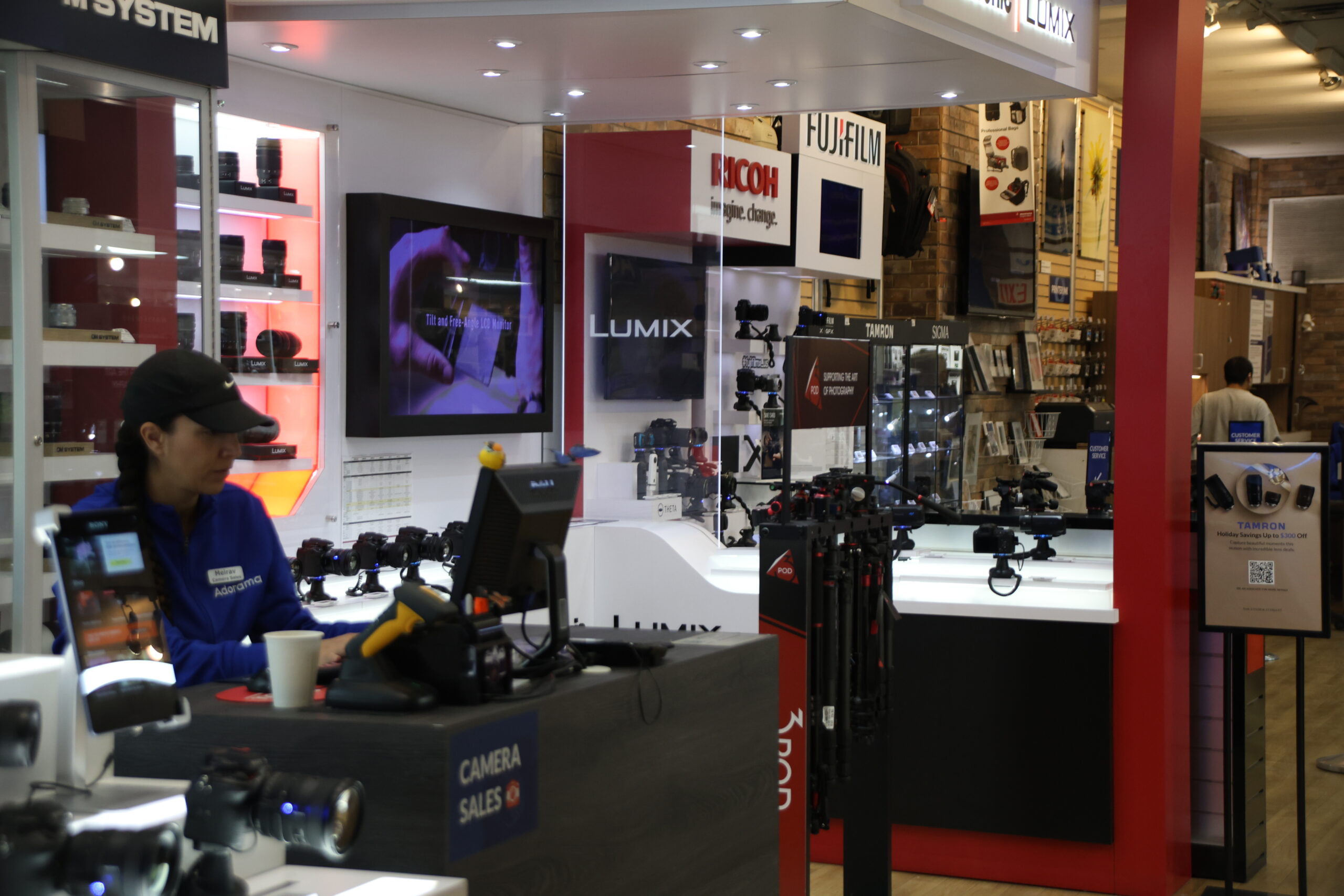
| IMG_1448-scaled.jpg | Interior of an Adorama photography store, featuring a Panasonic Lumix camera display with illuminated white counters, camera bodies, and lenses. Prominent signs identify Panasonic Lumix, Fujifilm, Ricoh, Tamron, Sigma, and OM System. A female employee in a blue Adorama uniform sits behind the camera sales counter. Red architectural pillars, illuminated glass cabinets, and digital advertising screens give the store a professional showroom atmosphere. |
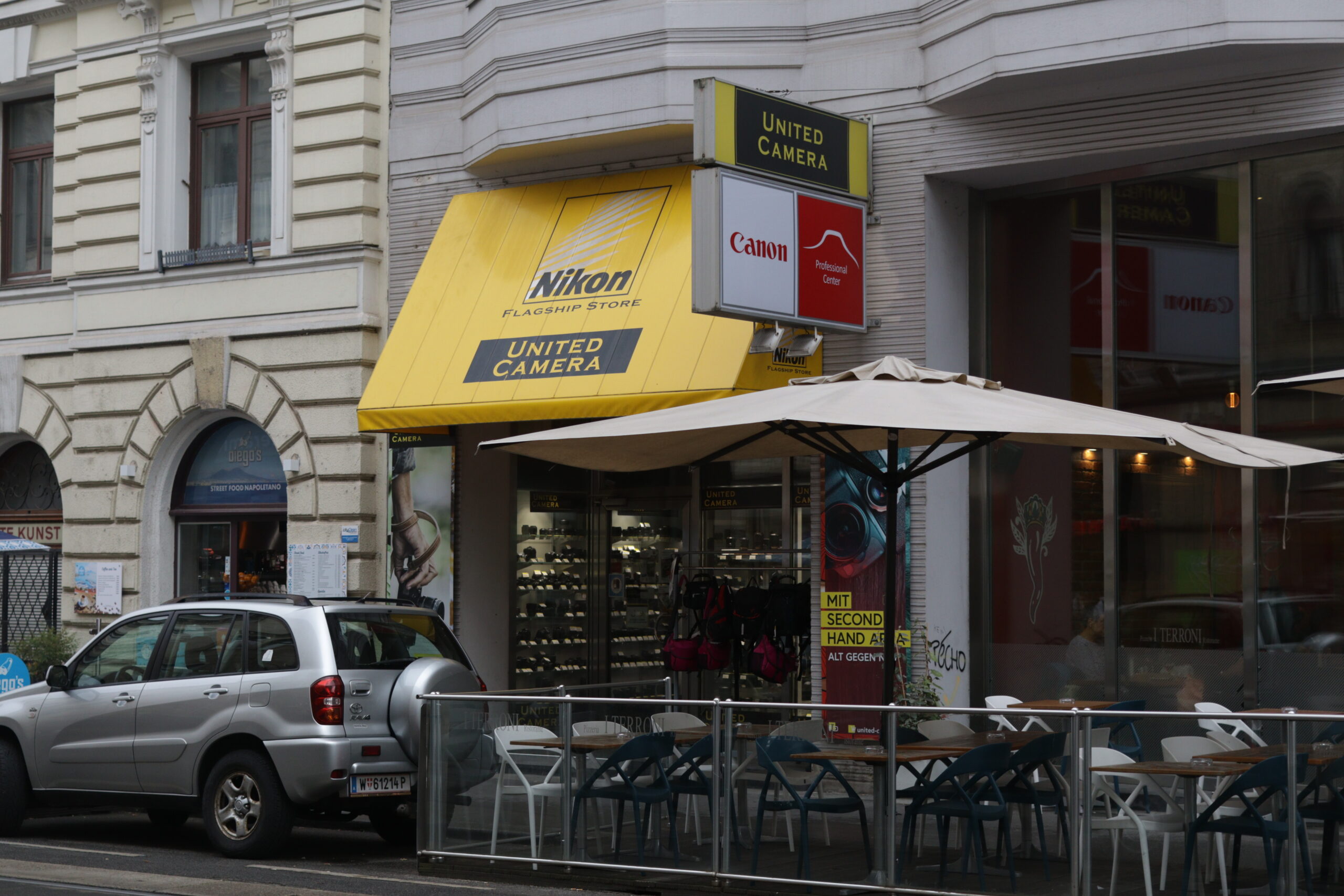
| IMG_4120-scaled.jpg | Exterior street view of United Camera, a photography retailer in a European-style historic building. A bright yellow Nikon Flagship Store awning dominates the storefront, while a separate illuminated sign advertises Canon Professional Center. Camera equipment and bags are visible through the windows, with a secondhand equipment sign near the entrance. A silver SUV and an outdoor café occupy the foreground. Nikon and Canon are the principal identifiable camera brands. |
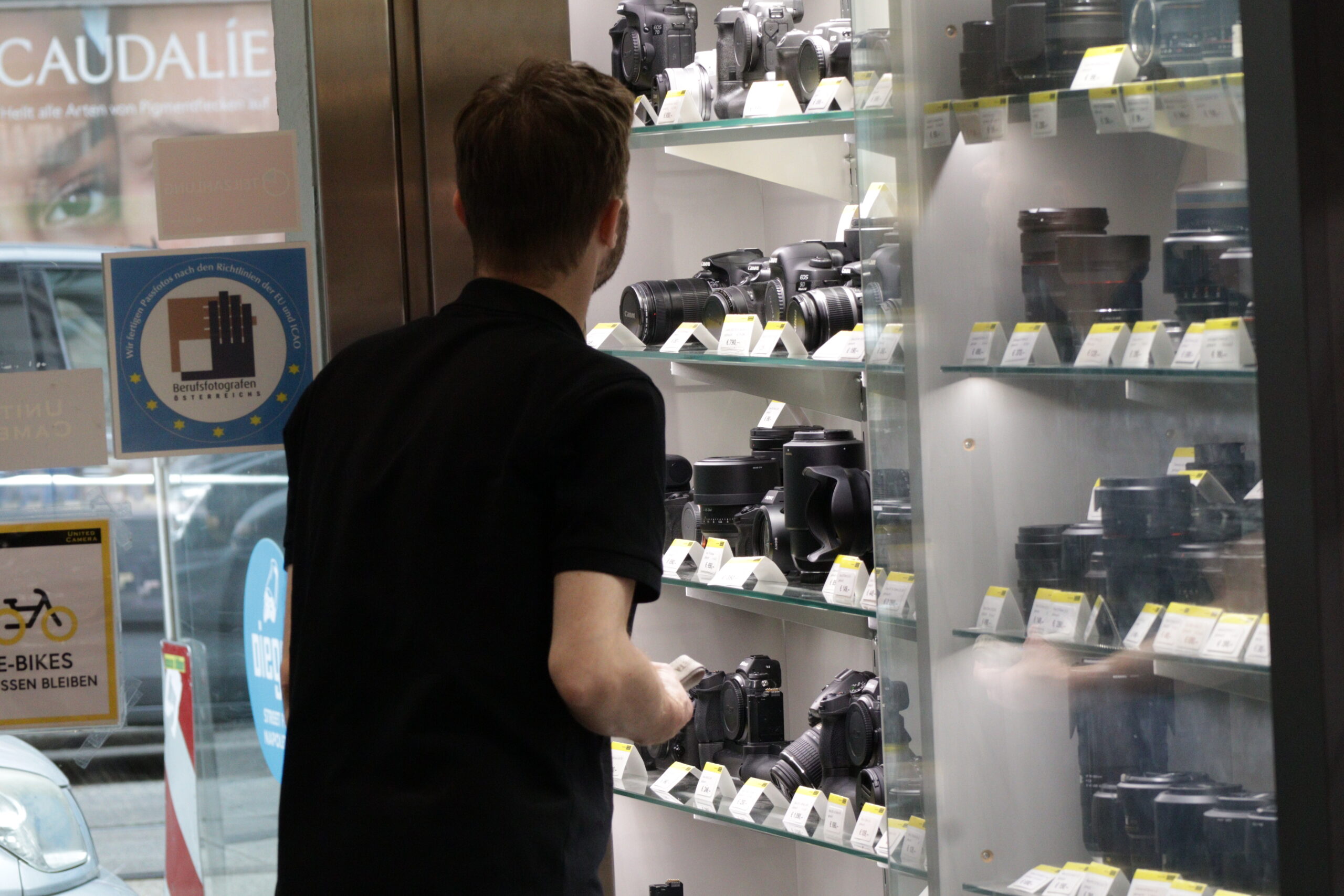
| IMG_5731-scaled.jpg | A young man wearing a black shirt examines photographic equipment behind a large glass display cabinet at United Camera. Several shelves contain DSLR and mirrorless camera bodies, attached zoom lenses, standalone telephoto lenses, and price labels. Some camera bodies have the familiar shape of Canon EOS equipment, although individual brand markings are too small to confirm reliably. Reflections of the street and the photographer add depth to the image. |
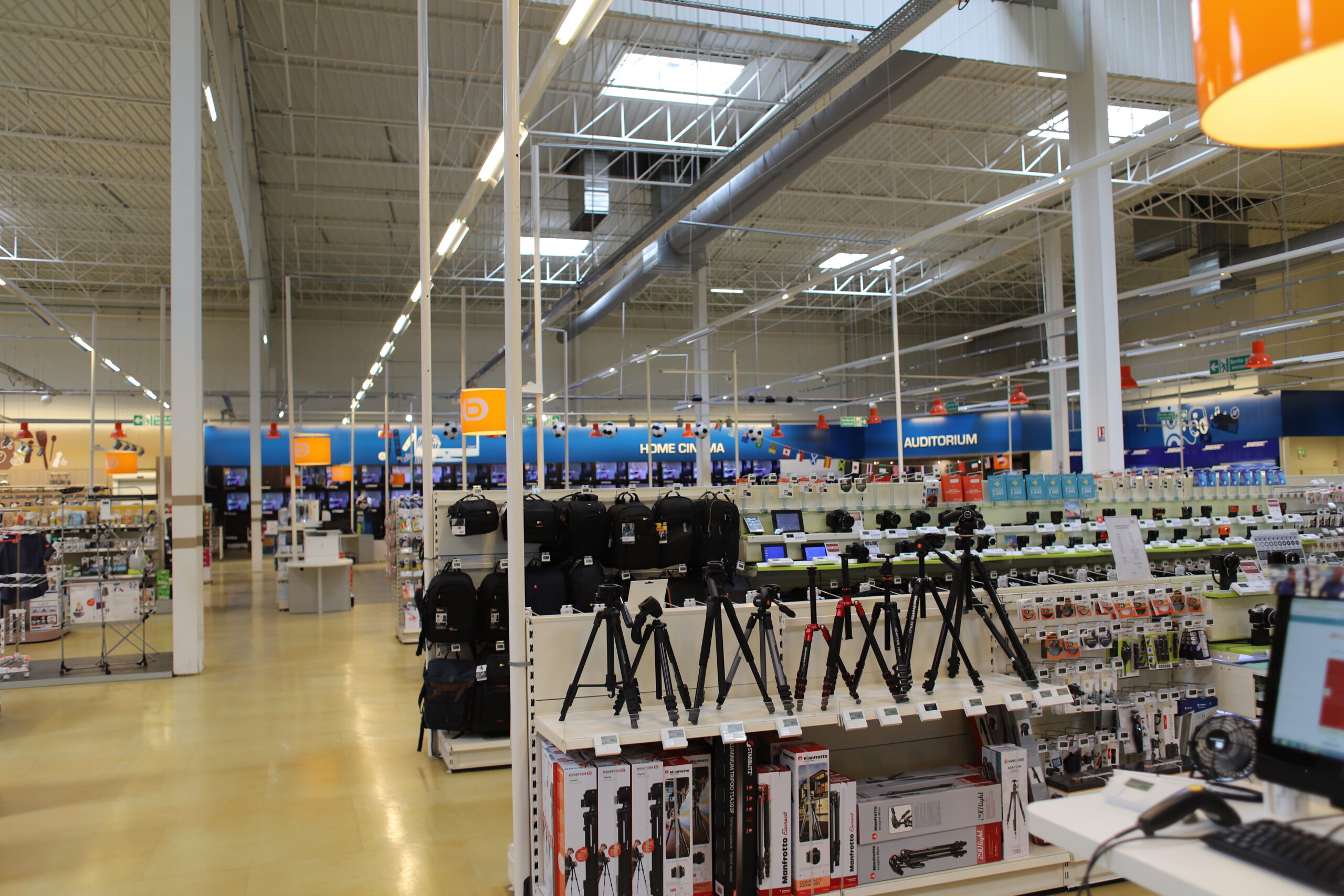
| IMG_9964-scaled.jpg | Wide interior photograph of a large electronics and photography retailer with high industrial ceilings, skylights, and extensive fluorescent lighting. A central display features numerous camera tripods, monopods, and black camera bags. Manfrotto branding appears on tripod packaging near the bottom of the frame. The background includes computer equipment, photographic accessories, and an auditorium section. Individual camera brands are not clearly identifiable. |
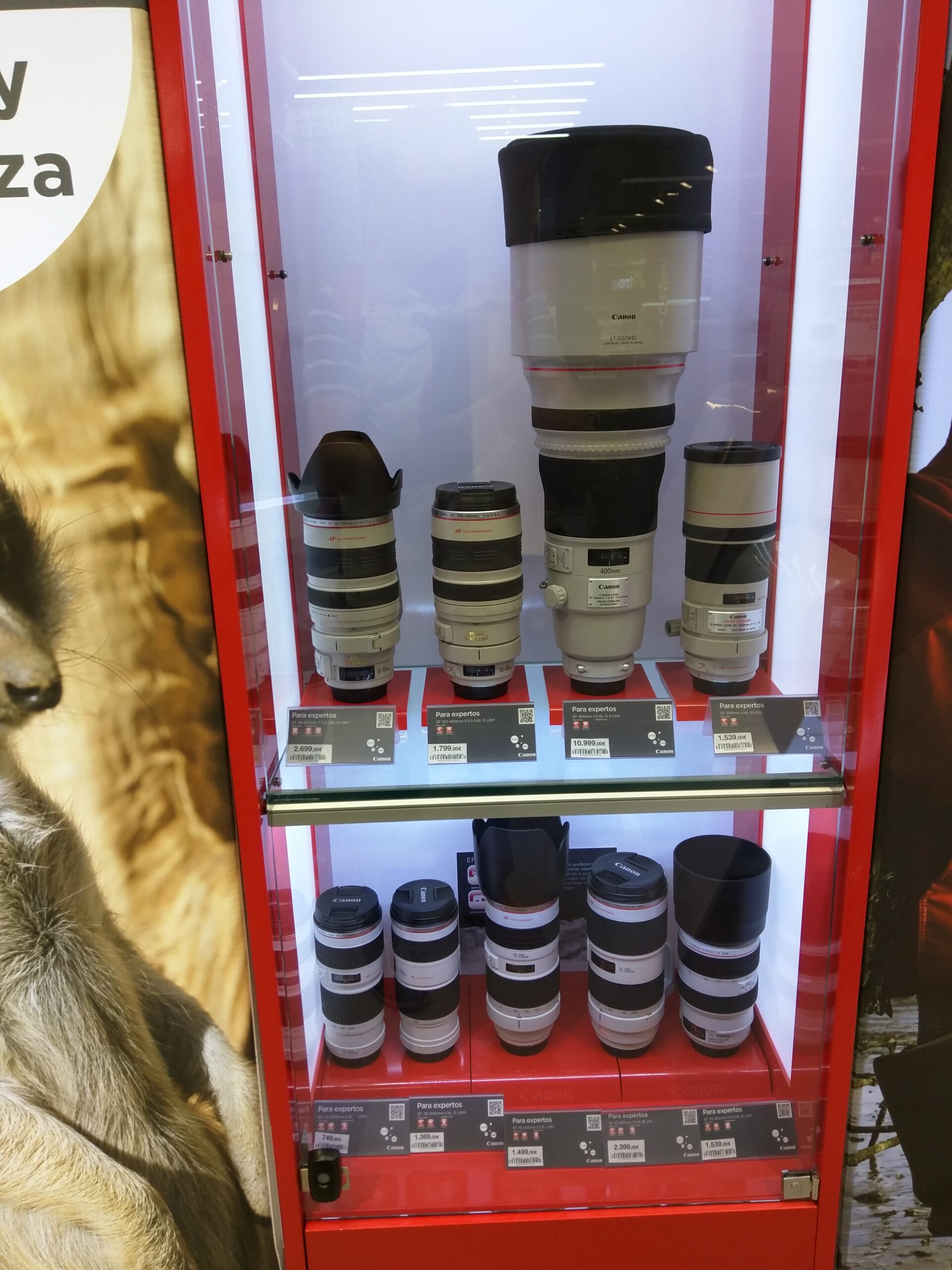
| IMG_20151013_161713-scaled.jpg | Tall red-and-white Canon display cabinet containing professional Canon EF L-series telephoto lenses, distinguished by white barrels and red identification rings. The upper shelf includes an exceptionally large Canon 400mm f/2.8 L-series super-telephoto lens with a black hood, accompanied by smaller white telephoto zooms. Additional Canon lenses are arranged on the lower shelf. Price labels in euros are visible beneath the equipment, with a wildlife photograph partially visible beside the cabinet. |
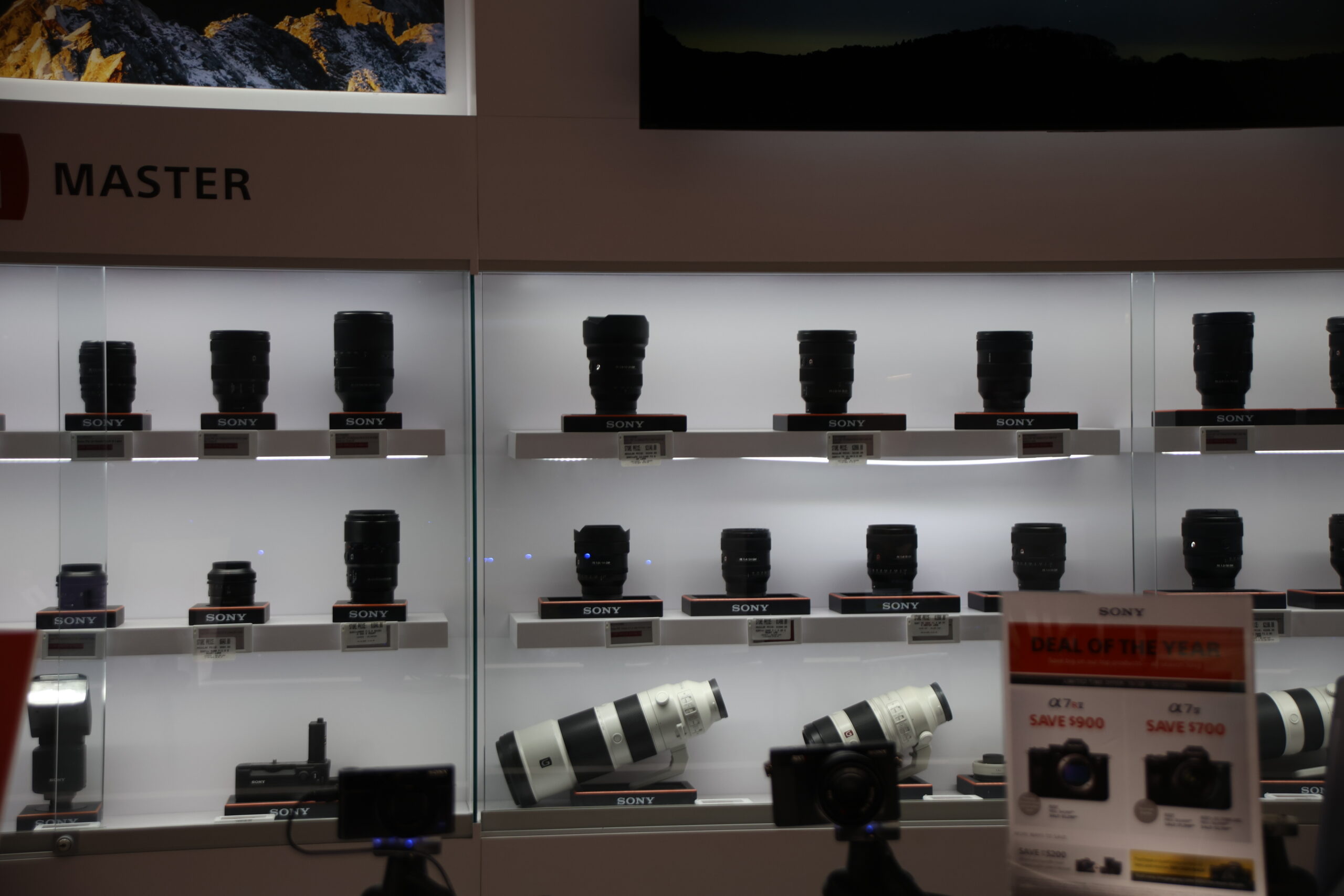
| IMG_1447-scaled.jpg | Illuminated Sony lens display inside a photography store, featuring rows of black Sony E-mount lenses and several distinctive white Sony G Master telephoto zooms on the bottom shelf. The lenses stand on individual black-and-orange Sony display platforms with electronic price labels. A promotional sign in the foreground advertises Sony Alpha cameras. The composition emphasizes the extensive Sony lens ecosystem, ranging from compact primes to large professional telephoto lenses. |
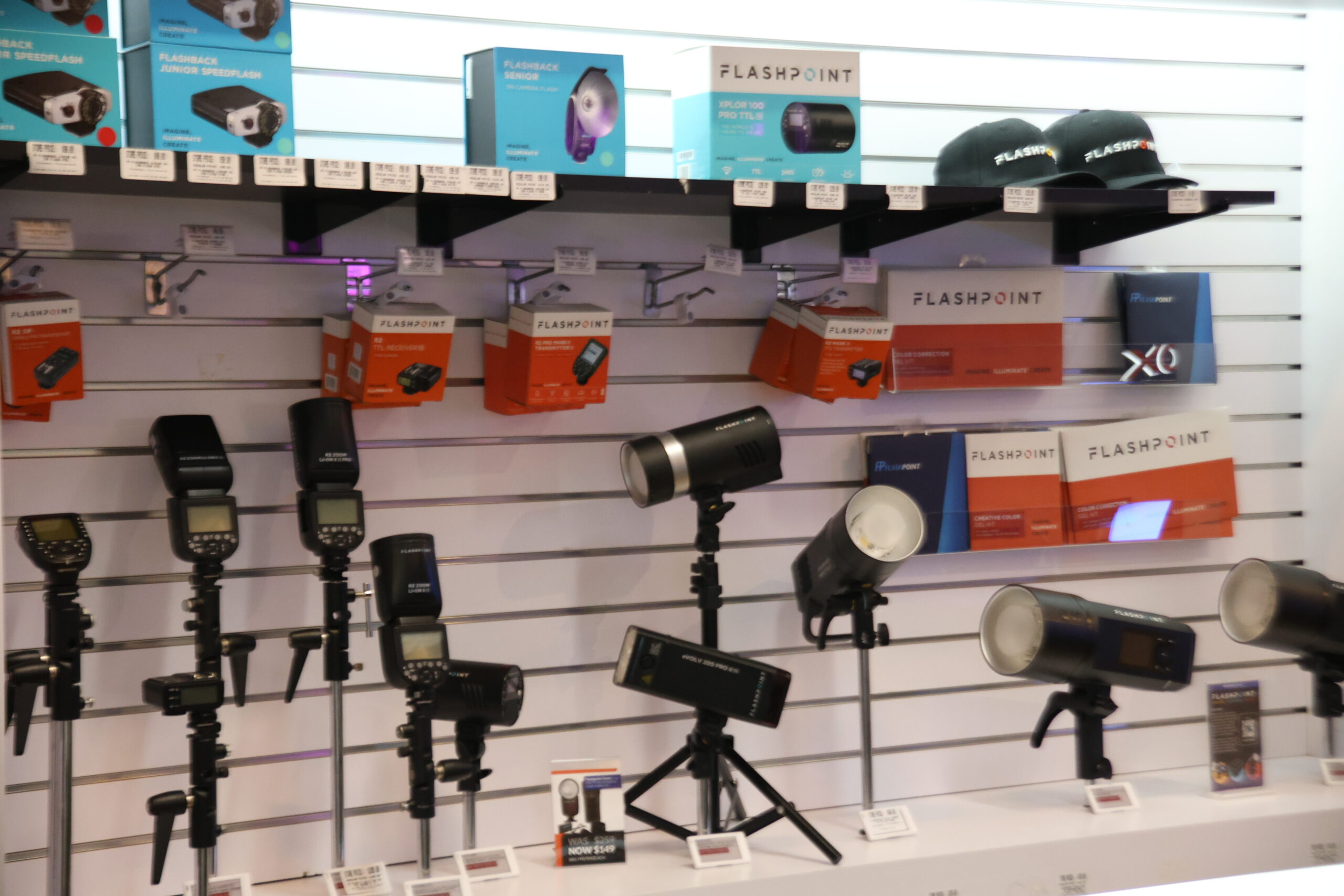
| IMG_1441-scaled.jpg | Photography lighting equipment display featuring Flashpoint-branded electronic flashes, portable studio strobes, wireless triggers, and lighting accessories. Several upright speedlights stand on metal supports, while larger cylindrical strobes are mounted on miniature stands. Flashpoint XPLOR and other lighting products appear in branded orange, white, and turquoise packaging. Two black Flashpoint baseball caps occupy the upper shelf. The display focuses on lighting rather than camera bodies. |
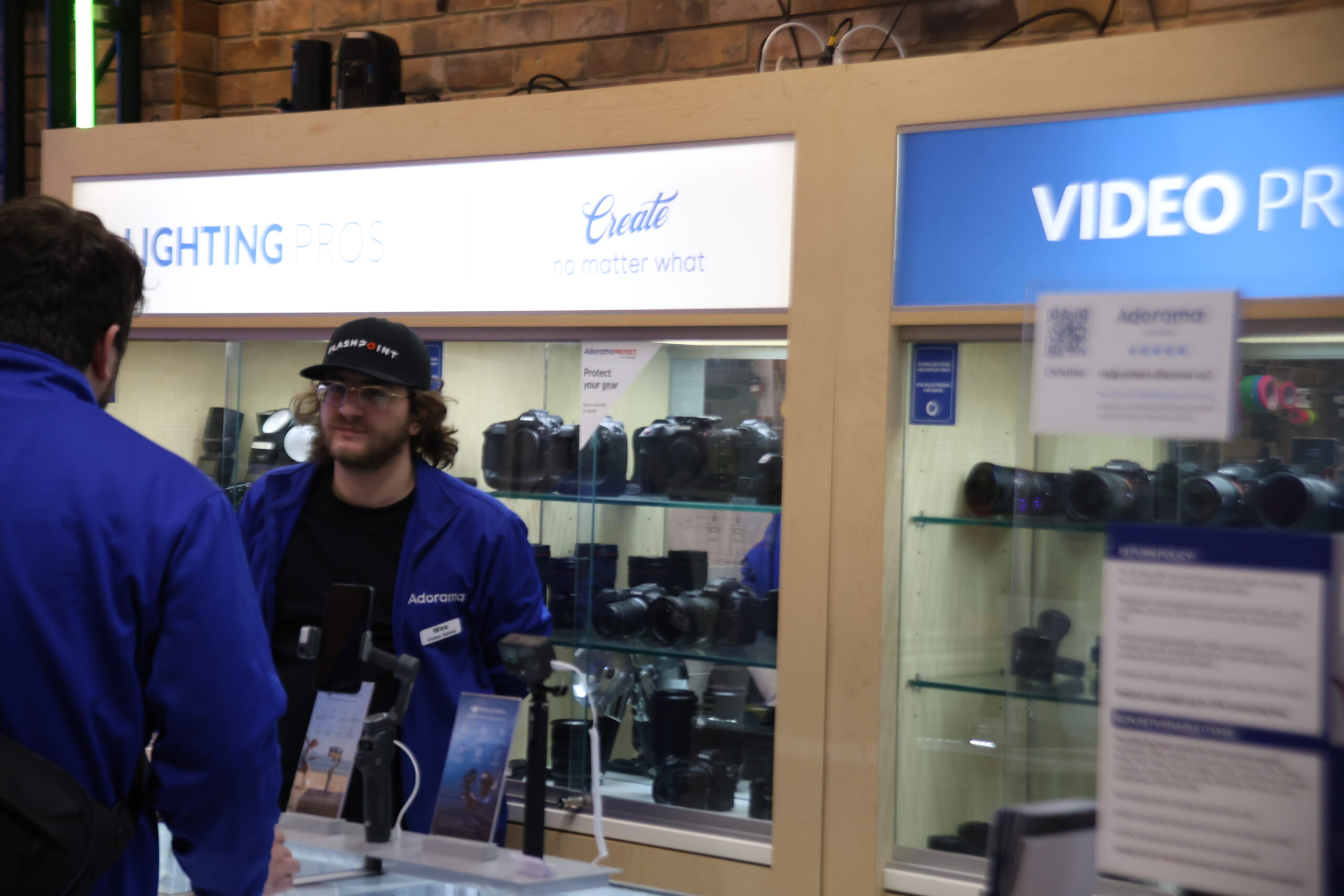
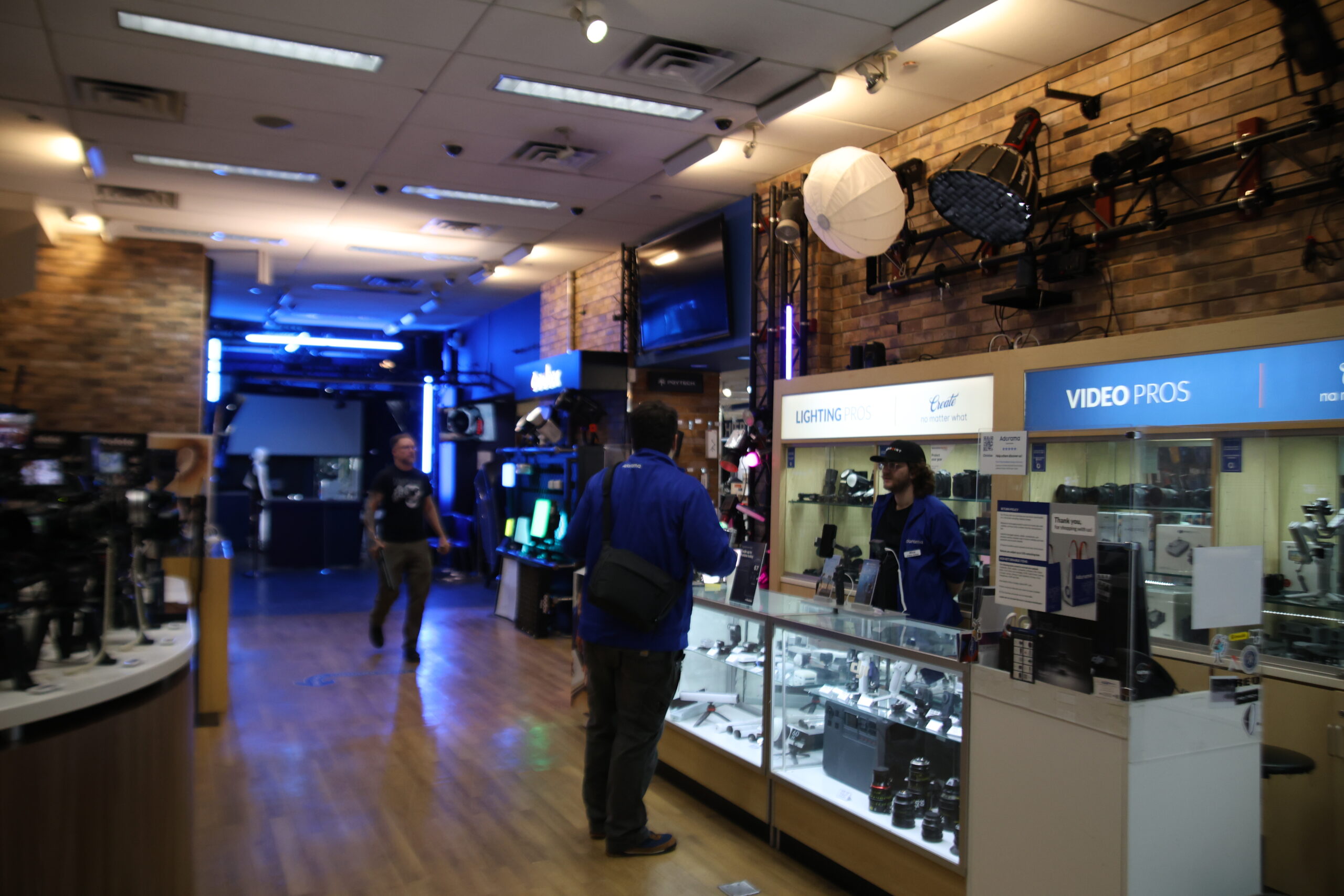
| IMG_1440-scaled.jpg | Customer service counter at Adorama’s professional video and lighting department. A male employee with glasses, shoulder-length hair, a blue Adorama jacket, and a black Flashpoint cap speaks with a customer. Behind them are glass cabinets containing professional cameras, lenses, and video accessories. Illuminated signs read Lighting Pros and Video Pros. Flashpoint and Adorama are clearly identifiable; individual camera brands in the cabinets are not sufficiently legible. |
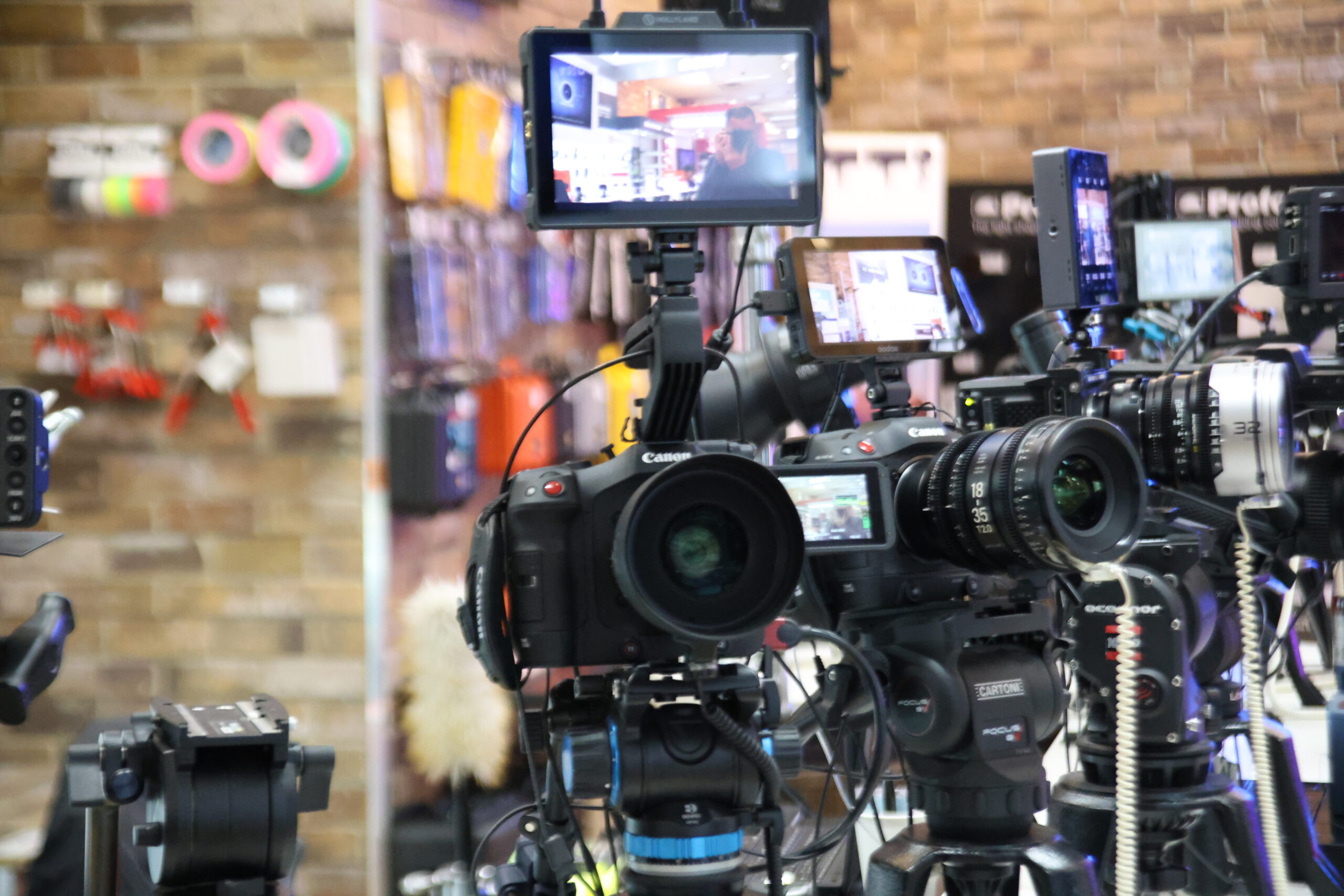
| IMG_1439-scaled.jpg | Close-up of professional cinema and video cameras mounted on heavy-duty tripods inside a photography retailer. A Canon cinema camera dominates the foreground, with the Canon logo clearly visible above its lens. Several cameras feature large cinema lenses, external monitoring screens, cables, and professional tripod heads. One lens displays focal-length markings including 18 and 35. The screens show live views of the store interior. Canon is identifiable, while other camera brands cannot be established confidently. |
| IMG_1438-scaled.jpg | Wide interior view of Adorama’s professional lighting and video department, with polished wooden flooring, exposed brick walls, and illuminated display cabinets. Large softboxes, circular light modifiers, and other studio lighting accessories hang above the counters. Several customers and employees occupy the scene, while video cameras and lenses are displayed behind glass. The Lighting Pros and Video Pros signs identify the departments, but individual camera brands are not clearly readable. |
| IMG_1437-scaled.jpg | Wide view down the main aisle of Adorama, showing dedicated photographic equipment sections for OM System, Panasonic Lumix, Fujifilm, and Nikon. Large illuminated Nikon signage hangs on the right, while a central Panasonic Lumix pavilion displays camera bodies and lenses. An OM System showcase occupies the left foreground. The polished wooden floor and branded retail islands create a distinctive specialist photography store atmosphere. |
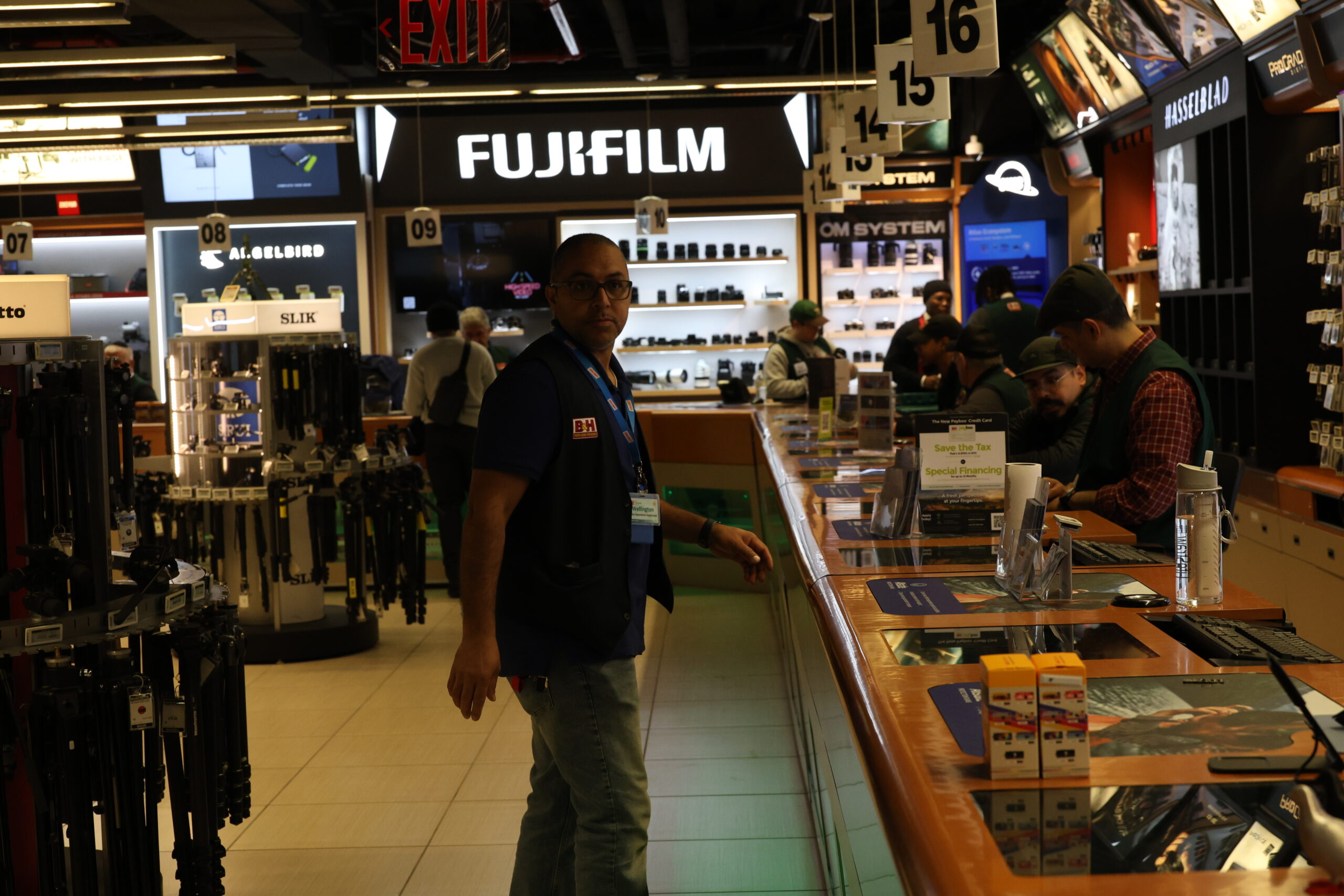
| IMG_1235-scaled.jpg | Interior of a busy B&H Photo Video store, with a large illuminated Fujifilm display at the back and a Hasselblad-branded counter on the right. An OM System display is visible behind the Fujifilm section. A store employee wearing a B&H badge stands beside a long glass sales counter while customers examine equipment. Tripods and accessories fill the left side of the image, including Slik and Manfrotto signage. Fujifilm, Hasselblad, OM System, Slik, and Manfrotto are identifiable brands. |
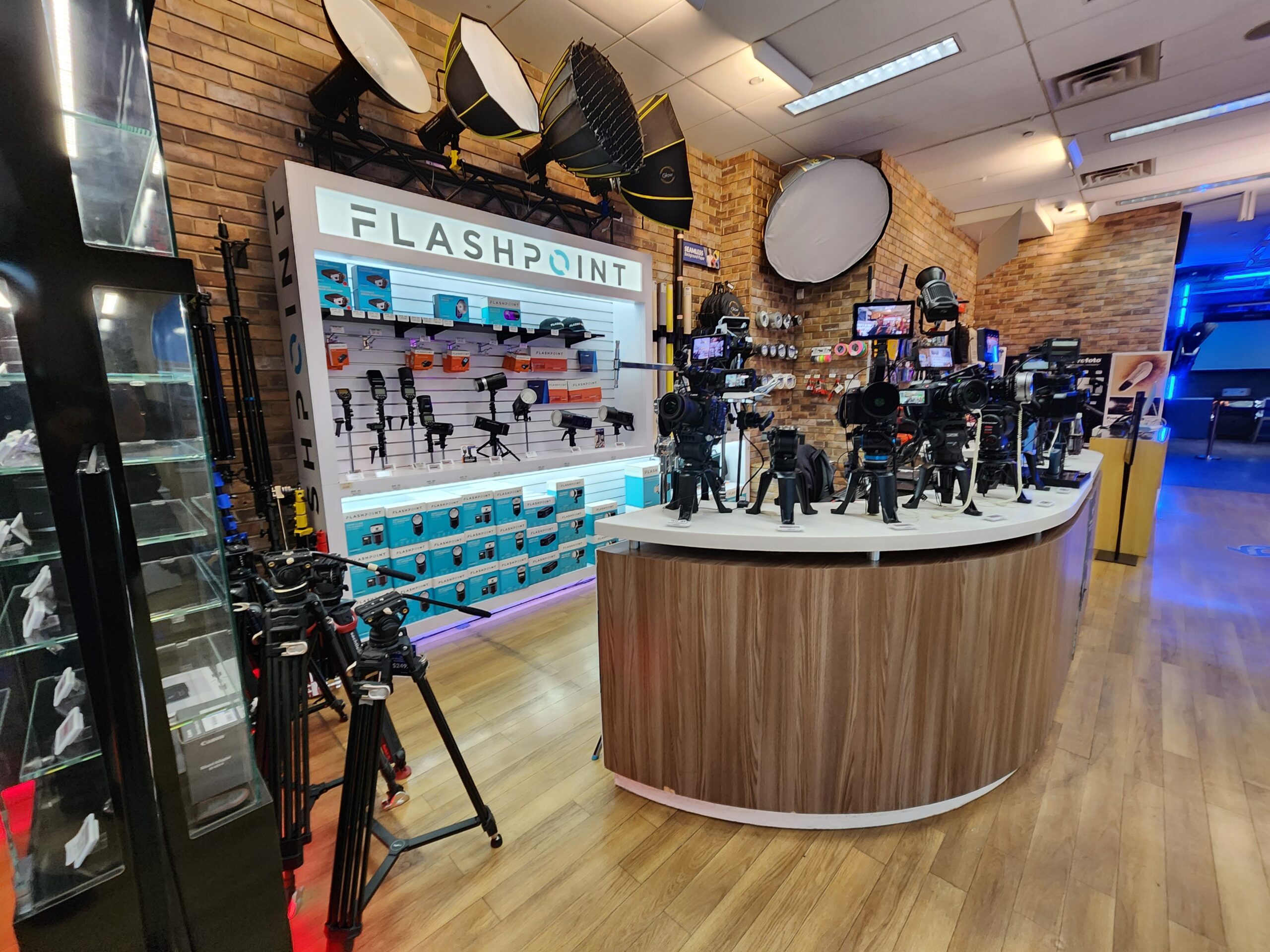
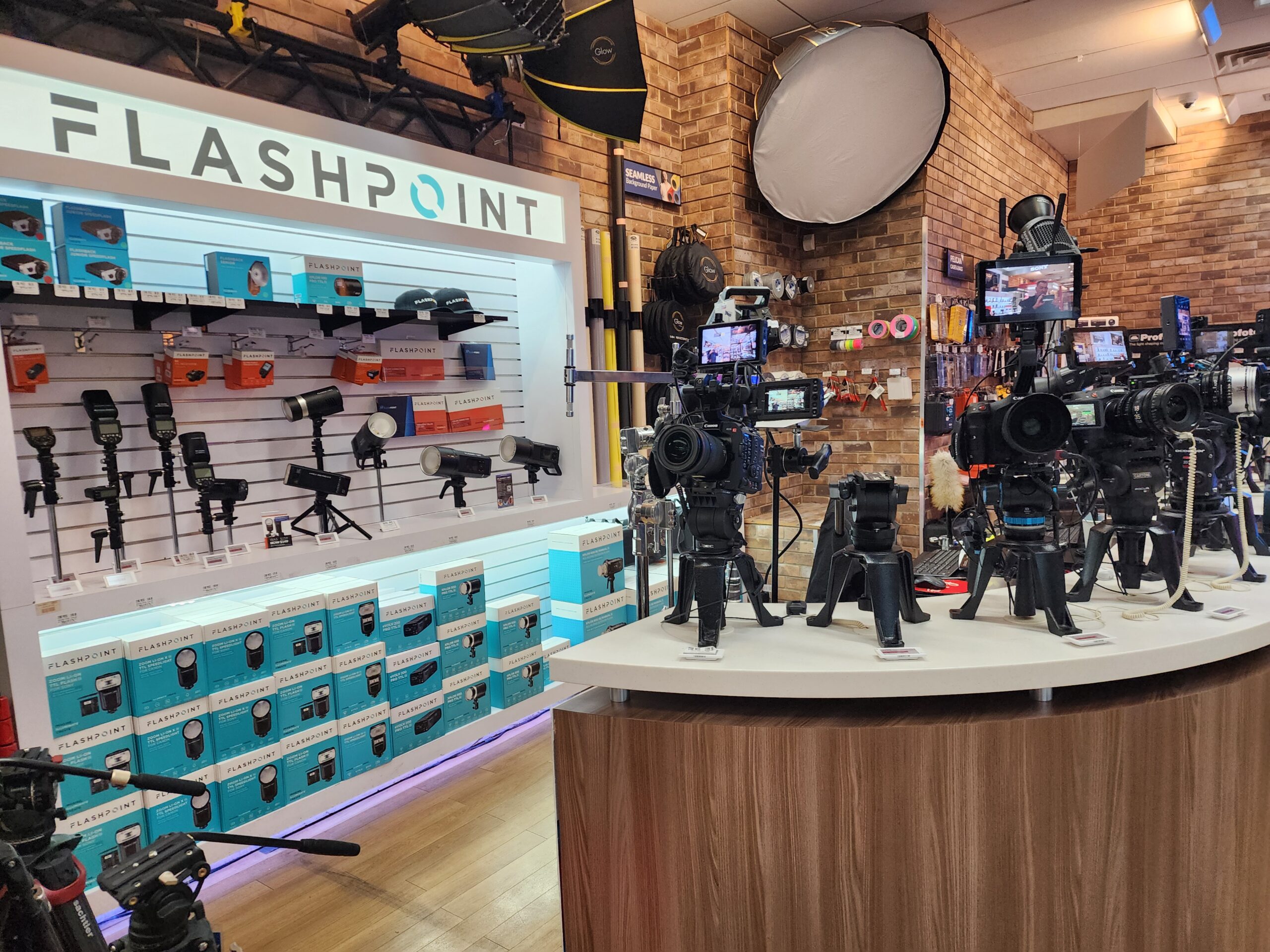
| 20251229_101609-scaled.jpg | Wide-angle photograph of Adorama’s professional video equipment section, showing a semicircular wooden display island covered with large cinema cameras, external monitors, lenses, and heavy-duty tripod heads. A brightly illuminated Flashpoint display occupies the left wall, with studio strobes and flash accessories arranged beneath large overhead softboxes. The composition emphasizes the scale and complexity of professional filmmaking equipment. Flashpoint branding is clearly visible; most individual cinema camera brands cannot be read. |
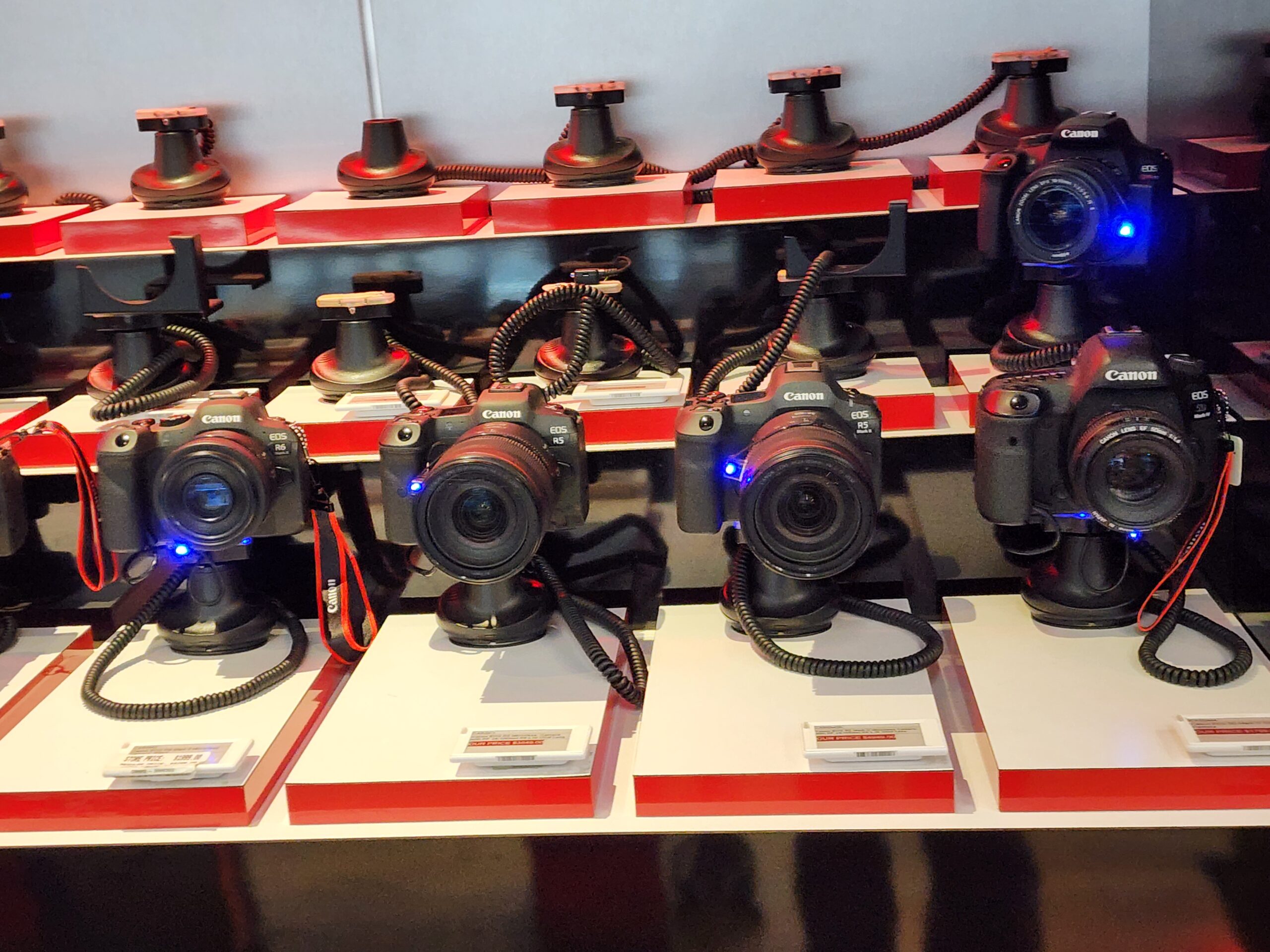
| 20251229_101546-scaled.jpg | Close-up of a Canon EOS camera display, with four prominently positioned Canon cameras secured to white-and-red demonstration stands. The central cameras include Canon EOS R5-series mirrorless bodies, identifiable by their front markings, while another Canon EOS body appears at the right. Each camera has an attached Canon zoom lens, and coiled security cables connect them to the stands. The black camera bodies contrast with the red illuminated display shelving. |
| 20251229_101517-scaled.jpg | Another view of Adorama’s professional cinema equipment department, featuring a curved display counter with multiple large cinema cameras, cinema lenses, external monitors, and professional video tripod heads. Several monitors display live views of the store. A large Flashpoint lighting display fills the left background, with speedlights, studio strobes, and boxed accessories. Large overhead light modifiers hang against an exposed brick wall. Flashpoint is clearly visible; the camera models are not reliably readable. |
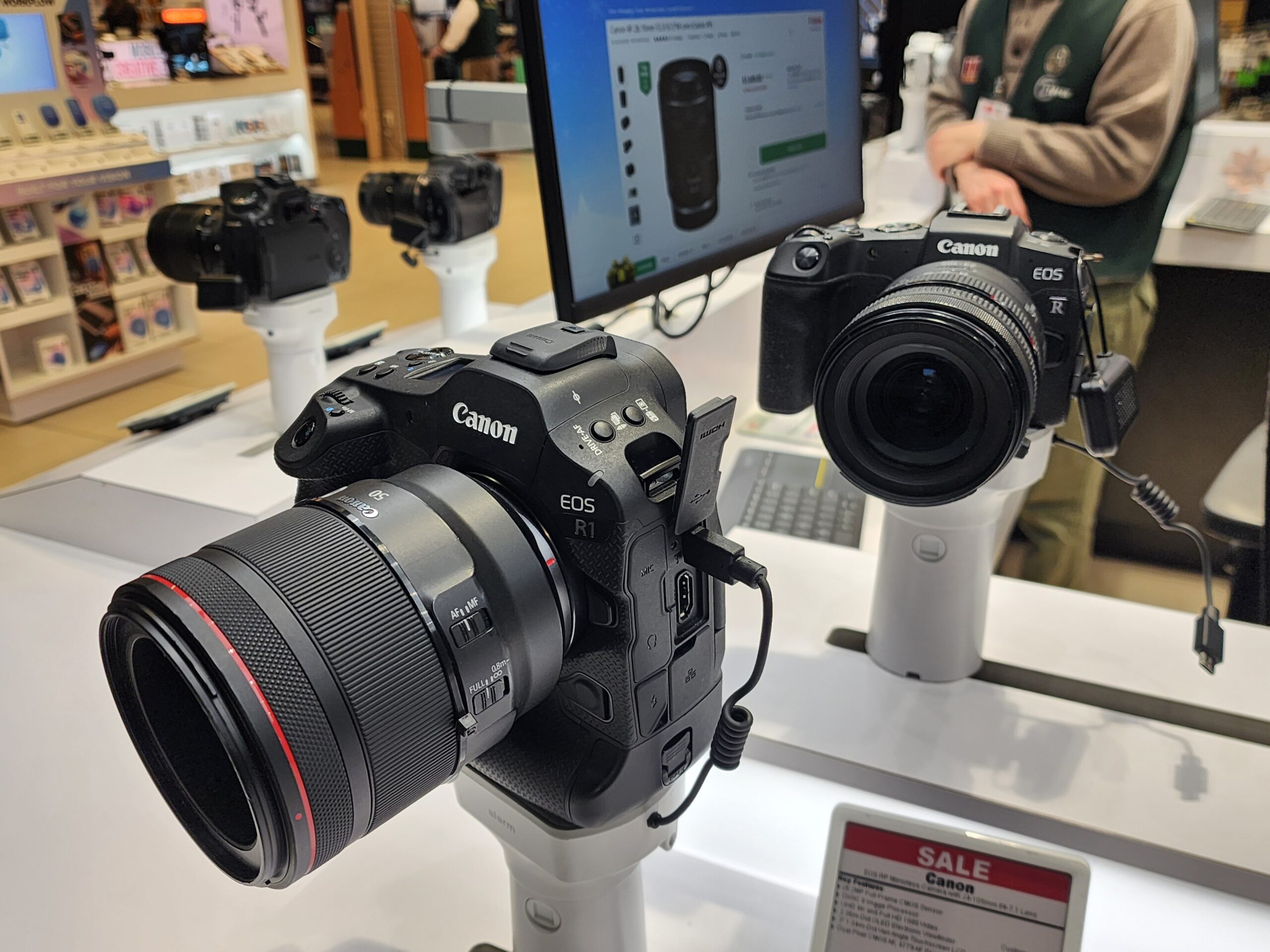
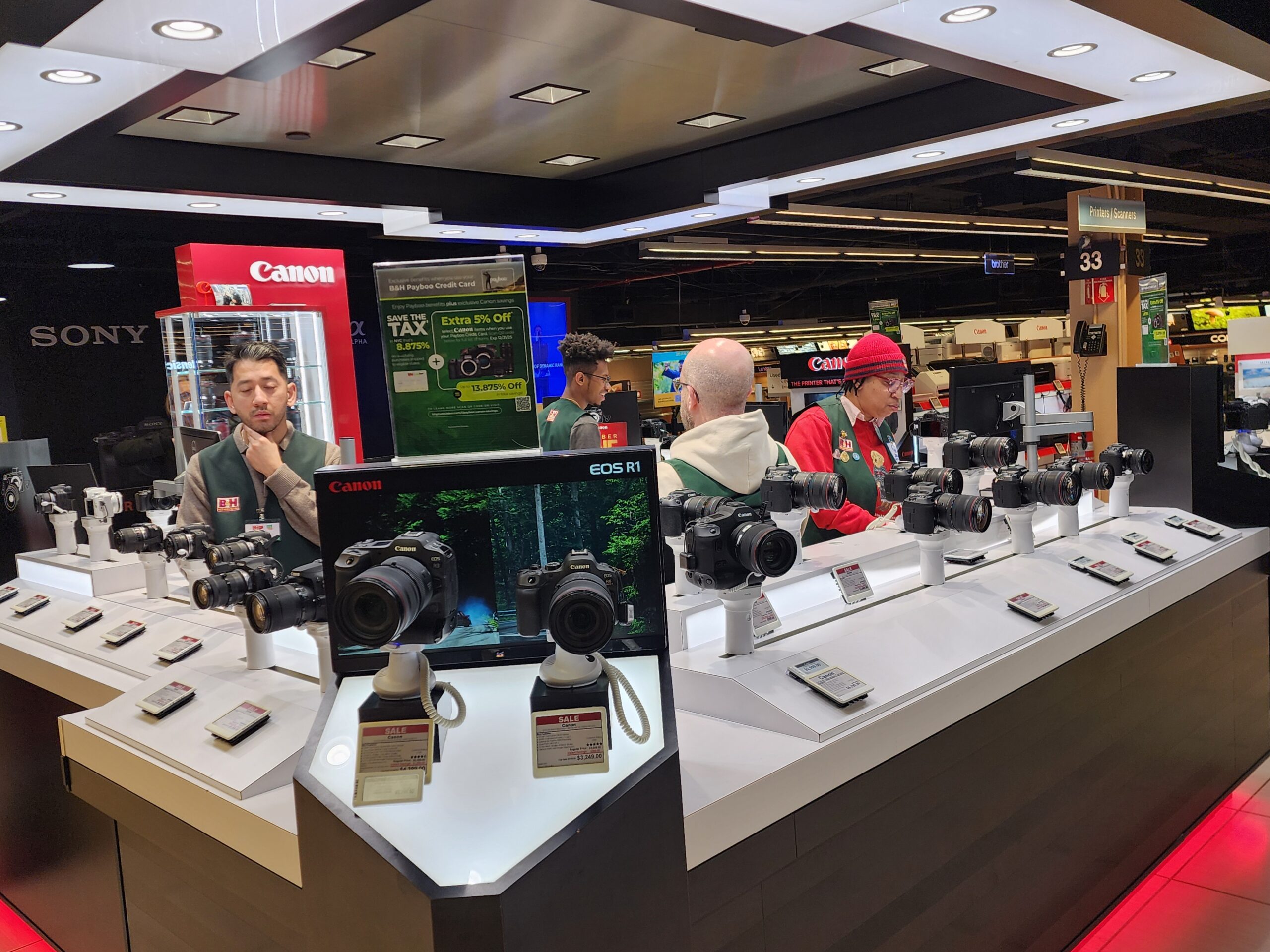
| 20251228_101634-scaled.jpg | Detailed close-up of Canon mirrorless cameras on white security stands at a retail counter. The foreground features a Canon EOS R1 professional full-frame mirrorless camera with an attached red-ringed Canon RF L-series lens, viewed from the side and rear. A second Canon EOS R-series body stands to the right with a black zoom lens. Two additional cameras mounted on white motorized stabilizers appear in the background. Canon EOS R1 and Canon branding are clearly visible. |
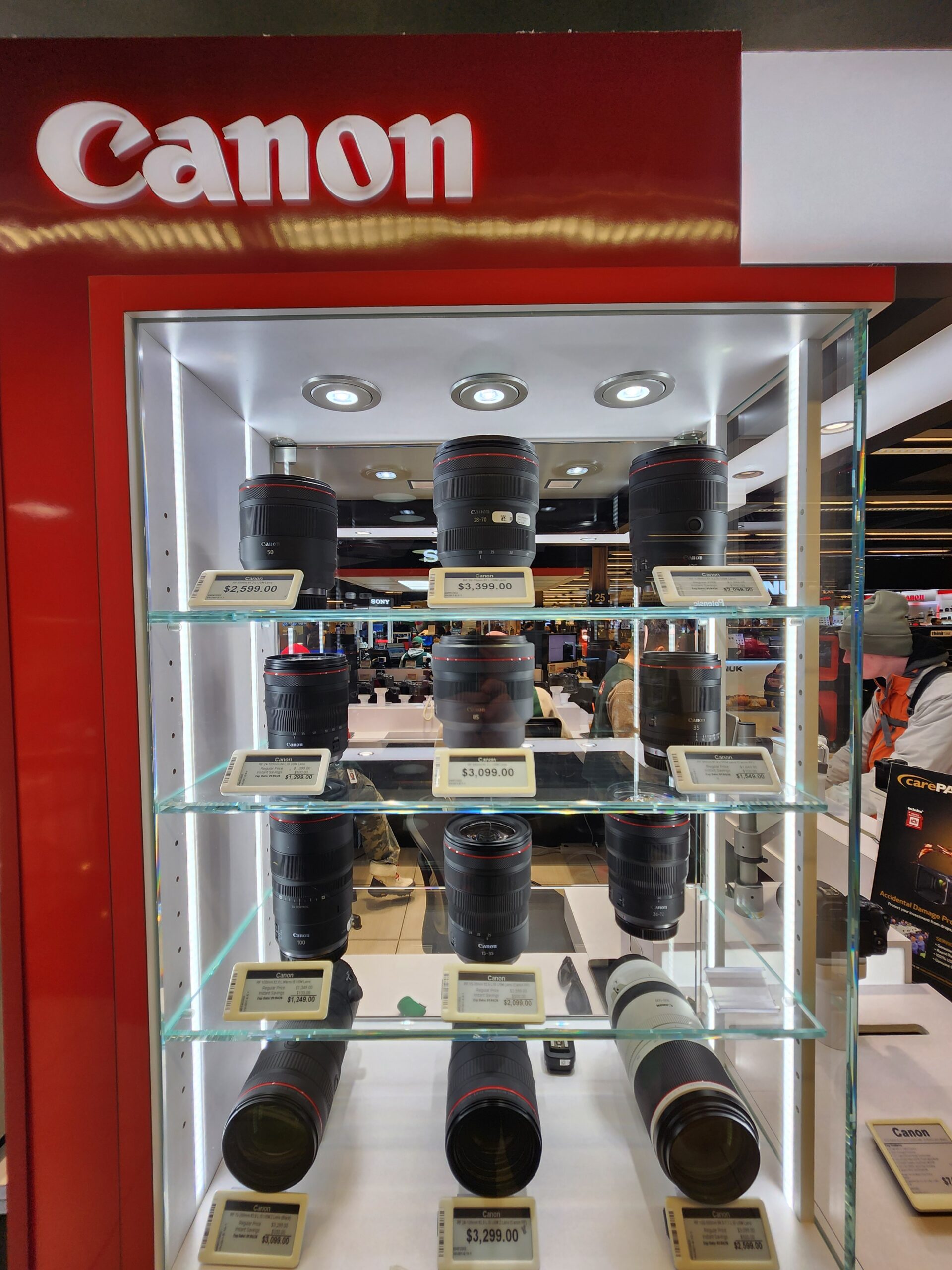
| 20251228_101739-scaled.jpg | Tall illuminated Canon lens cabinet beneath a large white Canon logo on a red background. Multiple Canon RF L-series lenses are arranged on four glass shelves, including large telephoto zooms, shorter professional zooms, and compact lenses. Most feature the characteristic red L-series ring. Electronic price labels display amounts such as $2,599, $3,399, and $3,299. The bright display lighting highlights the lenses’ optical elements and barrel designs. |
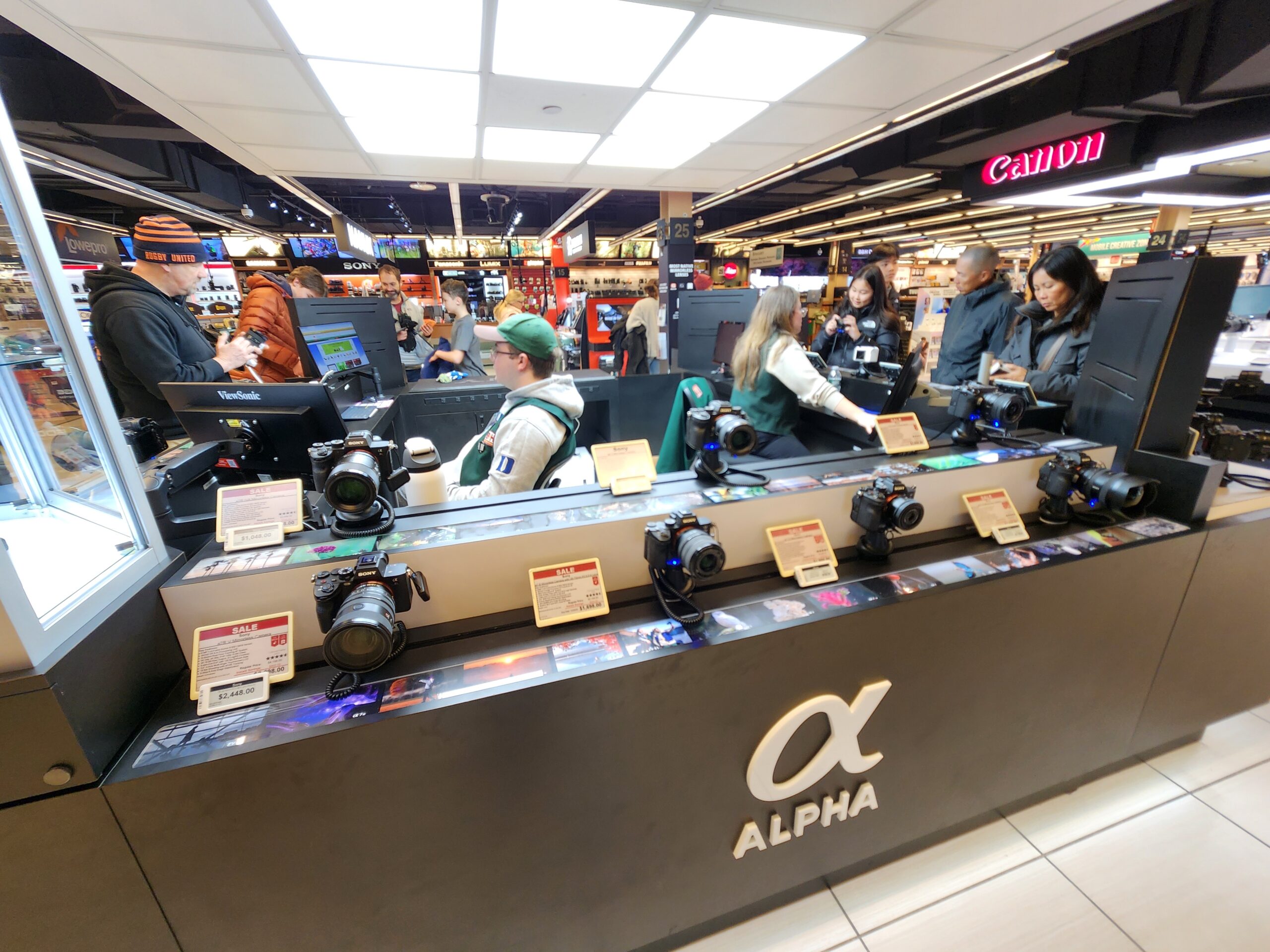
| 20251228_102114-scaled.jpg | Busy B&H photography store interior featuring a prominent Sony Alpha demonstration counter in the foreground. Several Sony Alpha mirrorless cameras with attached zoom lenses are mounted on angled display stands. Customers and employees discuss equipment behind the counter, while illuminated Canon and Sony signs appear farther into the store. The large white Alpha symbol on the counter identifies the Sony camera system. |
| 20251228_101625-scaled.jpg | Extensive Canon EOS demonstration island at B&H Photo Video, featuring numerous Canon mirrorless cameras with RF lenses secured to white display stands. A central promotional monitor advertises the Canon EOS R1, showing professional camera bodies against a dark forest background. A Canon-branded red display cabinet and Sony signage appear behind the counter. Store employees and customers examine the equipment. Canon is the dominant brand, with Sony visible in the background. |
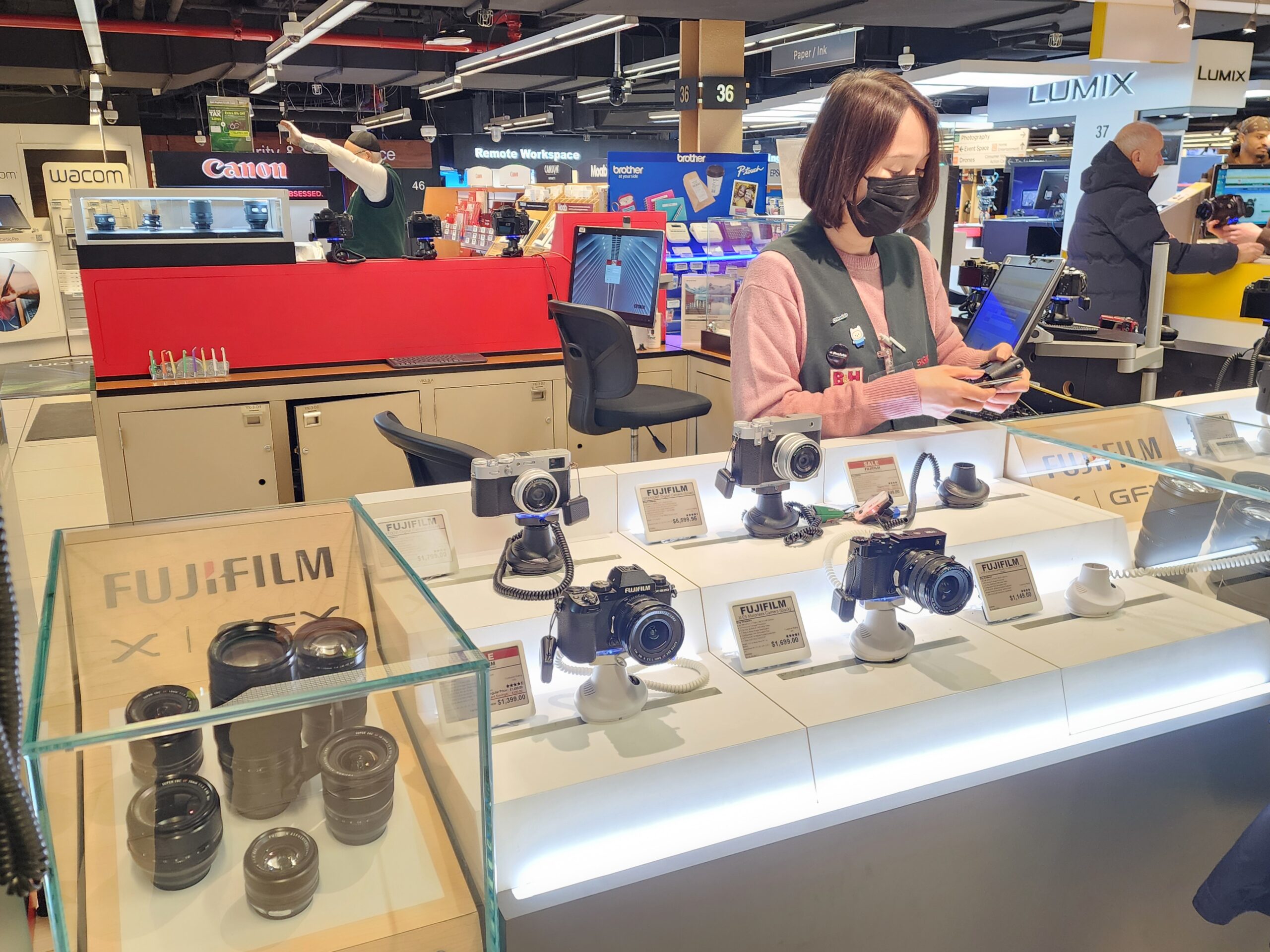
| 20251228_101611-scaled.jpg | Fujifilm camera display at B&H Photo Video, featuring multiple Fujifilm X-series mirrorless cameras mounted on white security stands. Several compact silver-and-black and all-black camera bodies are displayed with attached lenses, while a glass cabinet in the foreground contains Fujifilm interchangeable lenses. A female store employee wearing a green vest and black face mask works behind the counter. Fujifilm branding and an X-series promotional graphic are prominently visible. |
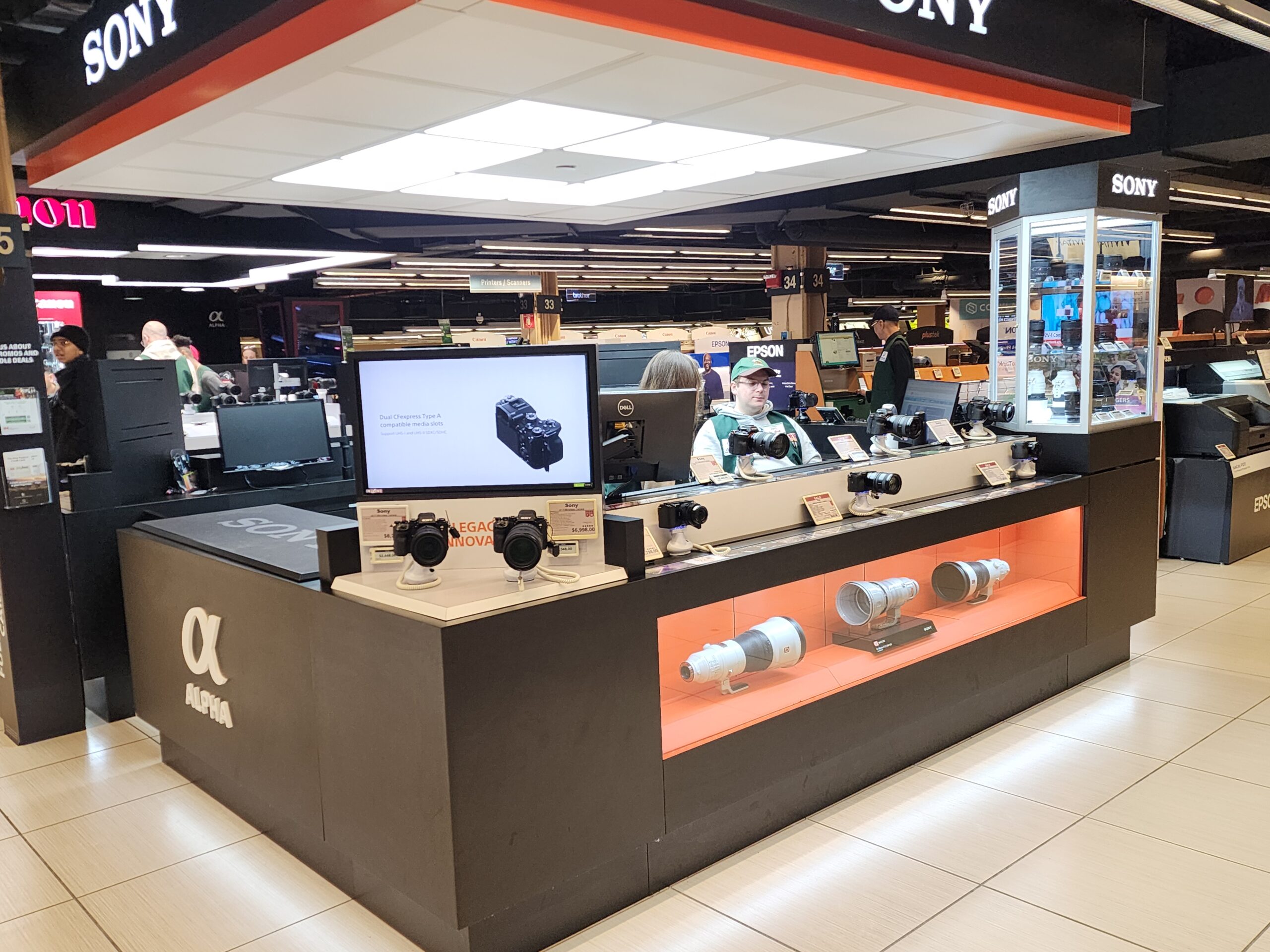
| 20251228_101559-scaled.jpg | Large Sony Alpha retail display island at B&H, beneath illuminated Sony signage and a bright overhead light panel. Multiple Sony Alpha mirrorless cameras are arranged across the counter, with a promotional monitor advertising a Sony Alpha camera. A lower illuminated glass cabinet contains several white Sony G-series and G Master telephoto lenses. Customers and employees occupy the background. Sony Alpha is the clearly identifiable camera brand. |
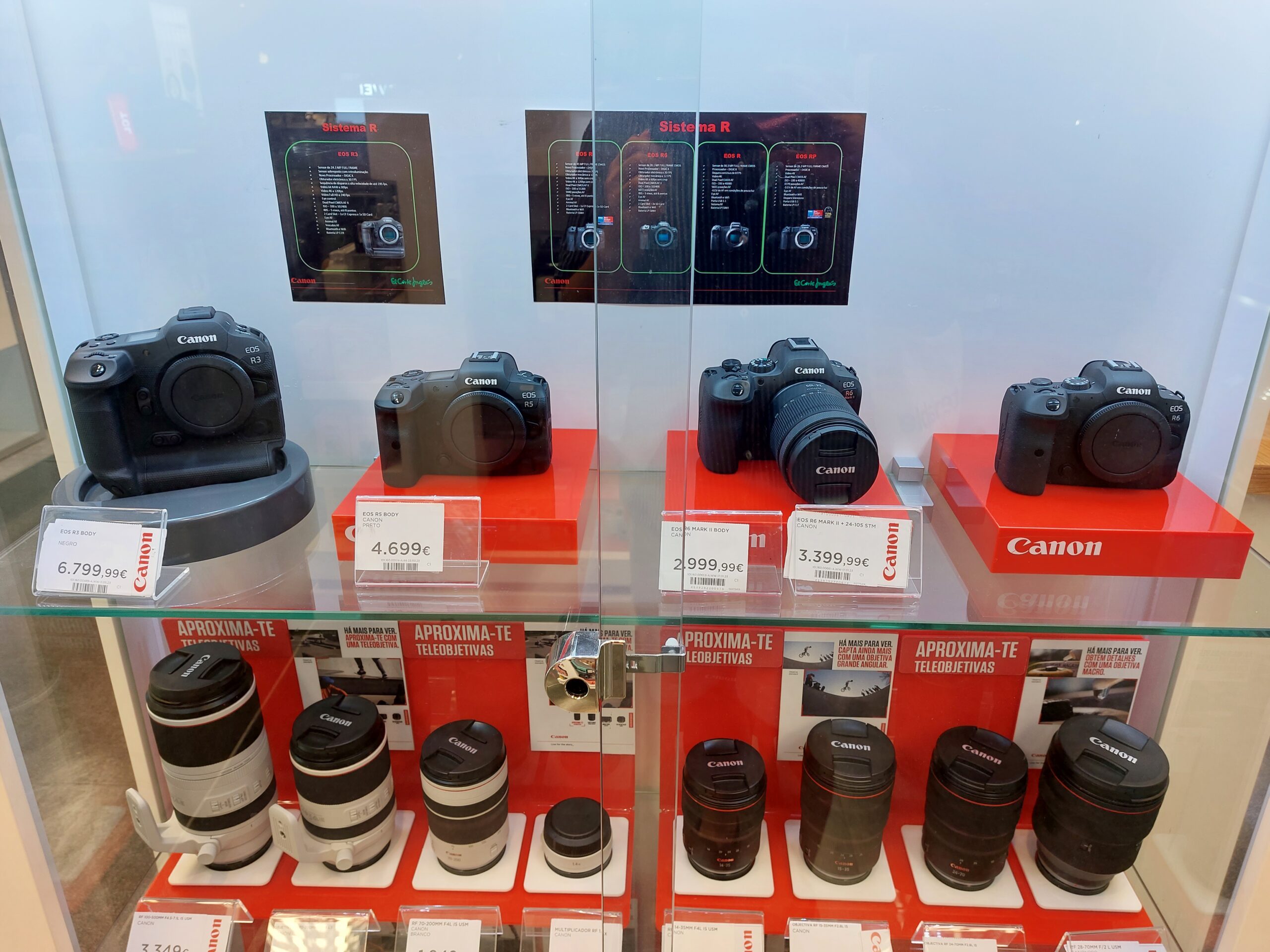
| 20231012_114954-scaled.jpg | Glass display cabinet featuring Canon EOS R-series mirrorless cameras and RF lenses, with promotional charts labeled Sistema R in Spanish. The upper shelf includes Canon EOS R3, EOS R5, and other EOS R bodies, some without lenses and others fitted with compact zoom lenses. The lower shelf displays several white Canon RF telephoto lenses and black RF zooms. Prices are shown in euros, and Canon’s red display platforms provide a consistent visual identity. |
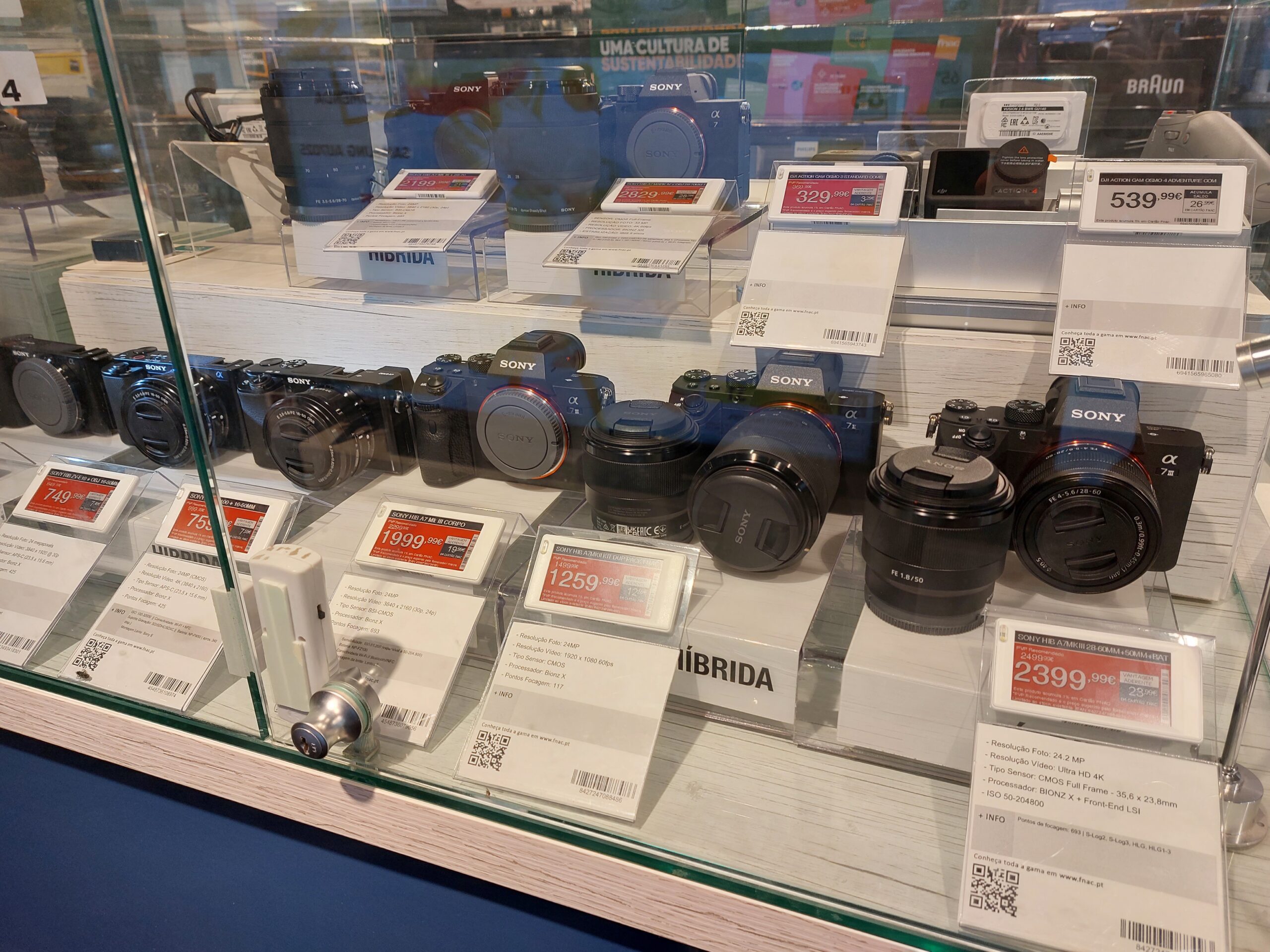
| 20231005_102006-scaled.jpg | Glass retail cabinet displaying a range of Sony digital cameras, from compact models to full-frame Alpha mirrorless bodies. The lower shelf includes several Sony Alpha 7-series cameras with attached lenses, including a body marked Alpha 7 IV and another Alpha 7-series model. A separate Sony FE 1.8/50 prime lens is positioned near the center. Electronic price labels show euro prices, including €1,259.99 and €2,399.99. Sony branding is visible on the cameras and lens caps. |