The photograph captures a demonstration in Rennes, France, against a backdrop of elegant nineteenth-century architecture. A bare-chested female protester with umbrella creates an almost theatrical reenactment of Eugène Delacroix’s famous painting Liberty Leading the People. But the resemblance is visual rather than ideological. Where Delacroix depicted revolution as a struggle with historical purpose, much of France’s contemporary street disorder seems increasingly driven by confrontation for its own sake.
There is an important distinction between legitimate political protest and the romanticization of anarchy. France has a long and sometimes admirable tradition of public resistance, but that history cannot automatically confer legitimacy on every crowd occupying a street or every confrontation with the authorities. The right to protest is fundamental. The supposed right to turn political dissatisfaction into permanent disorder is something else entirely.
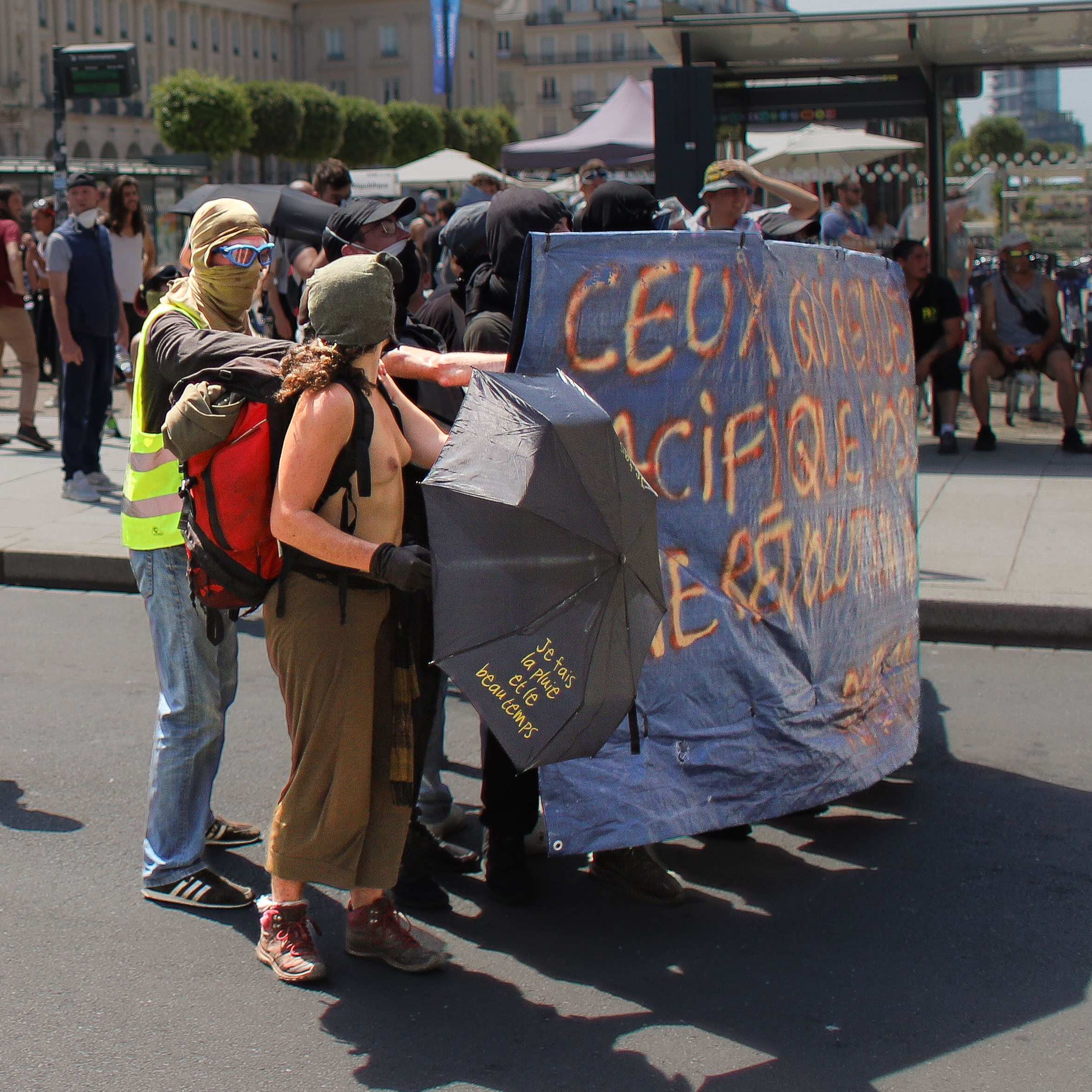
Look closely at the scene. An umbrella becomes a shield against the relentless sun, reflective vests serve as an instantly recognizable political uniform, and the handmade sign commands attention even when its message is hard to decipher. The crowd stands in front of the République transport stop and a row of grand civic buildings. It is an arresting street photograph, but not a photograph of a riot: no act of violence is visible here, and the image alone cannot establish the motives of the people it shows. That distinction matters, especially when criticizing the broader culture of disruption.
Still, there is something exhausted about the spectacle of perpetual rebellion. France has real disputes over living standards, public services, taxation and political representation, and those disputes deserve serious debate. Yet when demonstrations spill into vandalism, intimidation or pointless confrontation, the language of liberty becomes an alibi for irresponsibility. The costs fall not on an abstract establishment but on ordinary residents, workers, commuters and small businesses. Smashing a window does not create a policy. Blocking a street does not, by itself, constitute a political argument.
Delacroix’s Liberty advances above a barricade with a flag in hand, embodying the dramatic hopes of the July Revolution of 1830. That painting did not make every later revolt noble, and borrowing its visual vocabulary does not make modern disorder heroic. Protest needs an objective beyond the performance of being against something. Otherwise, the barricade becomes a prop, the slogan becomes a costume and the cause disappears behind the noise.
France does not lack revolutionary imagery; it has centuries of it. What it needs is political seriousness, responsibility and the ability to tell necessary dissent from senseless anarchy. The photograph is compelling precisely because it looks, for a moment, like history painting. Then the illusion fades, and we are left with a harder question: what, exactly, is all this supposed to achieve?