Museums are usually photographed for their collections, their architecture, or the remarkable objects they preserve. Yet sometimes the most interesting subject is neither the exhibition nor the building itself, but the visitors moving through it. A moment of ordinary human activity can become an expressive photograph when light, architecture, and movement come together.
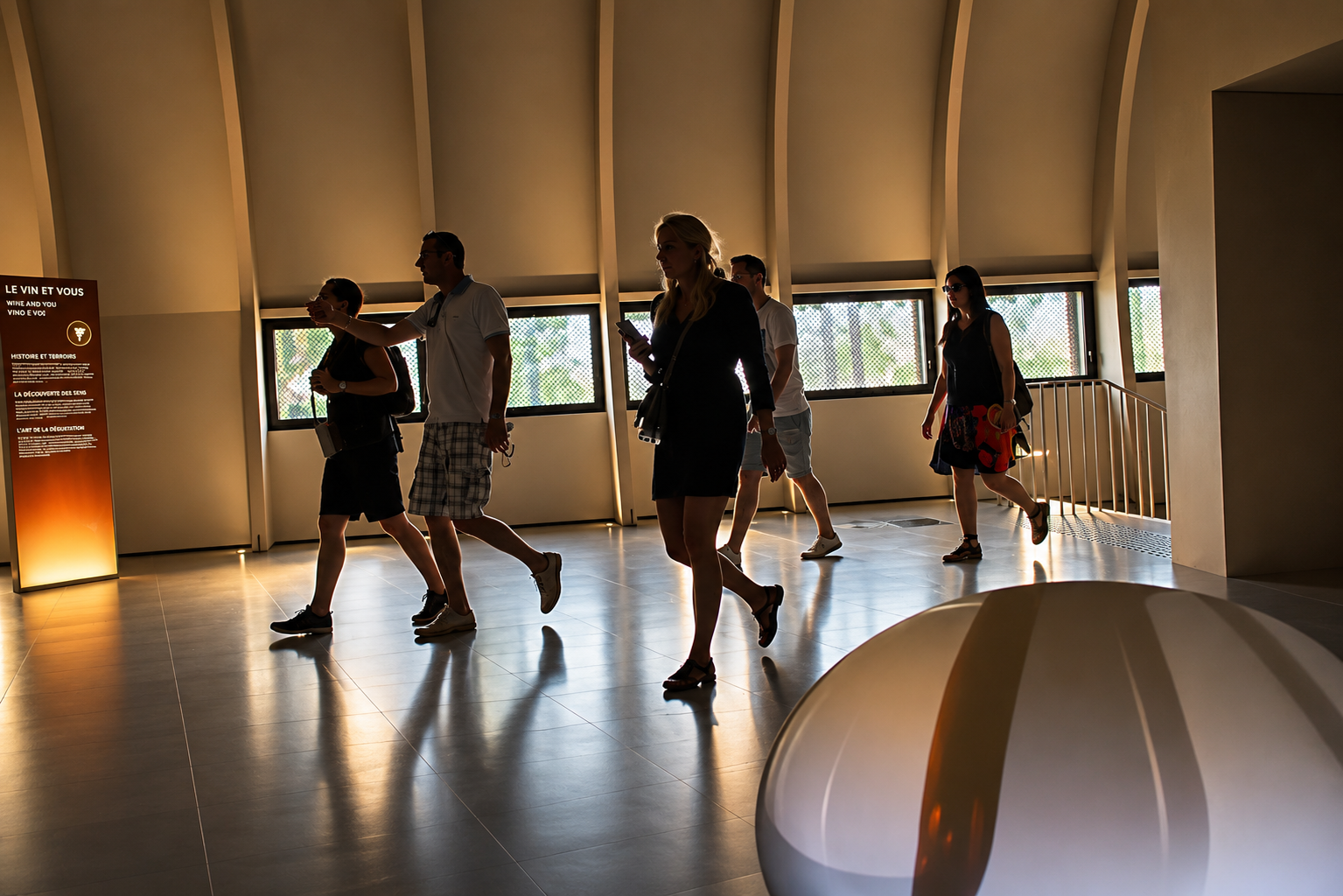
This photograph captures five visitors crossing a spacious exhibition gallery, their figures silhouetted against a row of bright windows. The interior is dominated by tall, gently curving architectural supports, warm beige walls, and a polished floor catching the light. One man gestures toward something outside the frame while walking beside a woman. Another visitor follows behind, partially concealed by the central figure, a blonde woman looking at her phone. On the right, a woman in sunglasses walks toward the stairway, her colorful skirt providing one of the few vivid accents in an otherwise restrained composition.
The exhibition panel on the left, titled “Le Vin et Vous,” or “Wine and You,” provides a clue about the setting. Its references to wine, history, terroirs, and tasting suggest an exhibition devoted to wine culture. But the photograph is not really about wine. The exhibition becomes a background for a more universal subject: how people occupy public spaces, interact with one another, and move through architecture.
The windows create strong backlighting, reducing the visitors to dark shapes while illuminating the floor beneath them. Their legs, arms, and gestures become more important than their facial expressions. The large architectural surfaces above the windows establish a quiet, almost monumental background, while the moving figures introduce a sense of temporary human presence. The contrast between the permanence of the building and the fleeting movements of its visitors gives the photograph much of its character.
There is an appealing irregularity to the composition. The visitors are distributed across the frame at different distances, walking at different speeds, with their bodies overlapping in places. The man gesturing on the left, the central woman holding her phone, and the solitary figure approaching the stairs on the right form three distinct points of attention. Nothing feels arranged, which is precisely why the scene works.
The large rounded structure in the lower-right foreground adds another dimension. Its smooth, pale surface contrasts with the angular floor tiles and vertical architectural elements, giving the photograph a strong sense of depth. Rather than simply documenting people in a gallery, the image brings together several visual layers: an object close to the camera, moving visitors in the middle distance, and bright windows behind them.
Conventional exposure advice might suggest brightening the visitors until their faces and clothing become clearly visible. But doing so would weaken the silhouettes and potentially sacrifice the luminous quality of the background. The darker figures are not necessarily a technical failure. They can be the very reason the photograph succeeds.
Visitors are often treated as distractions in museum photography, something to wait out before pressing the shutter. Here they provide the subject, the scale, and the narrative. Without them, the room would still be architecturally attractive, but it would lose its sense of life.
Five people walk through a museum, doing nothing particularly remarkable. A fraction of a second later, the arrangement is gone forever. Photography takes that unremarkable instant and turns it into a composition worth looking at.