What do coffee and a camera have in common? An Instagrammer. Walk into a decent coffee house these days and there’s a fair chance someone at the next table is photographing their cappuccino before the first sip. I can’t pretend to be above it. I run a coffee site and a few photography sites, so when a good cup lands next to a good camera, my hand goes for the shutter before the spoon.
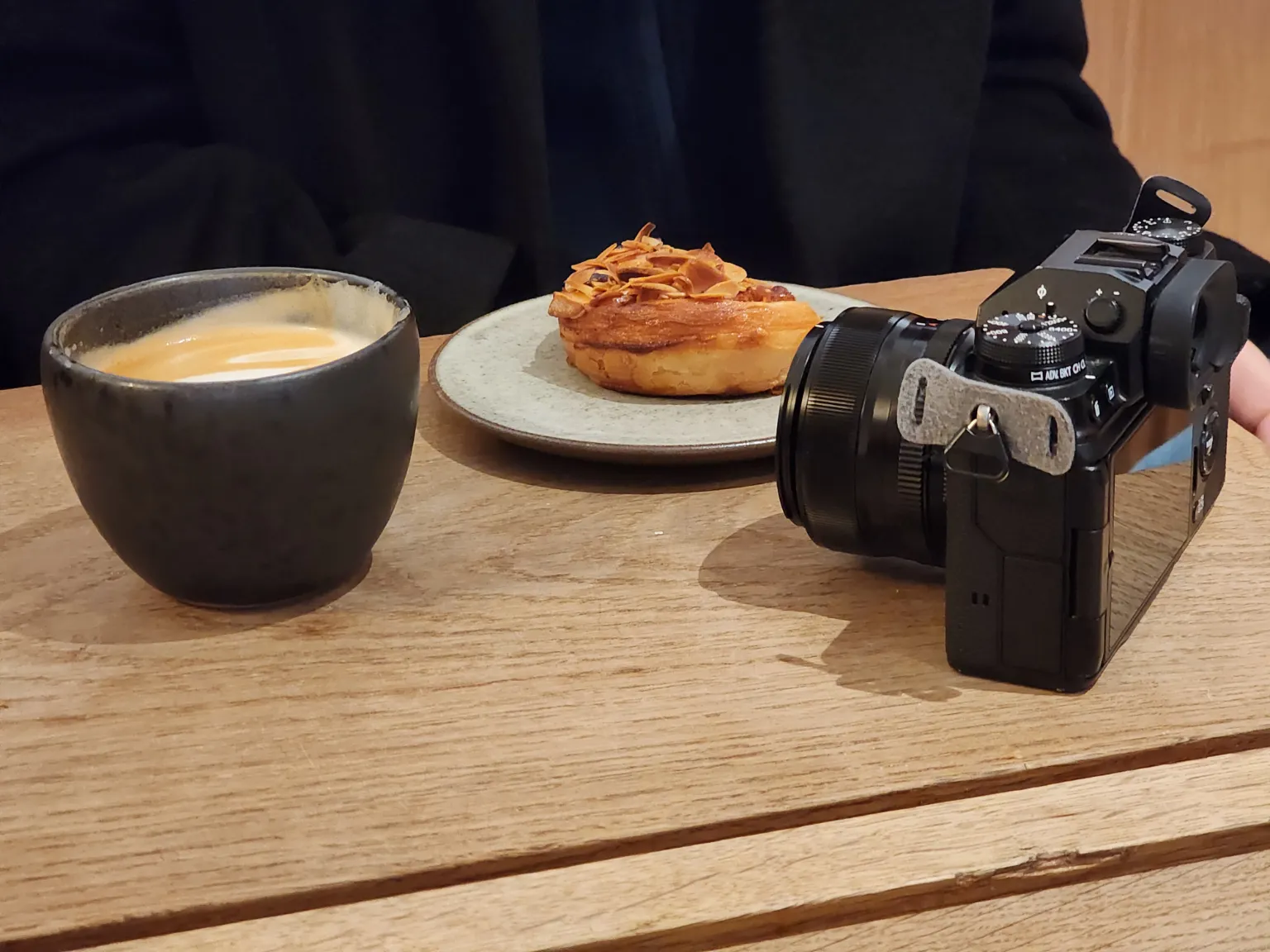
This table is a nice example. A dark, almost charcoal stoneware cup, with the last of the latte art drifting off to one side. Behind it, a pastry crusted with toasted almond flakes on a speckled grey plate. And on the right, a black Fujifilm X-T body (you can tell from the ISO dial with the drive ring underneath it, ADV, BKT, CH, CL) with a short, fast prime on the front and a grey felt strap tab hanging off the lug. I shoot Canon, an R8 and an R100, and I’ll admit to some dial envy here. Fuji built a whole following on cameras that look good on a café table even when they’re switched off.
Which is the funny part. The camera in this frame isn’t taking the picture. It’s in it. It’s a prop, the same as the pastry, and it’s doing its job well.
Why cafés make such easy studios
Think about it from a creator’s side. A coffee is cheap. It doesn’t move. The café has already done the set design for you: textured walls, nice cups, window light, a pastry counter, maybe a handsome espresso machine. One visit gets you a still, a short clip of the barista pouring, an interior detail and enough notes for a review. Compare that with organizing a fashion shoot or a travel sequence. No contest.
Look at the background in this shot, too. Somebody in a black coat is sitting right behind the plate, and at this distance their coat turns into a perfectly good black backdrop. Nobody planned that. It just happens at café tables all the time, and it’s half the reason these pictures look better than they have any right to.
How I’d shoot a table like this
A few things I’ve learned, mostly the hard way:
- Get down to cup height. This frame is shot almost level with the table, and that’s why the cup has some presence. The overhead flat-lay is everywhere now. A low angle with the wood grain running away from you looks more like being there.
- Be quick with the foam. Latte art doesn’t wait. Within a minute or two the pattern starts to slide and the crema goes patchy, which you can already see happening at the rim of this cup. Shoot first, then drink, but don’t make it a production.
- Sit side-on to the window. Café overhead lights are usually warm and messy. Window light from one side gives the cup shape and the shadows you see here, falling to the right.
- Mind the focal length. If I had the R8 with the RF 16mm on it, I’d be in trouble at a table this small; ultra-wide pulls in the sugar bowl, the napkins and the neighbor’s elbow. Something around 35mm to 50mm equivalent, like the prime on that Fuji, is about right. Wide open, it’ll melt whoever is sitting opposite into a soft dark shape.
- Leave the camera in the shot if it’s nice. Apparently that’s half the point.
There’s more of this kind of thing, gear and technique for small everyday scenes, over on pho.tography.org.
What the picture says about the person
An Instagram café review is rarely just about coffee. It’s about the neighborhood, taste, the small win of finding somewhere new, and the idea that you’ve got time to sit down at all. A cappuccino next to a camera says something different from the same cappuccino next to a pile of office paperwork. The objects around the cup build the identity of the person posting it. The camera, in this case, is as much a lifestyle accessory as a tool.
For café owners that’s a real incentive. A distinctive cup, a well-lit corner or a nicely presented almond pastry becomes free advertising. Someone photographs it, tags the location, and the next people come in hoping for the same picture. Independent places do benefit from that. But a café built only for photos tends to forget why people come back, which is good coffee, a chair you can actually sit in and staff who are glad to see you.
A photo isn’t a review
A useful review tells you whether the espresso is balanced, whether the pastry was baked today, whether the chairs are any good and whether the prices make sense. A beautiful photo gets attention, but it can’t tell you what the coffee tastes like. That still takes the old-fashioned step of drinking it. It’s the reason I keep espressocortado.com about the coffee itself (the machines, the beans, the prices) and treat the pictures as the side dish.
Still, I like this scene. Coffee used to be the excuse to put work aside for ten minutes. For an Instagrammer, the coffee is the work. The camera waits beside the cup, the pastry is ready for its close-up, and somewhere between the first frame and the first sip an ordinary coffee break turns into a small piece of media. I’ve done it too. I’ll probably do it again tomorrow.