New York City is not necessarily beautiful. Much of Manhattan is a chaotic collection of oversized buildings, dirty sidewalks, construction barriers, traffic, commercial signage and architectural compromises. The city can be exhausting, visually aggressive and occasionally downright ugly. Yet somehow, when you point a camera at an ordinary intersection, the result can look like a frame from a major motion picture. There is something about New York’s density, scale, light and perpetual movement that makes even its least glamorous corners extraordinarily photogenic. Other American cities have more attractive neighborhoods, more elegant streets or more impressive natural surroundings, but few can match New York’s ability to turn everyday urban disorder into cinema.
This photograph, taken at Seventh Avenue near Pennsylvania Station in Midtown Manhattan, illustrates the phenomenon almost perfectly. There is nothing particularly picturesque about the location. In the foreground, a dark sedan cuts across the pedestrian crossing while two yellow taxis provide those unmistakable flashes of New York color. A traffic signal hangs diagonally over the intersection, its red arrow adding another sharp accent. Behind the vehicles, pedestrians move through a relatively narrow opening between enormous glass-and-steel buildings. The triangular glass entrance to the Penn Station and Long Island Rail Road concourse rises from the pavement, with its curved roofline and structural ribs creating a surprisingly elegant architectural centerpiece. A decorated Christmas tree stands beside it, while the surrounding storefronts, restaurant signs and illuminated advertisements compete for attention.
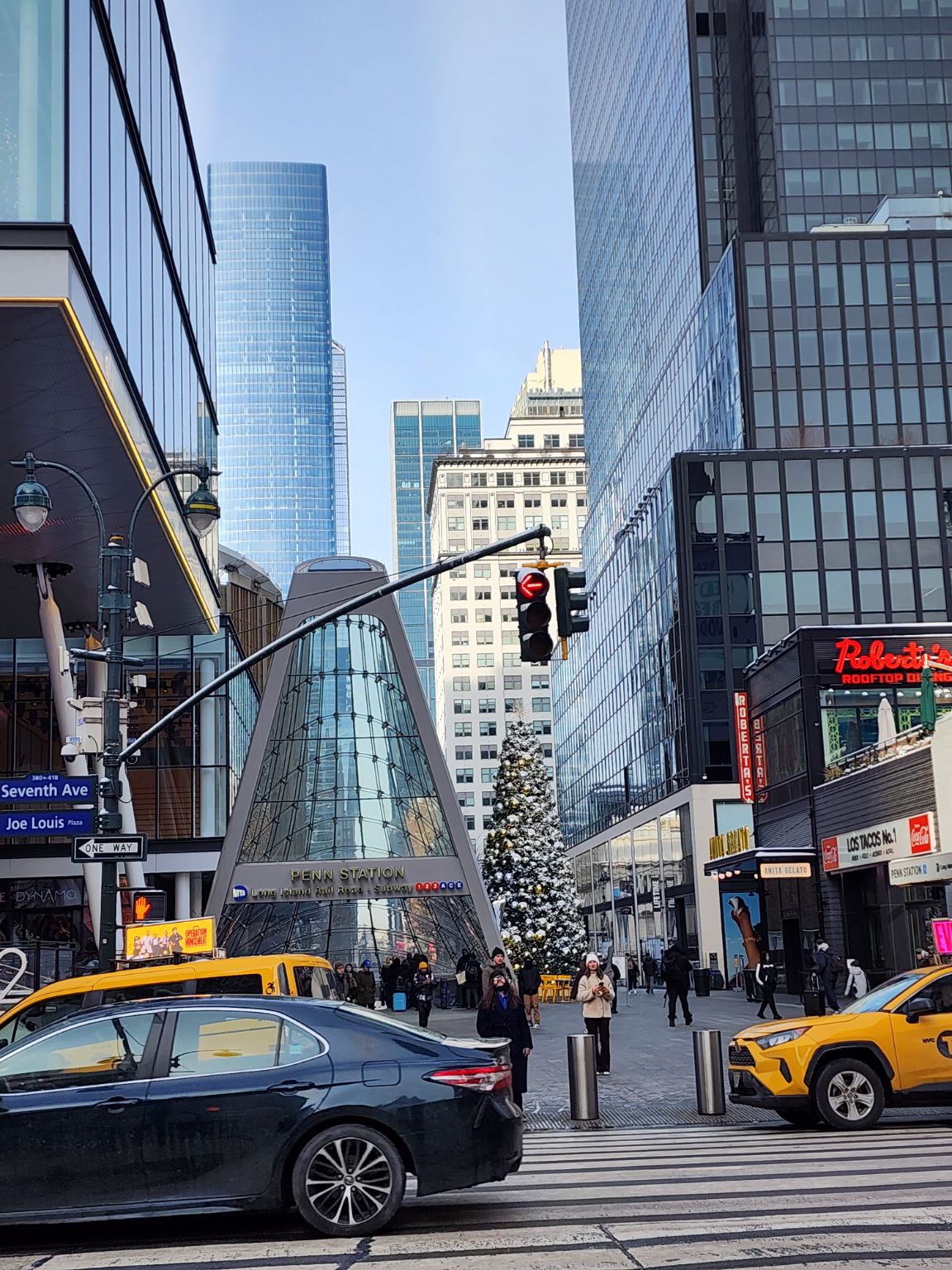
Look farther into the photograph and the composition becomes even more interesting. A cylindrical blue-glass skyscraper rises in the background, contrasting with the rectangular office towers and older, pale stone buildings. The facades on both sides create a deep urban canyon, drawing the eye toward the center of the frame. The pale winter sky softens the otherwise hard geometry. Reflections multiply the buildings, the glass entrance introduces another layer of transparency, and the small figures on the sidewalk give the scene a human scale. There is no single spectacular monument here. The visual impact comes from the accumulation of ordinary details, arranged by the city itself into something that feels carefully staged.
New York’s cinematic character is partly a matter of architecture, but even more a matter of spatial compression. In Los Angeles, the same elements might be separated by wide roads, parking lots and low-rise developments. In many American downtowns, the streets become strangely empty after business hours. Manhattan compresses everything into a continuous visual field. Cars, people, skyscrapers, storefronts, traffic lights, subway entrances and fragments of older architecture occupy the same frame. There is almost always a foreground, a middle ground and a background, and each contains something worth looking at. For a photographer, that is a remarkable advantage.
It also explains why New York has been such an effective setting for generations of filmmakers. From the gritty street photography of 1970s crime dramas to the polished Manhattan of romantic comedies, the city supplies its own production design. Think of the restless urban atmosphere of Taxi Driver, the crowded sidewalks and architectural scale of Manhattan, or the winter streets of countless New York films. The buildings do not merely provide a backdrop. They become participants in the story, imposing their scale on the characters and making human activity appear simultaneously insignificant and intensely dramatic.
What makes this particular photograph appealing is precisely its lack of an obvious postcard subject. It is not the Empire State Building at sunset, the Brooklyn Bridge in golden light or the skyline viewed from across the Hudson. It is an ordinary Midtown intersection, photographed at street level, with vehicles partially obstructing the view and pedestrians scattered across the scene. The visual clutter is not a defect to be eliminated. It is the subject. Remove the taxis, signs, traffic lights and competing architectural styles, and much of the atmosphere disappears with them.
There is a reason photographers can spend days walking Manhattan without running out of compositions. New York rarely offers visual simplicity, but it offers endless relationships between objects, people and spaces. Its streets can be harsh, untidy and overwhelming in person, yet through the camera they acquire rhythm and narrative. Perhaps that is the city’s greatest visual paradox: New York does not have to be beautiful to look magnificent on film. It only has to be New York.