Palermo is a city that rewards looking straight ahead, looking up, and occasionally looking behind you. Its narrow streets are not simply passages between buildings. They are elaborate compositions of architecture, human activity, accumulated history, and the small improvisations of everyday life. Sometimes an entire city seems to fit into a single photograph.
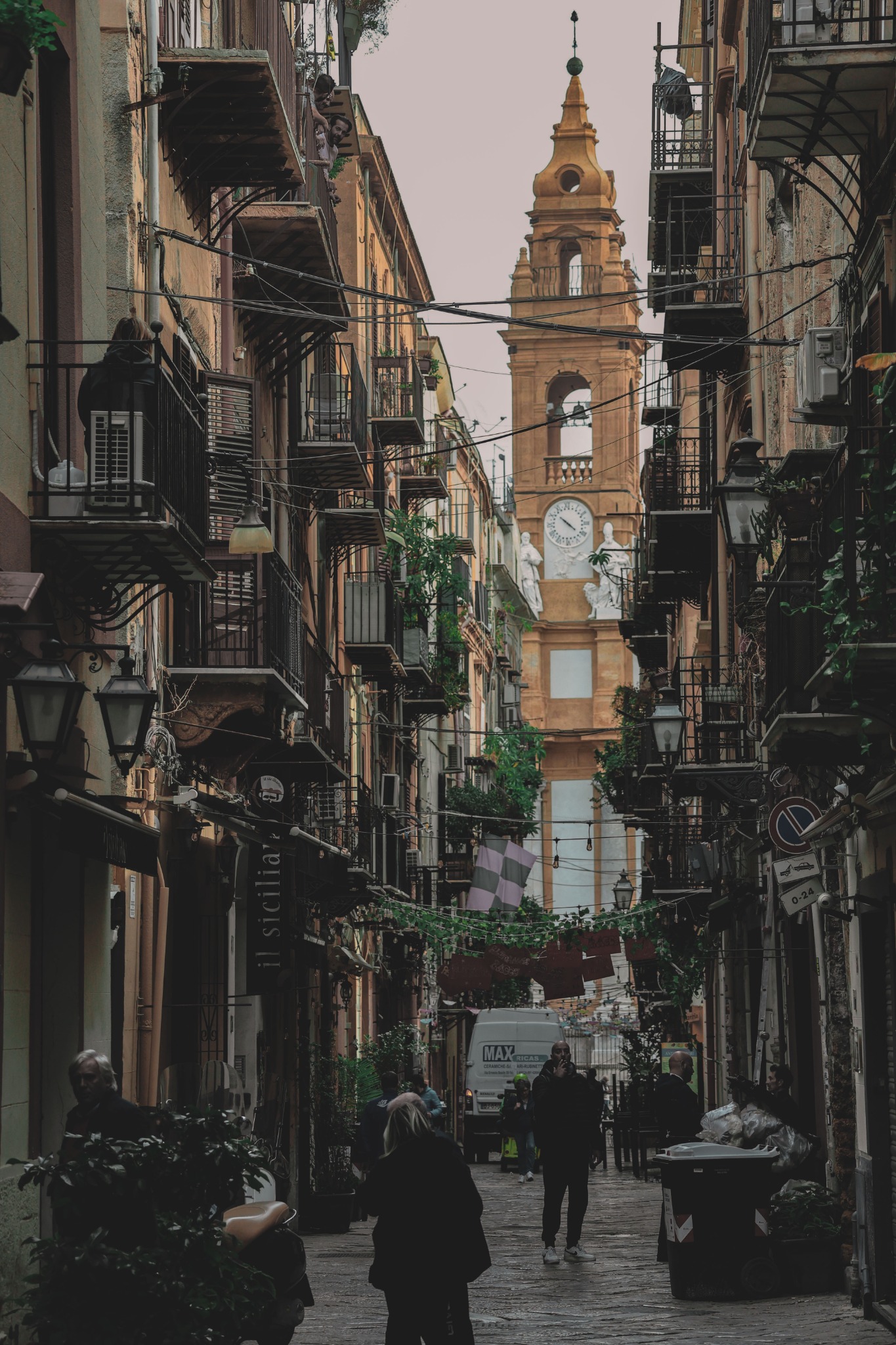
This street scene captures something particularly characteristic of Palermo’s historic center. Tall, weathered buildings press toward each other, their façades crowded with wrought-iron balconies, shutters, air-conditioning units, hanging plants, and an extraordinary network of electrical cables. The street is narrow enough for the balconies to feel almost conversational, as though residents on opposite sides could exchange a few words without leaving their apartments.
At the far end, an elegant ochre-colored clock tower rises above the surrounding buildings, providing an architectural focal point that contrasts beautifully with the disorder of the foreground. Its classical proportions, arched openings, decorative stonework, statues, and slender spire introduce a sense of ceremony into an otherwise thoroughly ordinary urban scene. The clock is visible, but the street below seems to operate according to a different understanding of time.
There is a wonderful visual contradiction here. The tower represents order, permanence, and public authority. The buildings surrounding it represent adaptation, private life, and the gradual accumulation of practical necessities. Electrical cables cut across the view in every direction. Balconies have been enclosed, reinforced, decorated, or left to age. Plants emerge from unexpected corners. Nothing appears to have been arranged for the photographer, and that is precisely what makes the scene interesting.
The human details are just as important. A man walks toward the camera while talking on his phone. Another pedestrian approaches from the foreground. A delivery van occupies the middle distance, while people gather near doorways and shopfronts. A scooter, rubbish containers, street lamps, and commercial signs remind us that this is not an architectural museum. It is a functioning neighborhood, with all the compromises that entails.
The photograph’s vertical framing is particularly effective. It allows the cobblestone street, pedestrians, crowded façades, and distant tower to occupy distinct visual layers without losing their connection. The eye begins among the people at street level, follows the converging buildings toward the clock, and finally reaches the pale sky above the spire. The composition has an almost cinematic depth, with the surrounding architecture acting as a natural frame.
Palermo is frequently described through its contradictions: grandeur and decay, beauty and neglect, history and modernity. Those descriptions can become clichés, but walking its streets makes their origins understandable. What looks chaotic at first gradually reveals an intricate urban character. Even the untidy cables and mismatched balconies contribute to a visual language that would be difficult to reproduce in a carefully restored tourist district.
Perhaps the most appealing thing about this photograph is that it refuses to isolate the monument from its surroundings. The tower is beautiful, certainly, but the street makes it meaningful. Without the apartments, balconies, pedestrians, and daily clutter, it would be just another handsome piece of historic architecture. Here, it belongs to the city.
And that, more than polished monuments or postcard views, is what makes Palermo so compelling to photograph.