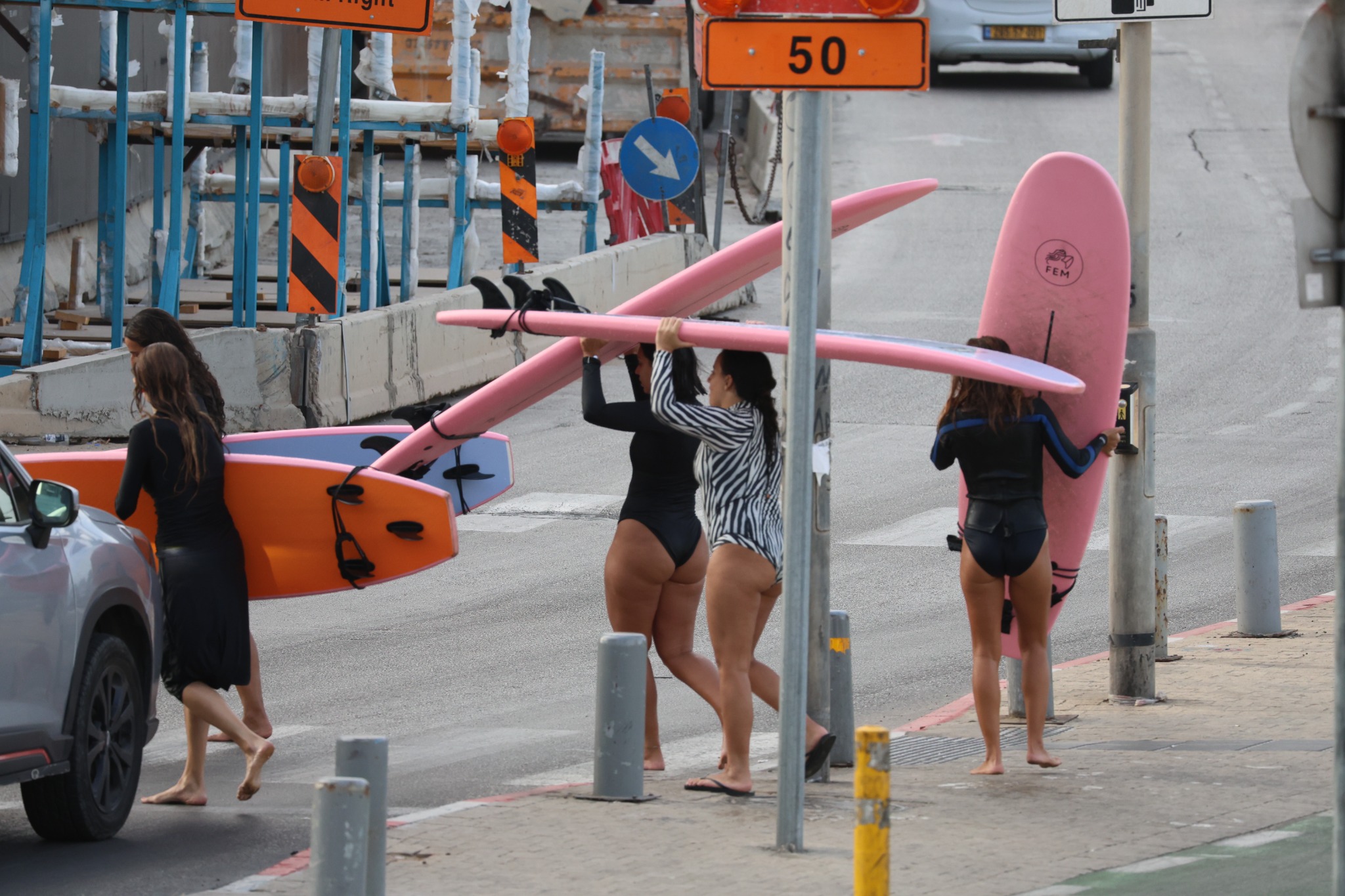
The sea is missing, which is partly why I like this photograph. Everything needed to suggest it is moving through the frame: surfboards, wetsuits, bare feet and the practical business of carrying something much longer than yourself. Everything else seems to belong to another picture. Concrete barriers. Construction materials. Traffic signs. A parked car. The city has supplied an obstacle course, and the pink boards are making their way through it.
One board runs almost horizontally across the centre, held above two heads. Behind it, another pink board climbs diagonally, its dark fins visible against the construction site. At the right, a rounded board stands nearly upright beside a surfer in a black wetsuit with blue detailing. A circular mark bearing the letters “FEM” sits near its nose. To the left, an orange board cuts across the lower part of the scene, with black fins and a loose leash hanging against its surface. The overlapping shapes briefly make it difficult to work out which board belongs to which person. That small puzzle keeps the eye busy.
The clothes add another rhythm. Black wetsuits repeat across the group, interrupted in the middle by a bold black-and-white striped suit. One surfer wears flip-flops; several others walk barefoot over the paving or road surface. A dark garment hangs around a figure at the left beside the car. Nobody has arranged these details into a coordinated colour scheme, yet the pink, orange and black hold together unusually well. The grey street does most of the work by giving the bright surfaces very little competition.
Except, of course, for the signs. An orange rectangle marked “50” hangs above the group. Below and to the left, a blue circular sign directs traffic down and right. Orange warning lamps and black diagonal stripes stand along the construction barriers. Blue metal storage frames rise behind them, holding pale wrapped materials. The picture is full of instructions, borders and things designed to stop people going where they should not. Across all that regulated geometry, a surfboard draws a long pink line of its own.
I am particularly fond of the pole through the middle. Fond may be overstating it; I would probably have preferred it somewhere else while taking the picture. It interrupts the horizontal board and partly conceals the striped suit. In a cleaner frame, the group would read more immediately. Here, though, the obstruction belongs to the same crowded street as the bollards and barriers. It gives the photograph the slightly exasperating physical quality of looking at something interesting from a position that is not entirely yours to choose. Street photography contains quite a lot of that.
There is a familiar visual promise attached to surfing: open water, a clean horizon, perhaps a figure carrying a board along an uncluttered beach. This photograph catches the logistics that sit outside that promise. Boards have to pass parked vehicles. Feet have to get across roads. People have to negotiate poles while carrying objects that catch on practically everything. The boards still suggest pleasure and escape, but they are substantial pieces of equipment in a place already crowded with equipment. The orange board and the roadwork signs look almost as if they have accidentally joined the same team.
It would be easy to turn the scene into a grand claim about the city or the people in it. I would rather stay with the evidence. We cannot see the water, establish the direction of the journey or know whether the group has just finished a session. We can see the effort of carrying the boards, the shared movement across the frame and the extraordinary colour that movement brings into an otherwise ordinary stretch of street. The destination remains outside the picture. That is enough to give it a little forward pull.
The people are not all doing the same thing at the same time, which helps. At the centre, arms reach up to support the horizontal board. At the right, the upright board demands a different grip and posture. At the left, the orange board disappears towards the car and the edge of the frame. Feet are planted, lifted or mid-step. The scene holds several small adjustments together rather than offering one decisive, easily isolated gesture. Looking longer means finding another elbow, another hand, another explanation for why that long shape is at that particular angle.
For a media gallery, I would want to preserve the full frame rather than crop tightly around the surfers. The construction site gives the pink its force. The signs supply a second set of bright shapes. Even the bollards in the foreground establish the awkward route through the space. A tighter crop might make a more immediately appealing picture of people with surfboards, but it would lose much of the encounter between the activity and its surroundings. Our article on media gallery layouts looks at that trade-off: the edges can be part of the subject even when they appear to be getting in its way.
I would also keep the caption modest. “Surfers carrying colourful boards past roadworks” gives us a useful description without supplying a location or a story we cannot verify. The longer response belongs here, where there is room to admit a preference, follow the colours and spend a perhaps unreasonable amount of time discussing a pole. That is one pleasure of a photograph-led publication. A street scene does not have to illustrate a larger argument before it deserves attention.
What stays with me is the horizontal board suspended across the group, absurdly pink against a collection of things designed to be durable, functional and grey. The roadworks will presumably change. The car will move. The people carrying the boards will pass out of view. For this instant, their paths share the same inconvenient space, and the city acquires a colour it did not plan for.