Palermo is a city that reveals itself in layers, and sometimes the most interesting view is not across a grand piazza or toward a magnificent Baroque church, but straight into the narrow space between two aging residential buildings. This photograph captures a different Palermo, one of weathered stone, crowded balconies, hanging laundry, tangled electrical cables, satellite dishes, air-conditioning units, and small patches of greenery struggling to find their place among centuries of accumulated urban life.
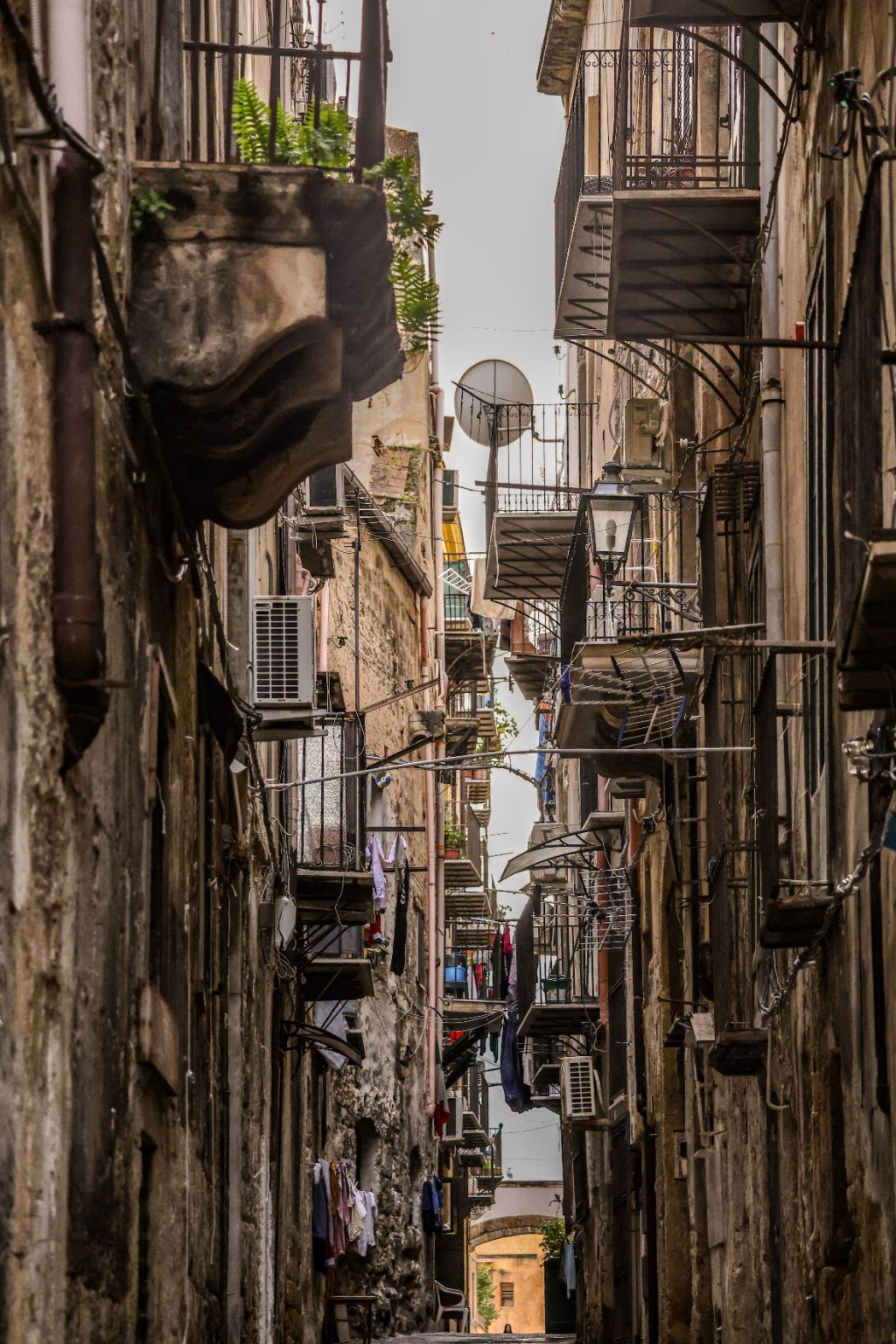
The photograph draws the eye through an extraordinary succession of architectural layers. On the left, an old projecting stone balcony dominates the foreground, its heavy curved underside darkened by age. A few ferns grow above its parapet. Across the alley, wrought-iron balconies project from the opposite facade, their railings and brackets creating a complicated pattern of lines. A traditional street lantern hangs among satellite equipment, metal supports, pipes, and cables. The buildings seem so close that their balconies are engaged in a permanent conversation across the narrow strip of sky.
Further down, air-conditioning units protrude from old walls, clothes hang from balconies, and bits of domestic life appear between shutters, grilles, and patched masonry. At the very bottom of the composition, beyond this dense vertical corridor, a sunlit ochre building appears through a distant archway. It provides a destination for the eye and a reminder that this enclosed passage continues into another part of the city.
The vertical framing is essential. A horizontal composition might have emphasized the narrowness of the alley, but the portrait orientation reveals its height, density, and remarkable accumulation of details. The viewer moves from the massive balcony in the foreground through successive levels of domestic architecture toward the distant arch. There is no single monumental focal point. The photograph invites exploration.
This is also a portrait of Palermo’s architectural resilience, though not necessarily in the romantic sense. Historic buildings accommodate modern electricity, television, cooling equipment, telecommunications, and household routines. The result is untidy, occasionally awkward, and visually fascinating. Practical requirements are written directly onto the architecture.
Palermo’s markets, churches, Norman palaces, and theatrical squares deserve attention, but residential streets show how the city actually functions. A line of laundry, a balcony plant, or an air conditioner may seem insignificant individually, yet together they produce the unmistakable character of a Mediterranean city that has never stopped changing.
Perhaps the most compelling quality of this image is that it makes no attempt to beautify Palermo. The rough surfaces remain rough, the cables remain tangled, and modern installations compete unapologetically with historic architecture. Even the pale sky concentrates attention on the crowded facades. Palermo is often described through its contrasts: grandeur and decay, elegance and disorder, history and contemporary life. This narrow alley contains all of them within a single frame.