The shape of a frame changes what you can put in it. It also changes where the picture ends up, which is why aspect ratios matter more than most people think.
Early television used 4:3, close to the shape of the standard film frame of the time. When high definition arrived, 16:9 became the standard for TV because it was a reasonable middle ground between old broadcast shapes and the wide formats cinemas had adopted.
The 16:9 ratio does suit this shot. The three walkers span the frame in a horizontal line, and the awning sign, the fence and the sidewalk all run sideways. A 16:9 crop cuts the empty ceiling and pavement that a taller frame would keep, so the group sits close to the middle. It’s also the standard shape for featured images and social cards, so it needs little re-cropping later.
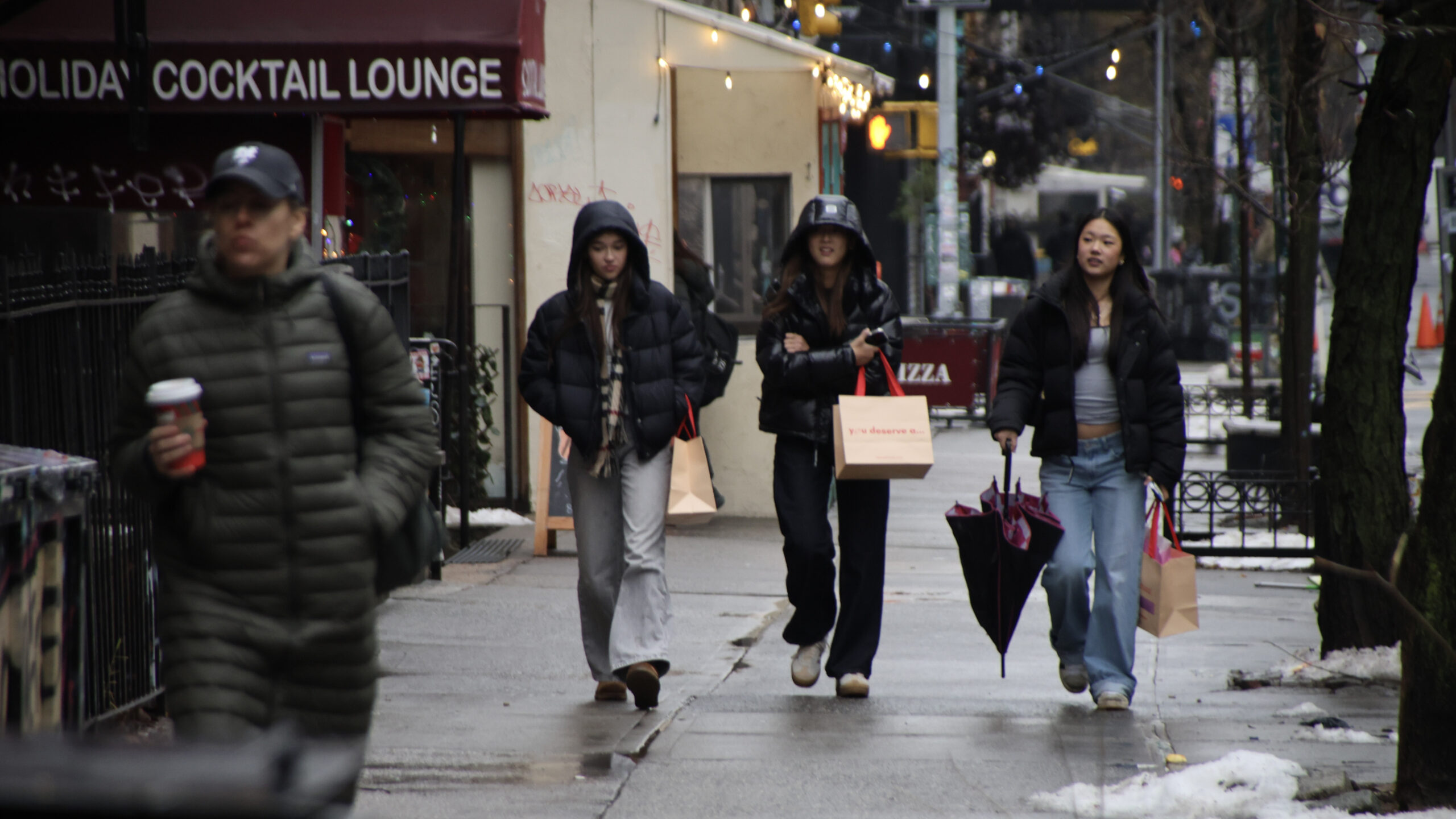
This is a candid street photo taken on a wet, overcast winter day, probably in a dense city neighborhood. The sidewalk is damp and dark, and slushy patches of snow sit along the curb and around the tree base at the lower right.
Three young women walk side by side toward the camera, all in puffer jackets. The one on the left has her hood up and wears a dark navy coat, a black-and-cream plaid scarf, light gray wide-leg pants and brown suede boots, with her hands in her pockets and a peach-colored shopping bag hanging from one arm. The one in the middle wears a glossy black puffer with the hood up. She hugs her arms to her chest, holds a phone, and carries a tan paper bag with red handles that reads “you deserve a…” in red lettering. She wears black wide-leg pants and cream sneakers. The one on the right has long dark hair and no hood. She wears a black puffer over a gray crop top and light-wash baggy jeans, with sneakers. She carries a folded burgundy-and-black umbrella in one hand and a pink-and-tan shopping bag in the other, and she looks off to the side.
A fourth person in the left foreground is deliberately out of focus. She wears an olive-green quilted down coat and a dark baseball cap, and she holds a red-and-white holiday coffee cup. Her blur pushes the eye toward the sharp trio behind her.
The background is busy and layered. On the left is a maroon awning with the white lettering “…HOLIDAY COCKTAIL LOUNGE”, a black iron fence, and graffiti-covered surfaces. In the center is a cream-colored building with faint graffiti and string lights. Farther back are a traffic signal glowing amber, a red bin marked “…IZZA”, an orange traffic cone, bare trees and a lamppost plastered with stickers. Bokeh from the lights softens the upper background.
The palette is muted and cool, with grays, blacks and wet-pavement tones. Small warm accents come from the maroon awning, the red bag handles and coffee cup, the burgundy umbrella, and the string lights. The lighting is flat and diffuse, as you’d expect under cloud cover. The mood is casual and holiday-season: people out shopping, bundled up against the cold, caught mid-stride.
The ones you’ll meet
Classic 35mm still photography is 3:2. Many compact cameras and phones shoot 4:3. Square, 1:1, got popular through social apps. Vertical video at 9:16 is what a phone gives you when you don’t rotate it, and platforms now build around that.
Cinema goes wider still. Some widescreen formats are more than twice as wide as they are tall.
What this means for a gallery
If your gallery crops everything to one shape, you lose the photographer’s intent. A tall portrait squeezed into a wide box loses a head. A panorama squeezed into a square loses the point.
Good galleries show images in their original shape, or crop with care. Bad ones crop by default and hope nobody notices.