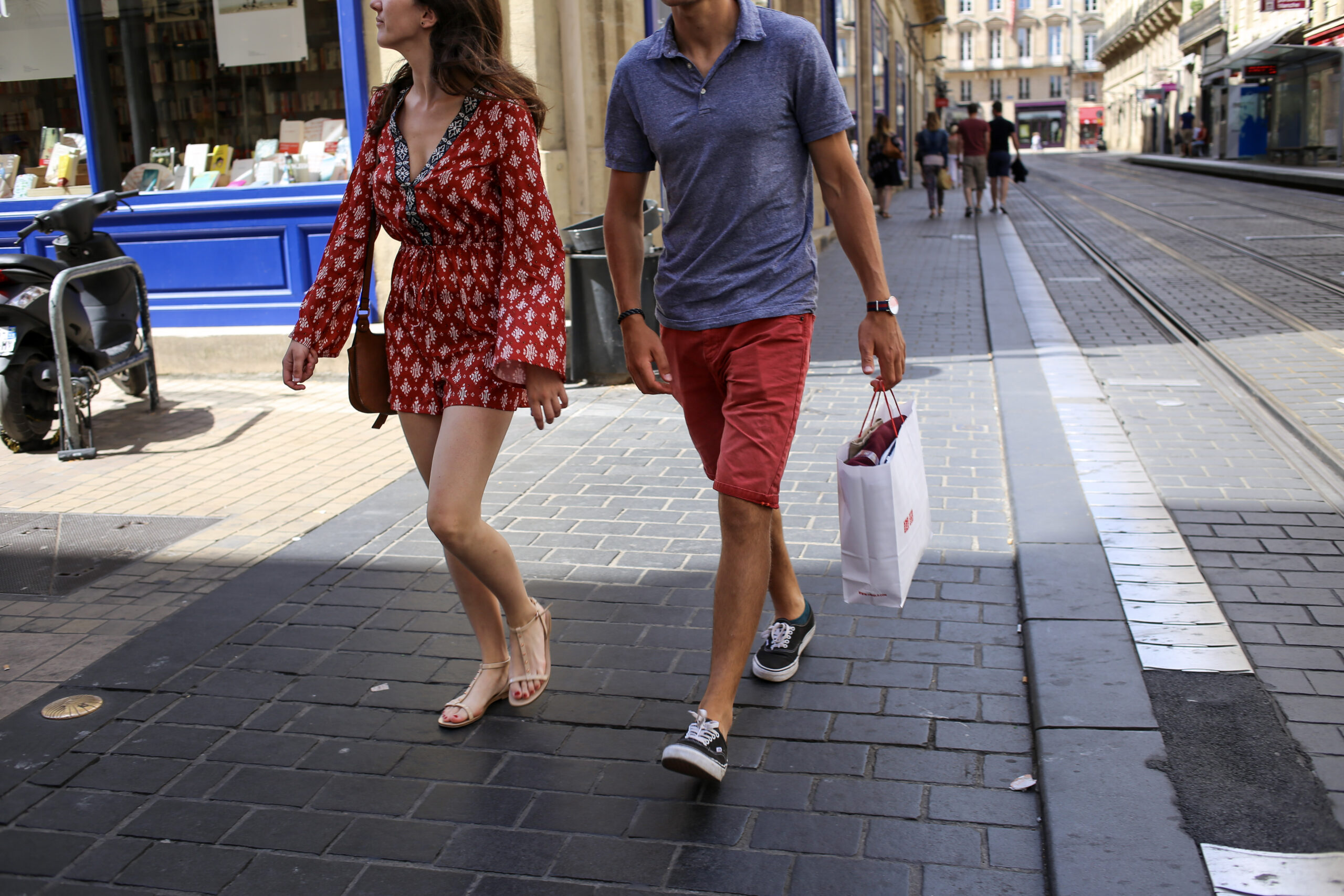
Two people walk past a blue shopfront on a bright day. She’s in a red printed playsuit with wide sleeves and flat tan sandals. He’s in a grey-blue polo, faded red shorts and black canvas sneakers, with a white paper bag swinging from one hand. Neither is looking at a camera, and one of them is looking at something out of frame entirely.
Nobody Here Is Selling Anything
That’s the first thing to notice, because it’s the one thing a fashion influencer can’t fake. There’s no ring light, no raised phone, no pause at the good spot in the light. The outfit was put on in a bedroom that morning for a day out, and the photograph just happened to catch it.
It’s also an outfit an influencer could post tomorrow. A boho playsuit, a soft polo, chino shorts, canvas sneakers. Every piece has an obvious match on a high-street rail, and a caption reading “summer city day” would do the rest.
The Product Is the Link
Followers think influencers sell clothes. Mostly they sell a click. The typical income is a commission when someone buys through the creator’s link, plus fees from brands that want a product seen. So the outfit has to do two jobs. It has to look good in a thumbnail, and it has to be buyable in about three taps.
That shapes what gets posted. Pieces that are in stock this month beat pieces that are better. A dress with a working link beats a dress from a market stall in a town nobody can find on a map. The look gets chosen for the checkout as much as for the eye.
- Burgundy Plaid, Red Fleece and Two Bags, How to Shop This City Look
- How Europeans Manage to Look Cool Without Trying Too Hard
- Quince Sells a 69.90 Dollar Cashmere Sweater With David Schwimmer as the Company Behind Calvin Klein and Coach Licenses Goes to Its CEO
- Qoo10 Japan Lets Shoppers Try On Color Contact Lenses and Scan Their Skin With Perfect Corp AI Before They Buy
- Amazon Prime Drops Grubhub for Uber Eats With No Delivery Fee on Orders of 25 Dollars or More
- Pink Sneakers and a Matching Headwrap Lift a Black Jacket and Jeans
- Vestiaire Collective The RealReal and Vinted Compared for Secondhand Luxury
- Affordable Alternatives to Louis Vuitton That Stand on Their Own
- What to Buy From BOSS for a Wardrobe That Works Beyond the Store Window
- What Every Travel Photo Leaves Out: Lisbon's Crowd, Wrocław's Empty Square and Venice's Rope
What the Feed Sands Off
Look at what the street version has that the feed version usually loses. The teal socks peeking out of the sneakers. The watch on a striped strap that doesn’t quite match anything. A woven bracelet, a shopping bag that clashes with the whole palette. Nobody stylist-checked these choices, and they’re the reason the pair looks like two actual people.
The bag matters most. Somebody bought something. A haul video shows you the purchase from every angle, while here the receipt is a paper bag with a weight to it. It’s the most honest object in the frame.
There’s a mirror effect going on, too. Influencers earn trust by looking like the street, and the street now looks like influencers. Wide-sleeved playsuits and washed-out shorts spread from feed to shop rail to pavement within a season. Sooner or later the two versions are impossible to tell apart, and only one of them came with an affiliate code.
What Influencers Still Get Right
None of this makes them useless. The good ones do the boring work: they try on thirty playsuits so you can buy the one that doesn’t gape at the neckline. That’s a real service, and people pay for it in clicks the same way they once paid for a shop assistant’s opinion. The trouble starts when the recommendation and the commission point in different directions, and the follower can’t see which one is talking.
The pair in the photograph aren’t recommending anything. That’s why anyone would look twice.