A fire has struck Paris’s Marché des Enfants Rouges, the historic covered market in the Marais. The loss is especially painful because this is not merely another commercial building. Dating to 1615, it is a living fragment of old Paris, a place where centuries of everyday French life remained visible amid a rapidly changing city.
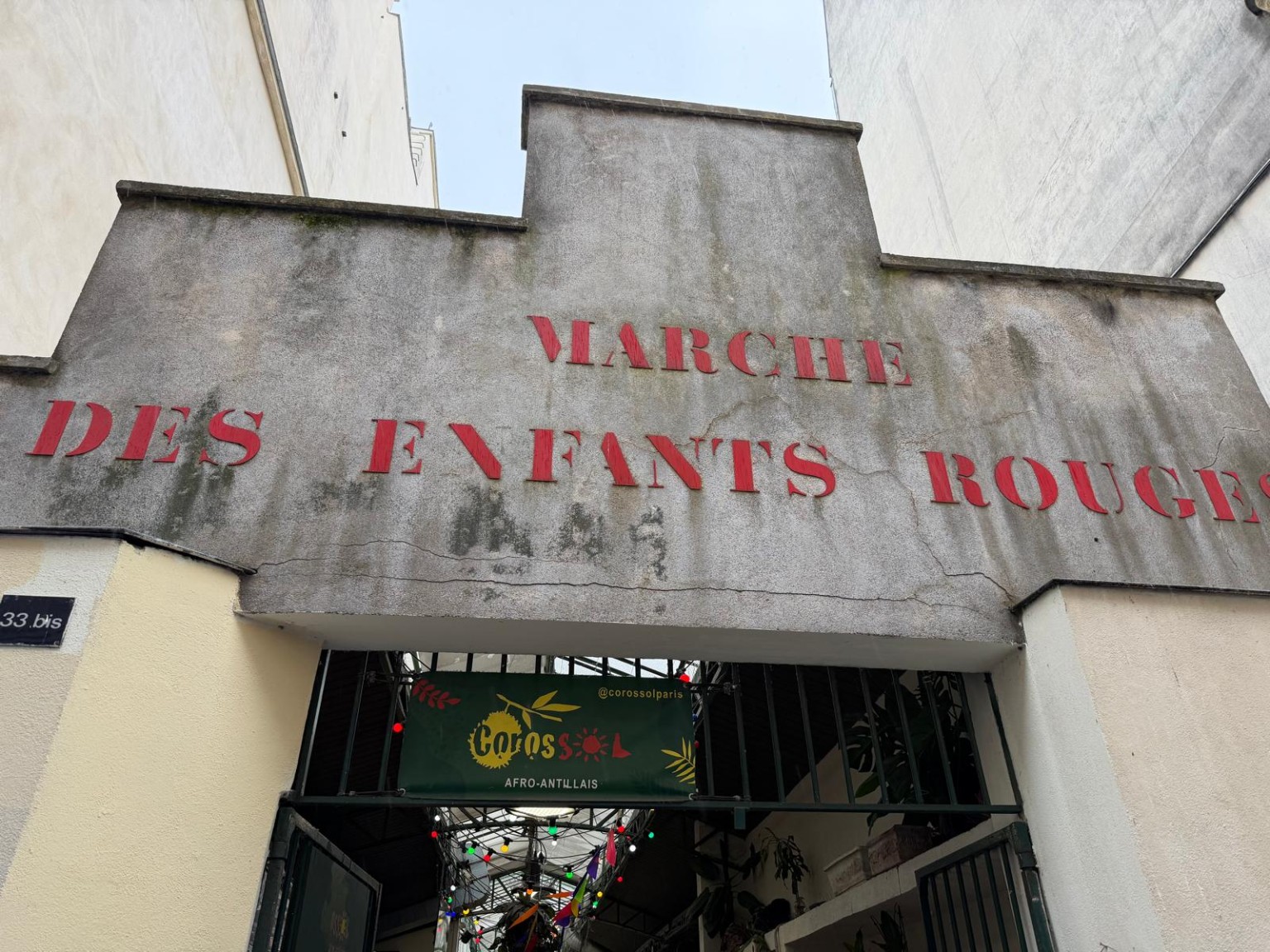
The photograph shows the market entrance at 33 bis rue de Bretagne before the fire. Its weather-stained gray facade bears large red letters spelling MARCHÉ DES ENFANTS ROUGES. Beneath it, dark green iron gates open onto the covered market. A Corossol Afro-Caribbean food sign, strings of colored lights and glimpses of the metal roof reveal a lively, multicultural food destination behind the modest historical frontage. The narrow view of sky between neighboring buildings, cracks in the old plaster and slightly uneven surfaces are part of its charm. Nothing looks staged or over-restored.
The market’s name, the Market of the Red Children, recalls an orphanage whose children wore red clothing. Over four centuries, the market evolved into a gathering place for food merchants, independent businesses and customers. It survived political upheavals and redevelopment pressures, including a late-twentieth-century struggle over its future. Places like this are among the reasons people love Paris: they remain useful and alive rather than being reduced to exhibits behind glass.
The cause of the fire deserves a careful investigation. Given reports of recent unrest in France, some observers may wonder whether arson is possible. That possibility should not be confused with evidence. No verified link between the fire and riots has been established, and accidental causes must be considered as well. Until investigators determine what happened, assigning responsibility would be premature.
There is nonetheless a deep sense of regret. Old France does not consist only of Notre-Dame, the Louvre or celebrated boulevards. It is also the small markets, iron gates, weathered storefronts, independent stalls and familiar streets that quietly connect modern life with the past. Every time one is destroyed, the city loses a little of the texture that makes it different from everywhere else.
This image has acquired an unexpected documentary value. A photograph of an ordinary entrance, taken on an ordinary day, can suddenly become a reminder of what existed before disaster. One hopes the market can be restored faithfully, that its merchants will return and that Paris will preserve the accumulated character of this extraordinary place rather than replace it with a generic modern development.