Some nations play football. Others prefer cricket, baseball or rugby. The French, of course, have elevated street demonstrations to something approaching a national sport. It has its traditions, its heroes, its uniforms, its unwritten rules and, occasionally, its spectacular clashes. It is played in city squares, along grand boulevards and outside government buildings. Paris provides the most celebrated stadiums, but practically every French town has a suitable venue.
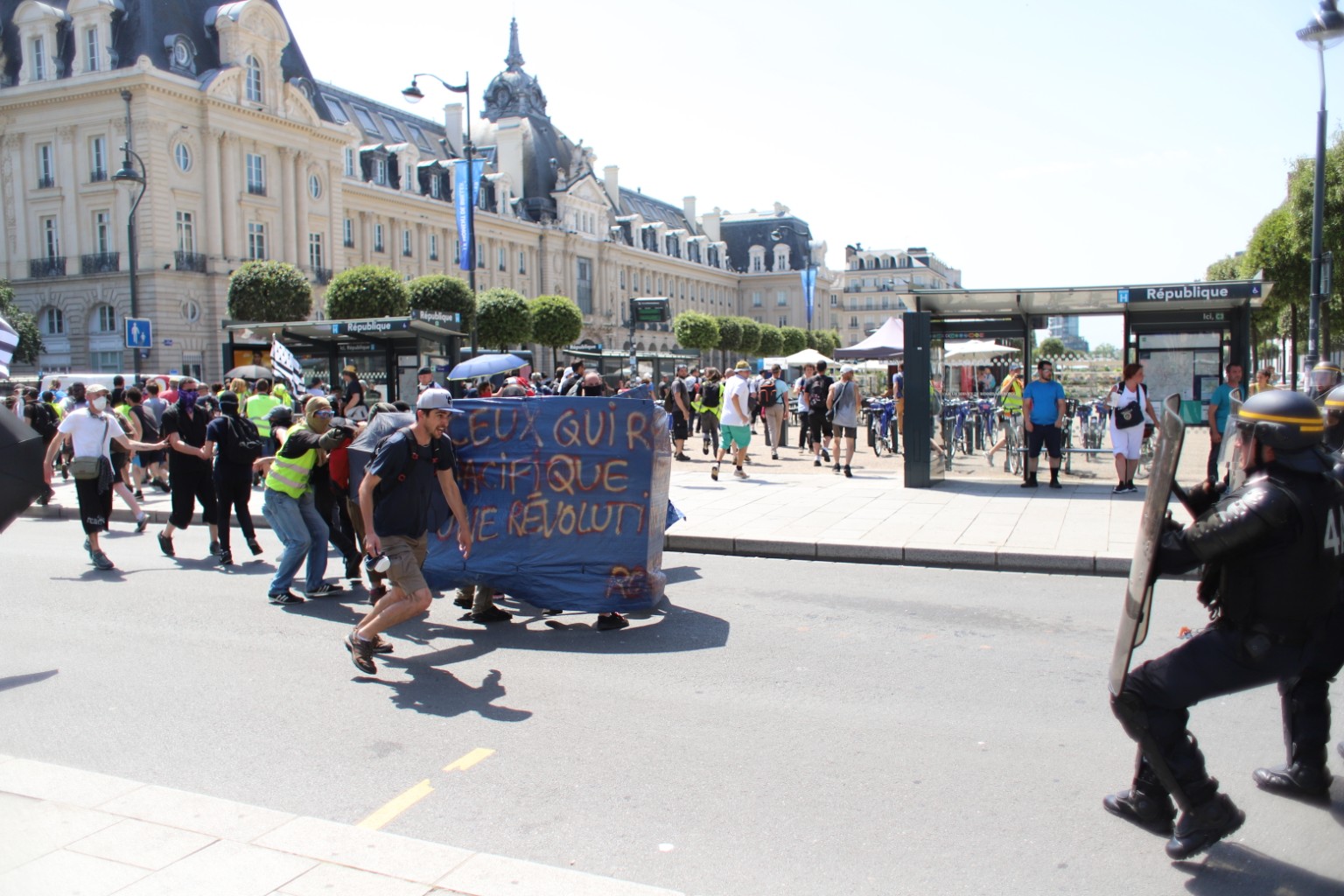
This photograph captures the sport in action at Place de la République, one of the great gathering places of French public life. The afternoon sun is blazing, the architecture is magnificent, and the usual assortment of participants has assembled. Protesters carry a large improvised banner, people in yellow safety vests mingle with the crowd, and a heavily equipped riot police officer stands at the edge of the action. Behind them, ordinary pedestrians continue their business, bicycles wait beside the metro entrance, and the elegant Parisian buildings look on with the indifference of structures that have witnessed considerably more dramatic events.
The location could hardly be more appropriate. République is not simply the name of a metro station or a square. It is a word deeply embedded in French political identity, a reminder that the modern French state emerged through revolution, conflict and a persistent suspicion of concentrated power. The French Republic was not handed down politely by a benevolent monarch. It was fought for, argued over, overturned, restored and reinvented. Several times, in fact. The French have had five republics, and the tradition of challenging authority has survived every one of them.
There is something wonderfully theatrical about a French demonstration. The handwritten slogans, the flags, the whistles, the chants, the improvised costumes and the inevitable police presence combine into a public performance that can be serious, angry, festive and faintly absurd, sometimes within the same few minutes. Not every participant necessarily shares the same political objective. Some arrive with carefully developed arguments, others with grievances that have been accumulating for years, and still others because something interesting is happening in the street. Yet together they create a spectacle that is unmistakably French.
The yellow vest became one of the most recognizable symbols of this culture during the Gilets Jaunes movement that began in 2018. What started as opposition to rising fuel taxes developed into a much broader expression of frustration over living costs, taxation, inequality and the distance between political elites and ordinary citizens. The genius of the yellow vest as a protest symbol was its simplicity. It was inexpensive, instantly recognizable and already present in millions of French cars. A compulsory piece of roadside safety equipment had become an unofficial political uniform.
The French approach to protest also reflects a particular understanding of citizenship. In many countries, political participation is largely associated with elections, party membership and occasional public meetings. In France, taking to the streets has long been regarded as another legitimate way of making oneself heard. The demonstration is not necessarily an admission that democracy has failed. For many participants, it is democracy operating at full volume.
Of course, the romance of protest looks somewhat different from behind a police shield. The officer in the foreground of this photograph is dressed for an encounter considerably less pleasant than an afternoon stroll through Paris. Helmet, body armor and protective shield provide a sharp contrast to the casual summer clothing of the demonstrators. It is a visual reminder that the French national pastime can turn rough, and that the relationship between the state and the street is not always a friendly one.
What makes the scene particularly interesting is the coexistence of confrontation and normality. A few meters from the demonstrators, people stand beside the metro entrance, apparently unconcerned. The city continues functioning around the protest. For visitors, such an encounter might seem extraordinary. For Parisians, it can be just another afternoon, perhaps an inconvenience to the bus schedule or an unexpected reason to take a different route home.
And this is precisely why street photography in France can be so rewarding. Public life is not hidden away behind closed doors. Political arguments, social tensions, collective frustrations and spontaneous expressions of solidarity regularly spill into streets and squares. The photographer does not always need to seek out a major event. Sometimes the event simply walks across the road.
The French did not invent political protest, and they certainly do not have a monopoly on public anger. But they have given demonstrations a distinctive cultural identity, one that combines revolutionary history, civic pride, organizational enthusiasm and a healthy appetite for confrontation. They may disagree about almost everything, including what exactly they are protesting against, but they rarely seem to disagree about the right to protest.
Football may have its World Cup, cycling its Tour de France and tennis its Roland-Garros. Street protest has République, Bastille and the boulevards of Paris. There are no official league tables, no referees everyone trusts and no universally accepted definition of victory. The matches can continue for weeks, sometimes months, and the same players may return for the next round.
A very French sport indeed.