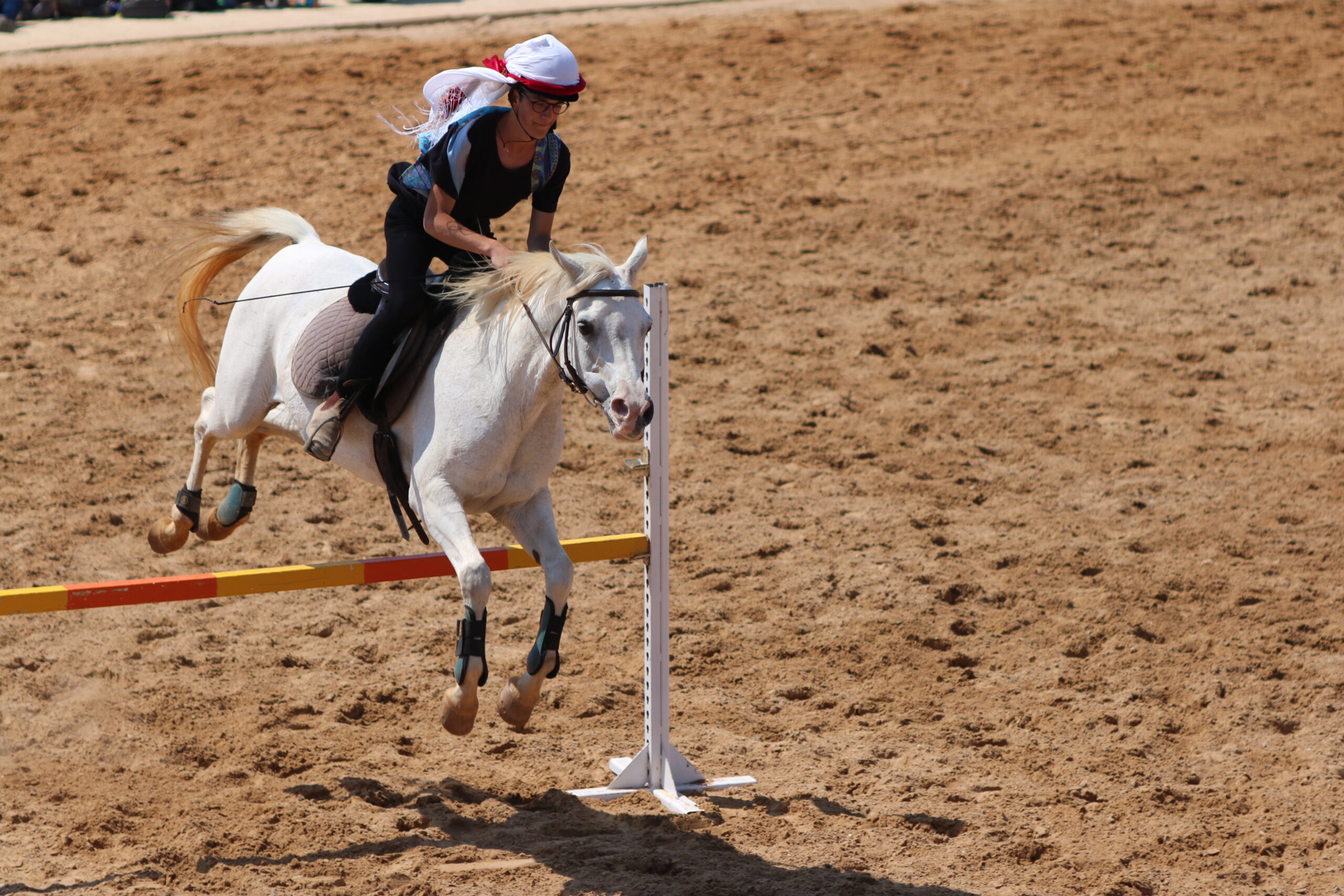
A grey horse clears a single orange and yellow rail in a sand arena, front legs reaching down for the ground, hind legs still folded up under the belly. The rider leans forward in black, a white headscarf held on by a red band, its loose end and fringe blowing back over her shoulder. Nothing is touching the sand. The shadow lies under and behind the horse, cut off from the hooves by a strip of bright ground, and that strip is what makes the picture.
A late frame that shows more
Every jump gives a photographer a handful of usable moments. Takeoff, with the hindquarters loaded. The top of the arc, knees up and level over the pole, which is the frame most people are hunting for. Then the descent. This one is the descent, a beat past the textbook shot, and it’s better for it.
At the top of the arc a horse looks like a statue. Here it looks like it’s going somewhere. The forelegs are already stretched toward the landing, the ears point forward, and the eye is fixed on the ground past the rail. You can read the next half second from the frame. The hind legs haven’t caught up yet (they’re still tucked, the bottoms of the hooves turned to the camera) so the body is caught mid-transfer, weight moving from back to front.
The shadow settles any doubt. Separate from the horse, it’s the proof this was taken in the air and not a few centimetres off the ground.
Horse and rider, up close
Horse people would call this a grey, not a white. The giveaway is the pink skin showing through around the muzzle and nostrils. The tail is carried high and flagged out behind, the way you’d expect from an Arabian type. Tendon boots in front, fetlock boots behind. A plain brown bridle.
The rider has pushed her hand up the crest of the neck and let the rein go soft, which gives the horse its head to balance on landing. That part is done well. Her lower leg has slipped back and the heel is up, so she’s riding on her knee. An instructor would flag it. A photographer can live with it, because the forward lean carries the diagonal of the whole frame from the scarf down through the neck to the front hooves.
The costume says this isn’t a graded class. A headscarf with a streaming fringe, an embroidered strip across the chest, a whip laid along the horse’s side. This is a display round, the kind put on at a festival or a stable open day, and the edge of a crowd is just visible at the top left of the frame.
Why a low rail works for pictures
Big fences photograph as height and effort. A low rail photographs as movement. The horse doesn’t have to throw itself upward, so the jump is flatter and longer, and the shape stretches across the frame instead of stacking up.
The colour does a lot of quiet work too. Warm sand chewed up by hoofprints from earlier rounds. A white horse. A rider in black. Then three small hits of hot colour that echo each other: the orange of the rail, the red band on the headscarf, the red in the scarf’s pattern. Hard midday light flattens most arena shots. Here it bleaches the horse bright enough to lift it clean off the ground behind it.
The rail stayed up.