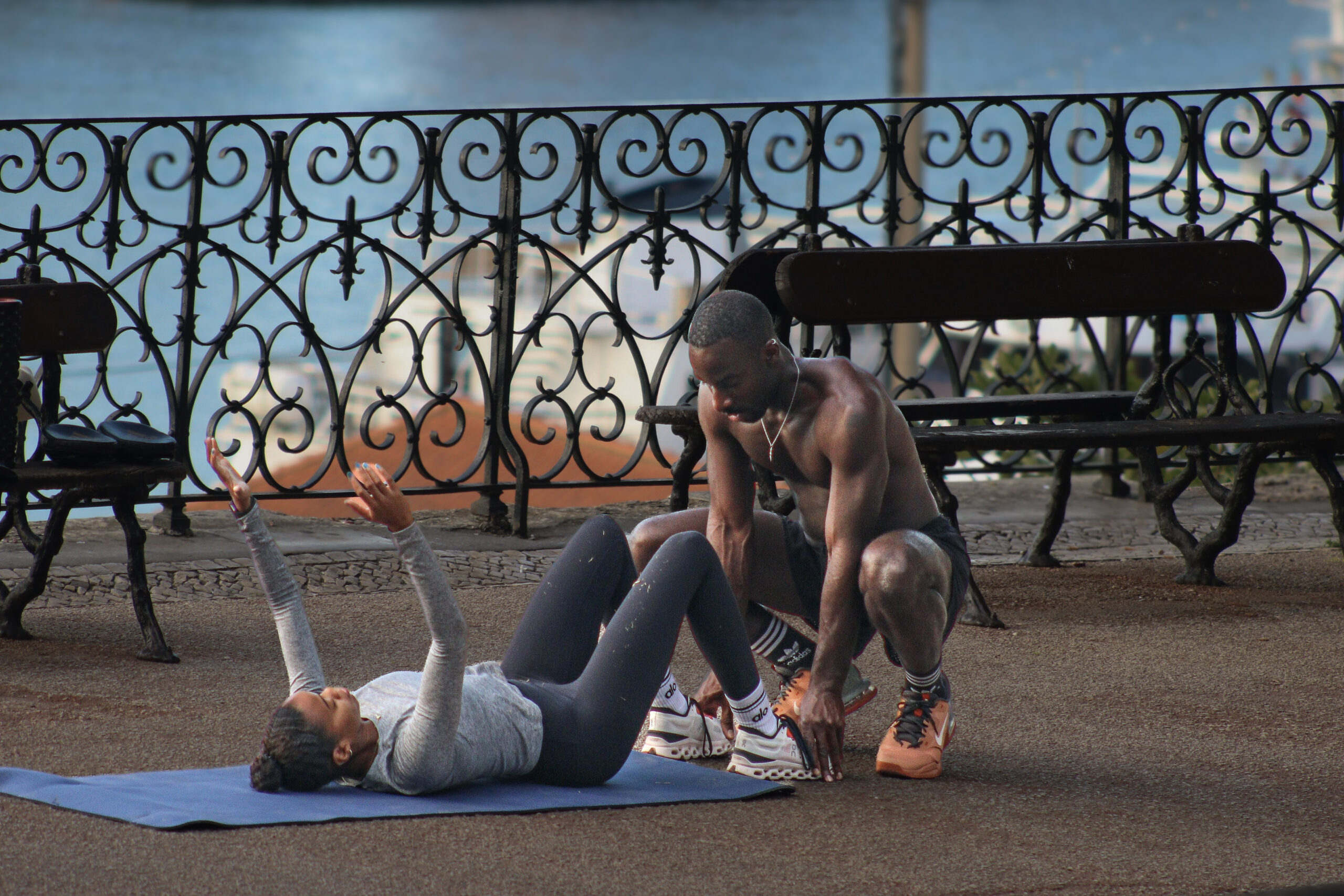
A woman lies on a blue mat with her knees bent and both arms reaching straight up, caught at the top of a sit-up. A man crouches over her feet with both hands pinning them to the ground. Behind them a black wrought-iron railing runs the full width of the frame, and past the railing there’s water and a blur of white boats.
Two bodies on one diagonal
The frame is built on a slope. Her raised arms and his bent back sit on one line that runs from the lower left up to the bench at the right. Her hands are the highest point on the left side, his head is the highest point on the right, and the railing behind holds both. The mat is the only patch of saturated blue on the ground, which pulls the eye to the lower left first and then across.
The exercise
She’s mid-rep with her eyes closed, hair in braids pulled into a bun that rests on the mat. Neither of them is looking at the lens; he has his head down, watching her feet. He’s the anchor. Without someone or something holding the feet, a sit-up on a flat surface turns into a slide, so he crouches and takes the load through his hands. It’s a simple partner drill and it needs no gear, which is why it works on a public terrace.
There is some gear anyway. Two dark pads or weights sit on the left-hand bench, next to a dark bottle or bag cut off by the edge of the frame.
Ironwork and benches
The railing is the real subject of the background. It’s a run of scrolls and pointed arches, each panel a copy of the last, with small fleur-de-lis finials on the posts and a top rail that curls over in a repeating wave. The benches are cast iron with slatted wooden backs and legs shaped like tree branches. It’s old-style park furniture; someone put it here so people could sit and look at the water, and today two people are using the ground beside it to do sit-ups.
Between the railing and the exercise surface there’s a strip of small stone paving laid in a pattern, the kind of mosaic pavement you see on old European waterfronts. The working surface is different: dark, smooth and a little gritty, and much better for a mat.
The water and the boats
Behind the railing the frame turns soft. Blue water fills the top, white hulls sit stacked and smeared in the middle, and a patch of terracotta roof shows through the ironwork just left of the man’s head. None of it is sharp enough to read as a specific place, which is useful. It says “harbour” and nothing more, so the eye stays on the two people and on the pattern of the railing.
What they’re wearing
The clothes are worth a look because they tell you it’s real exercise. She’s in a heathered grey long-sleeve top and black leggings, with white running shoes that have a chunky, pod-style sole and white ankle socks marked “alo”. He’s in dark shorts, a thin chain, black-and-white Adidas crew socks and orange Nike trainers. The orange shoes are the loudest colour in the picture after the mat, and they land right where his hands meet her feet.
Light and lens
The light is low and warm. It catches his shoulders, back and knee and leaves her side of the frame in a cooler shade. The shot looks like it was taken with a long lens from some distance: the space between the people and the railing is squeezed, the background boats melt away, and the ironwork stays crisp enough to count the scrolls. A wider lens would have shown more of the terrace and lost the compression. A closer one would have put the photographer in the exercise.
She reaches up. He holds her feet down.