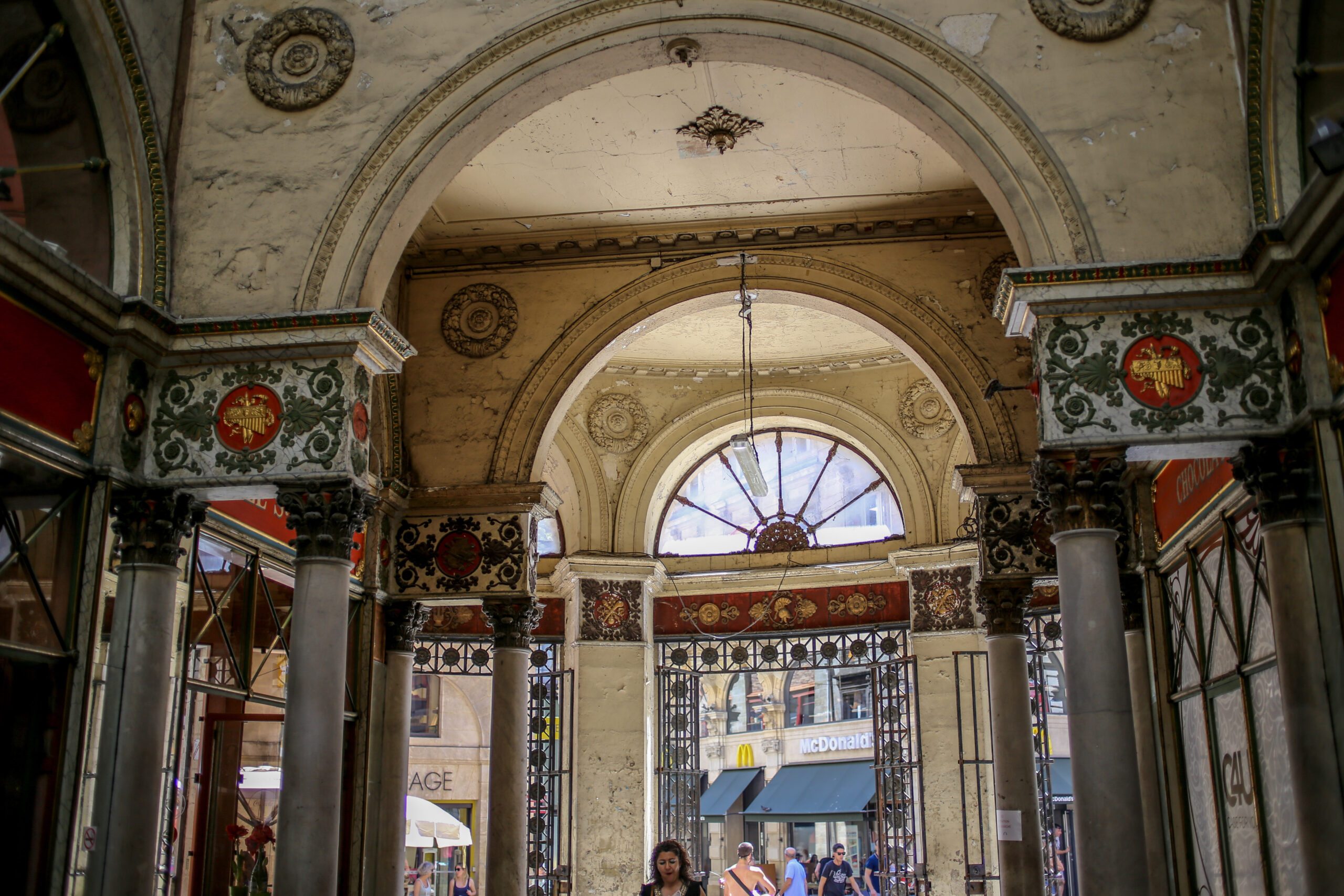
Three arches sit inside each other like nesting bowls, and the smallest one holds a half-round window with a bright street showing through it. Under the arches, grey columns with carved capitals run toward an open iron gate. Beyond the gate there’s a McDonald’s sign. The plaster overhead is cracked, and a bare tube light hangs on a cable in front of the glass.
An arch inside an arch
The picture runs on one repeat. There’s the big outer arch, then a middle arch with a moulded rim, then the half-round window at the back with iron bars fanning out from a small carved shell. Each step is smaller and brighter than the one before, so the eye slides down the tunnel and lands on the glass. The two capital blocks at left and right sit at almost the same height. That keeps the frame square even though the camera is tilted up a little.
Paint and gilt
Somebody spent real money here. The blocks above the columns are pale marble-look panels with dark green scrollwork, and in the middle of each one is a red roundel holding a gilded emblem, a bundle that reads as pan pipes tied with ribbon. Smaller gold medallions run along a red frieze under the window. The columns below carry Corinthian capitals with the leaves picked out dark. Round plaster rosettes are scattered across the arches, and a fan-shaped ornament hangs at the crown of the outer one. Red panels at either side frame the shop windows.
This is a room designed to make you slow down and look at what’s for sale.
What the years did
Now look at the surface. The outer arch is cracked across its top, with a patch of plaster gone at the upper right. Paint has lifted in flakes. The ceiling of the middle arch has turned the colour of weak tea. Someone ran a black cable across the frieze and left it in a loose loop, the tube light sags on its own wire, and a modern lamp housing (the kind that gets screwed onto anything) sits in the top right corner.
Nobody has tried to hide any of it. The shopfronts on both sides look kept up; the ceiling above them doesn’t, and a shared ceiling tends to belong to nobody.
The gate and the golden arches
The gates stand open, wrought iron with round bosses set in a grid. Past them is the far side of the street: dark green awnings, the McDonald’s sign, and a shopfront at the left with a sign that ends in AGE. A woman in a dark top and a gold necklace walks toward the camera with her eyes down. Behind her, men in sunglasses and short sleeves cross the gap, one with a bag strap slung over his bare chest. They fill about a tenth of the frame’s height and give the arches their scale.
Two eras of retail share this frame. One was built to sell to people who could afford a covered walk with gilt overhead. The other sells lunch to whoever is passing, and it got the best view.
Shade, sun and the highlights
The exposure is tricky and it holds. The street is in full sun while the passage is in deep shade, yet the window doesn’t blow out. You can still make out buildings through the glass, and the McDonald’s sign keeps its colour. The shade side stays warm, with ochre plaster and red panels reading as one palette. The columns at the bottom edge drop into near black, which is the right call. Lift them and the frame goes flat.
The arcade was built for shoppers. It still has them.