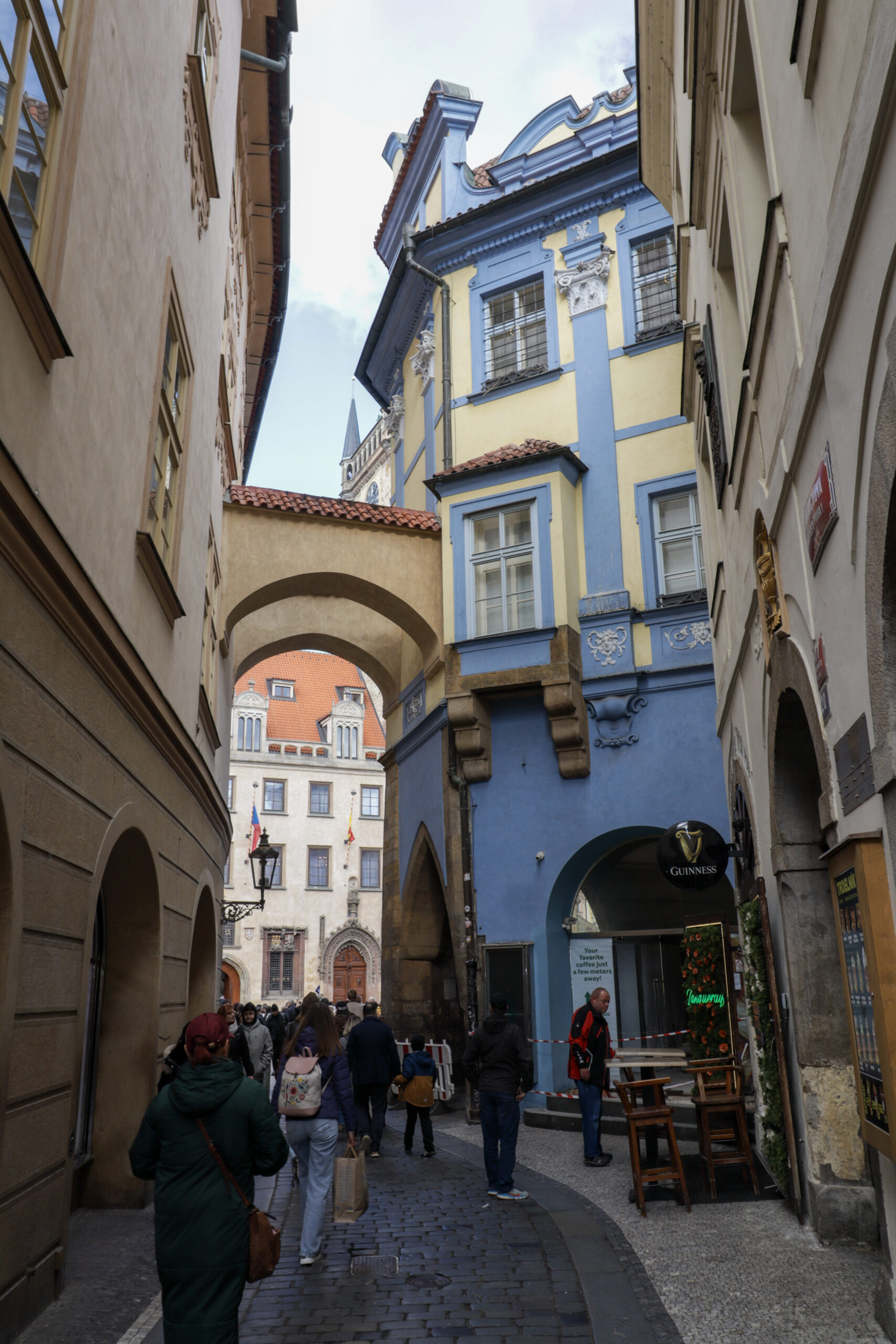
A curving cobbled lane in Prague squeezes between tall cream walls and opens on a powder-blue house with yellow panels. Above the lane a covered arch links the buildings on either side, and through the arch a paler building with an orange roof and two flags stands in soft light. On the ground, a slow stream of walkers passes a pub entrance with a black Guinness sign over the door.
The blue house
The house is the loudest thing here. The upper floors are pale yellow with blue trim: blue window surrounds, blue vertical strips, a blue cornice, a blue scrolled gable with a curl at the top. White stucco does the small work. There’s a Corinthian capital at the head of one pilaster, a pair of carved faces under the windows, and leaf scrolls between them. A window bay juts out over the street on heavy brown stone brackets, and below it the wall drops into plain blue plaster. It’s a Baroque paint job on a very old body.
Arch over the lane
Left of the house, a plastered arch with a terracotta tile roof crosses the lane at first-floor height. It works as a bridge between two buildings, and it works in the picture as a frame inside the frame. Through it you see the building at the end of the view: cream walls, an orange roof, two flags on poles (one is the Czech flag), rows of small windows and a carved Gothic-style portal with a wooden door. A black lantern-style lamp on the left wall points the same way. Behind the roofline to the left of the blue house, a thin spire with a clock face shows up in the gap.
What’s at street level
The bottom of the blue house is older than its clothes. A pointed arch in dark stone sits at street level, the kind of shape that says Gothic, and next to it a round arch of blue plaster has been made into a pub entrance. The Guinness sign hangs from it. A green neon script for Tanqueray glows on a stand beside a screen covered in orange flowers, and a poster on the door promises in English that “your favorite coffee” is only a few meters away. The street speaks the language of the people walking it.
A few bar stools stand on the paving with a table, held back by red-and-white tape. A man in a red-and-black jacket waits behind it, and a white plastic barrier stands further up the lane, so something on this block is either shut or getting ready to open.
The crowd
The walkers give the frame its scale and its rhythm. A woman in a dark green coat with a brown crossbody bag fills the lower left edge with her back to the camera. Just ahead, another woman in jeans and a blue quilted jacket carries a paper shopping bag and a backpack embroidered with flowers. A child in a blue-and-orange coat goes along beside a man in dark clothes, and further up a knot of people blends into the shade under the arch. Most of them are heading the same way, toward the light at the end of the lane.
The curve and the cobbles
The lane bends from the lower left to the right, and the paving does the work of an arrow. Dark, damp-looking cobbles run up the left side, edged with a strip of granite, and a lighter mixed paving takes over on the right where the pub sits. The eye follows the curve up past the tables, past the blue wall and up to the arch.
Shade, lens and sky
It’s a vertical frame shot in flat, cool light, in a lane too narrow for the sun to reach. The walls lean in as they rise because the camera is tilted up, and they leave only a thin wedge of sky at the top. The exposure keeps that sky from blowing out, which keeps the roofline crisp. The blue and yellow of the house look brighter than they are because everything around them is beige and grey.
The tape says closed. The lane is open.