A pride parade has two crowds. One marches. The other points cameras at the marchers, and by midday it gets hard to tell which crowd you’re in.
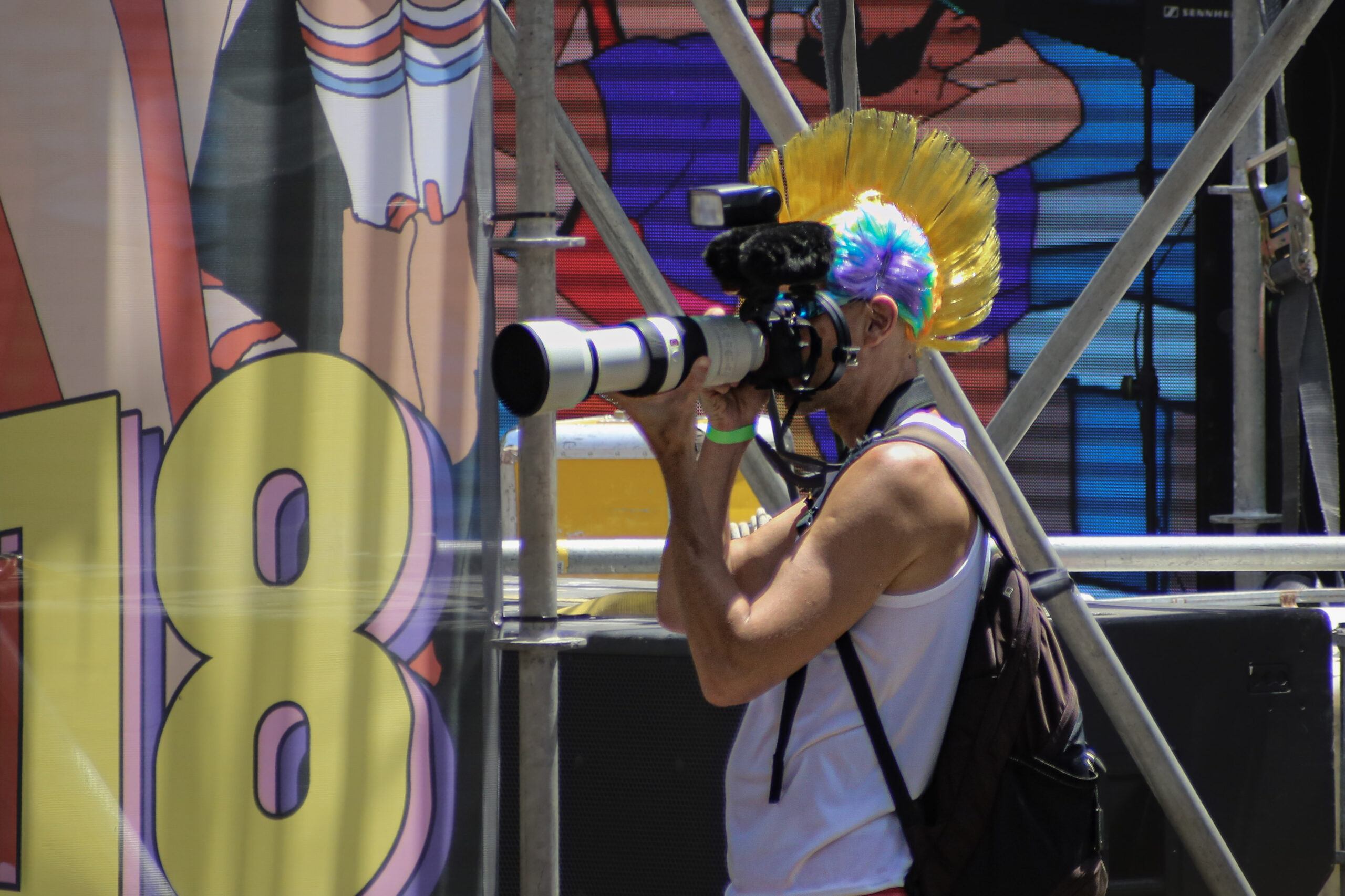
Take the man in the first frame. He’s standing in front of the main stage while the crew is still bolting it together, and he’s dressed for the party and for the job at the same time. Gold mohawk wig, a rainbow wig underneath it, white tank top, a heavy backpack. His rig is serious kit: a long white telephoto lens, a camera cage, a shotgun mic in a furry windscreen and a small light on top. The green wristband says he can get into places most people can’t.
Behind him the backdrop does half the work. There’s a cartoon banner with a fat yellow “18” in bubble lettering, and striped socks and bare knees dangling in from the top of the frame. On the stage an LED screen plays a cartoon figure in big flat blocks of red and blue. Scaffolding poles cut across all of it on the diagonal. He’s shooting something off to the left that we never see (a strange feeling in a picture of a photographer), so you end up looking at him instead of at whatever he’s looking at.
Out on the Route
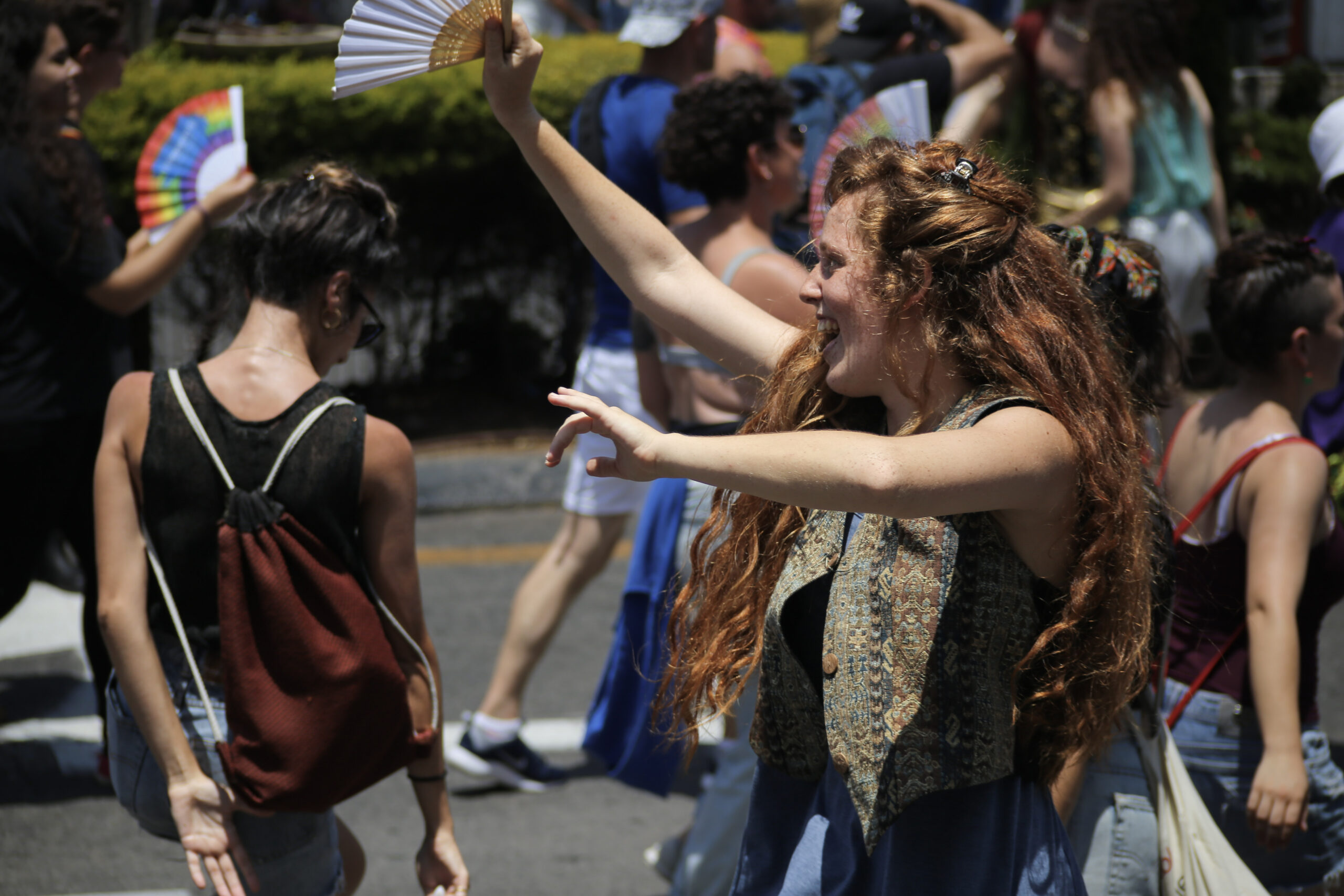
The second frame is out on the street. The road is packed and nobody is really walking in a line anymore. A young woman with long red curls, half of them pinned up with a clip, is mid-shout with one arm high and a white paper fan snapped open in her hand. Her other arm reaches toward someone just past the edge of the frame. Freckles. A woven tapestry vest over a navy dress. She could be calling a friend over, or just calling out to everyone.
Fans are all over this crowd. There’s a rainbow one to her left and another half hidden behind her head. On a day this hot they get used for cooling off, and for snapping open on the beat whenever the music picks up.
In front of her a woman in a black mesh top walks away from the camera, head down, a dark red drawstring bag on her back. She’s the counterweight in the picture. One person turned out and loud, one turned away and quiet, both inside the same parade.
Two Ways of Showing Up
Put the two frames side by side and they’re about the same thing from opposite ends. The photographer made himself part of the spectacle so he could work inside it without sticking out. The woman with the fan isn’t working at all. She’s there for the moment and she’s giving it everything she’s got, arm up, mouth open, hair everywhere.
Neither of them is posing. That’s what parade photography is after when it goes right: people too busy being themselves to notice the lens.
He’s looking at something else. So is she. Good.