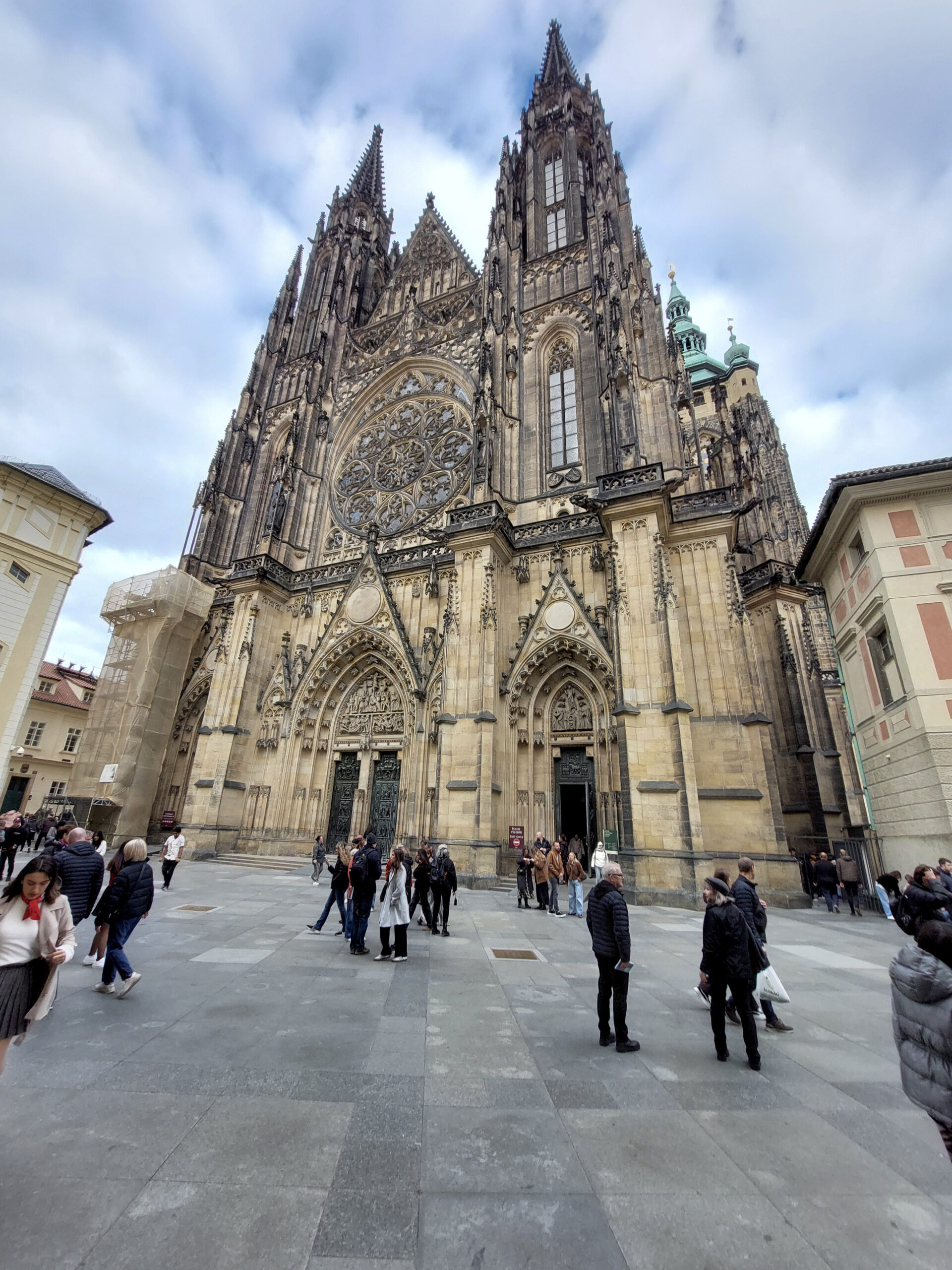
Two black spires, a rose window and three doorways fill a vertical frame from top to bottom, and a crowd in dark puffer jackets drifts across the paving in front. It’s the west front of St Vitus Cathedral inside Prague Castle, shot from the middle of the third courtyard on a mid-October afternoon under heavy cloud. The camera is a phone, tilted up so far that the towers lean in toward each other.
A Gothic front that isn’t old
Everything about this façade says fourteenth century: the pointed arches, the crocketed pinnacles, the lace of stone tracery around the rose window. The foundation stone went in back in 1344 under Charles IV, with Matthias of Arras as the first architect and Peter Parler taking over after him. Then work stopped. The east end and the great south tower were built; the west end stayed unfinished for hundreds of years.
What you see here is the completion campaign. It ran through the nineteenth century and into the twentieth, with architects Josef Mocker and later Kamil Hilbert working from the medieval plans and style. The cathedral was declared finished in 1929, almost six centuries after it started. So the “medieval” front in this picture, as a finished building, is less than a hundred years old.
Two tones of stone
The colour tells the story of maintenance. The lower storey is a pale honey sandstone, sharp at the edges, and it reads as recently cleaned. Higher up, around the rose window and along the spires, the stone is black. That’s soot and weather on the same material; the towers simply haven’t had the same treatment yet. The change in tone runs across the front at about the height of the balustrade under the rose window, a line you can follow from one side of the frame to the other.
Doors, glass and a green cap
Each doorway sits inside a stack of arches, with a carved relief filling the space over the doors. A pair of dark doors sits under the gable at the left, and a single door under the gable at the right has a small sign beside it marked exit. Above them the rose window carries stained glass from the 1920s, part of the same finishing job as the stone.
Look right, behind the spire, and there’s a green copper cap with a gold finial. That belongs to the older south tower and it’s from an entirely different century and a different style, which makes it the visual reminder that this cathedral was assembled in pieces over a very long time.
Scaffolding and scale
At the lower left, a stack of scaffolding wrapped in beige netting climbs the side of the façade. Something is always being repaired on a building this size. The crowd below gives the scale away: a woman in a beige coat and red neckerchief at the left edge, a man in a black puffer standing with a leaflet in his hand, a woman with a white shopping bag, groups pooled near the doors. Even the biggest figures reach only up to the first band of carving. The spires are about 80 metres tall, and at this angle they look taller.
What a phone’s wide lens does
This was taken on a phone, and the ultra-wide camera is doing the work. It swallows the full height of the front from close range, which a normal lens can’t do in a courtyard this size. The price is distortion. The towers converge, the paving stretches across the bottom third, and the person at the right edge is bulked up by the lens (a grey puffer, almost cut off). The pale granite slabs in the foreground vary in tone from panel to panel and give the eye a flat, quiet floor to cross before it climbs.
It took almost six centuries to finish. The people below are just passing through.