Sunset is a moment. Twilight is the stretch of time after it, split into three stages by how far the sun has dropped below the horizon. Dusk marks the end of a stage, though in everyday speech it just means the dim tail end of the evening. For photographers the difference is practical: the sky keeps giving color and usable light for half an hour or more after the sun disappears, and most people pack up right as it gets good.
Sunset is one moment
Sunset is the instant the top edge of the sun drops below the horizon. That’s all it is, which is why an app can give it to the minute.
The published time already allows for refraction. Air bends sunlight on the way in, and near the horizon it lifts the sun’s image by a little more than the sun’s own width. So when the bottom of the sun seems to touch the sea, the actual sun is already completely below the horizon. For those last few minutes you’re watching an image the atmosphere is holding up.
Two catches. The official time assumes a flat, clear horizon (open sea, basically), so hills or a skyline to the west can hide the sun several minutes early. The time also says nothing about color. A sunset can look flat at the moment itself, then light up ten or fifteen minutes later when the sun, now below the horizon, catches high clouds from underneath.
Twilight comes in three stages
Twilight is the period when the sun is below the horizon but still lighting the upper atmosphere, which scatters some of that light back down to you. The stages are set by how far the center of the sun sits below the horizon:
| Stage | Sun below the horizon | What you see |
|---|---|---|
| Civil twilight | Sunset to 6° | Enough light to see without lamps; most of the evening’s color |
| Nautical twilight | 6° to 12° | Deep blue sky; bright stars out while the sea horizon is still visible |
| Astronomical twilight | 12° to 18° | Night to most eyes; a faint glow still hides the dimmest stars |
The names come from what each stage was good for before electric light. Civil twilight was enough for ordinary outdoor work. Nautical twilight belonged to sailors: a navigator taking a star sight with a sextant needs the star and the horizon line at the same time, and this stage gives you both. Astronomers wait out the last stage entirely; faint galaxies and nebulae only show once it’s over.
There’s a morning twilight too, running the same stages in reverse and ending at sunrise.
How long it lasts depends on latitude and season. Near the equator the sun drops almost straight down, and civil twilight is over in about 20 minutes. At mid-latitudes it runs about 25 to 45 minutes, shortest around the equinoxes and longest in midsummer; full dark comes an hour to two hours after sunset. North of about 48.5 degrees (which takes in Paris and London) the sun never gets 18 degrees down around the June solstice, so for weeks the sky doesn’t reach full darkness at all.
Dusk is where each stage ends
Dusk is the word that muddles things. Strictly, it’s a moment: the end of a twilight stage. Each band in the table closes with its own dusk (civil at 6 degrees, nautical at 12, astronomical at 18). Dawn is the morning mirror, marking where each stage begins.
In everyday use, dusk is the darker end of the evening, when colors drain away and you start wanting lights on. Both meanings are fine. Just know which one you’re looking at when an app prints a dusk time to the minute; it’s usually civil dusk.
Where golden hour and blue hour fit
Golden hour and blue hour are photographers’ terms, and nobody official defines them, so the numbers shift depending on who you ask. Golden hour is mostly before sunset, while the sun sits in the last 6 degrees or so above the horizon; some definitions stretch it a few degrees past sunset. Blue hour lives inside twilight, usually put somewhere between 4 and 8 degrees below the horizon (the back half of civil twilight running into nautical). It’s rarely an hour. At mid-latitudes it’s closer to 20 minutes, sometimes less.
Much of that blue comes from ozone. During twilight, the sunlight reaching the sky overhead has taken a long, grazing path through the ozone layer, which absorbs a broad band of light centered on orange. What scatters down to you is weighted toward blue. That’s why the sky overhead turns a deep, even blue while the horizon under the sunset is still orange.
Shooting twilight
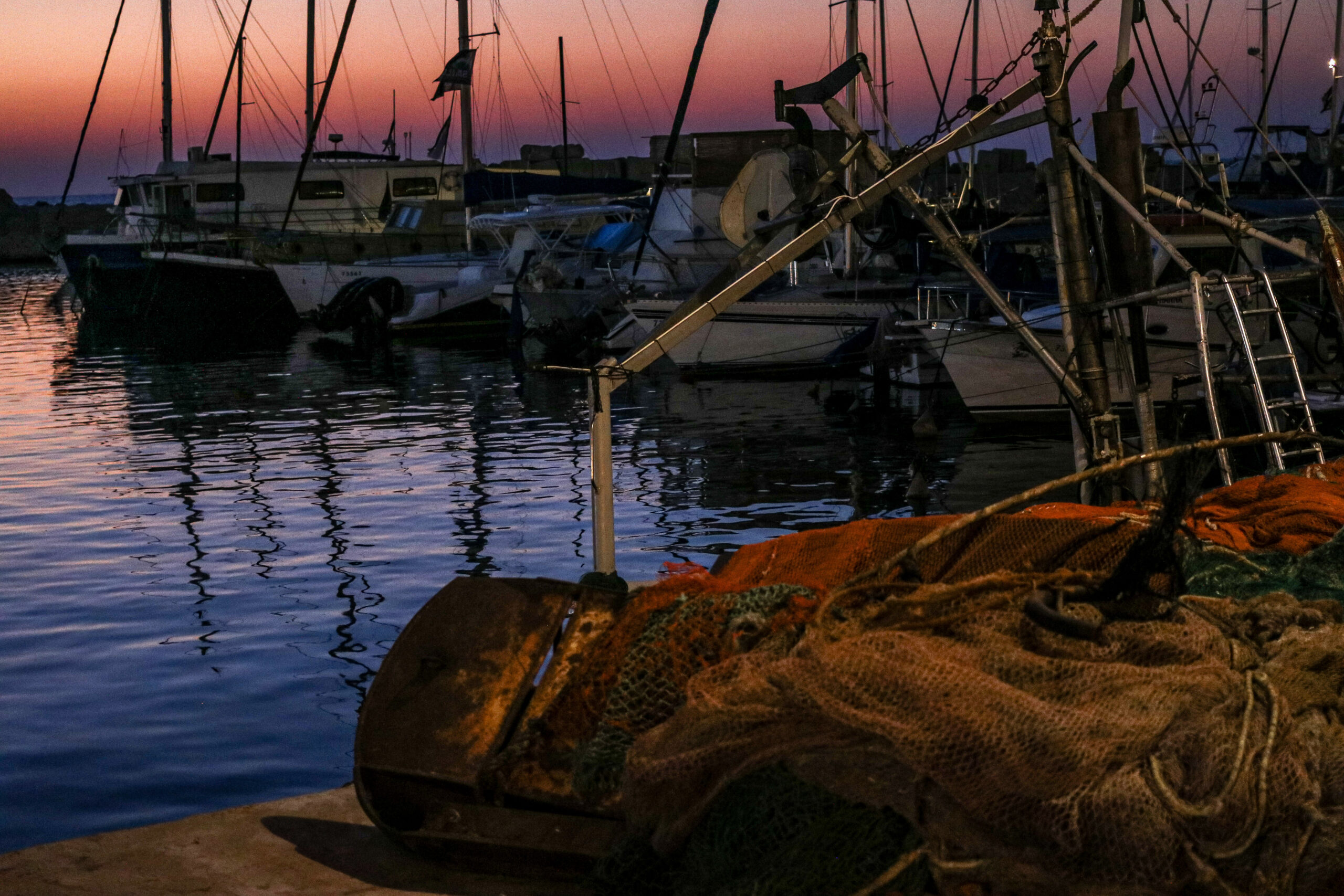
The photo at the top shows the other thing twilight does for you. The sky dims by the minute; the lamps on the quay stay the same. For a while the two are close enough in brightness that one exposure holds both, so the nets and the rusted drum come out warm while the water carries the blue from above. That balance usually lands in the second half of civil twilight or early in nautical. Before it, the lamps look weak against the sky. After it, the sky goes black and the lamps turn into hot spots.
The water is working too. Near the camera it reflects sky from high overhead, already blue; farther out it reflects sky close to the horizon, which is why the pink shows up in the middle distance. Wet paving and shop glass do the same, and it’s the cheapest way to get color into the bottom of a frame that would otherwise go black.
None of it took special gear. The frame was shot on a Canon EOS 760D, an entry-level APS-C body from 2015, with the EF 40mm f/2.8 STM pancake (on the crop sensor it frames like a 64mm). Settings were 1/100 s at f/2.8 and ISO 1600, fast enough to handhold.
A few habits help.
Expect the light to fall fast. On a clear evening it drops roughly seven stops between sunset and the end of civil twilight, so an exposure that was right five minutes ago is already off. Check the histogram every few frames.
Watch the white balance. Auto white balance tends to cancel out the blue you stayed for. Daylight keeps the sky blue and the lamps warm; tungsten turns the lamps neutral and pushes the sky deeper. Shoot raw and the choice can wait.
Pick scenes with their own light. Once civil twilight is over, the sky rarely carries a frame by itself, and a lit window or a lamp on a quay gives the eye somewhere to land.
Turn around now and then. Early in twilight a dark blue-gray band rises above the horizon opposite the sunset: the Earth’s own shadow, cast on the atmosphere, with a pink band above it called the Belt of Venus. It makes a soft, even backdrop when you’re shooting east.
Check the civil dusk time before you go. Then stay at least that long.