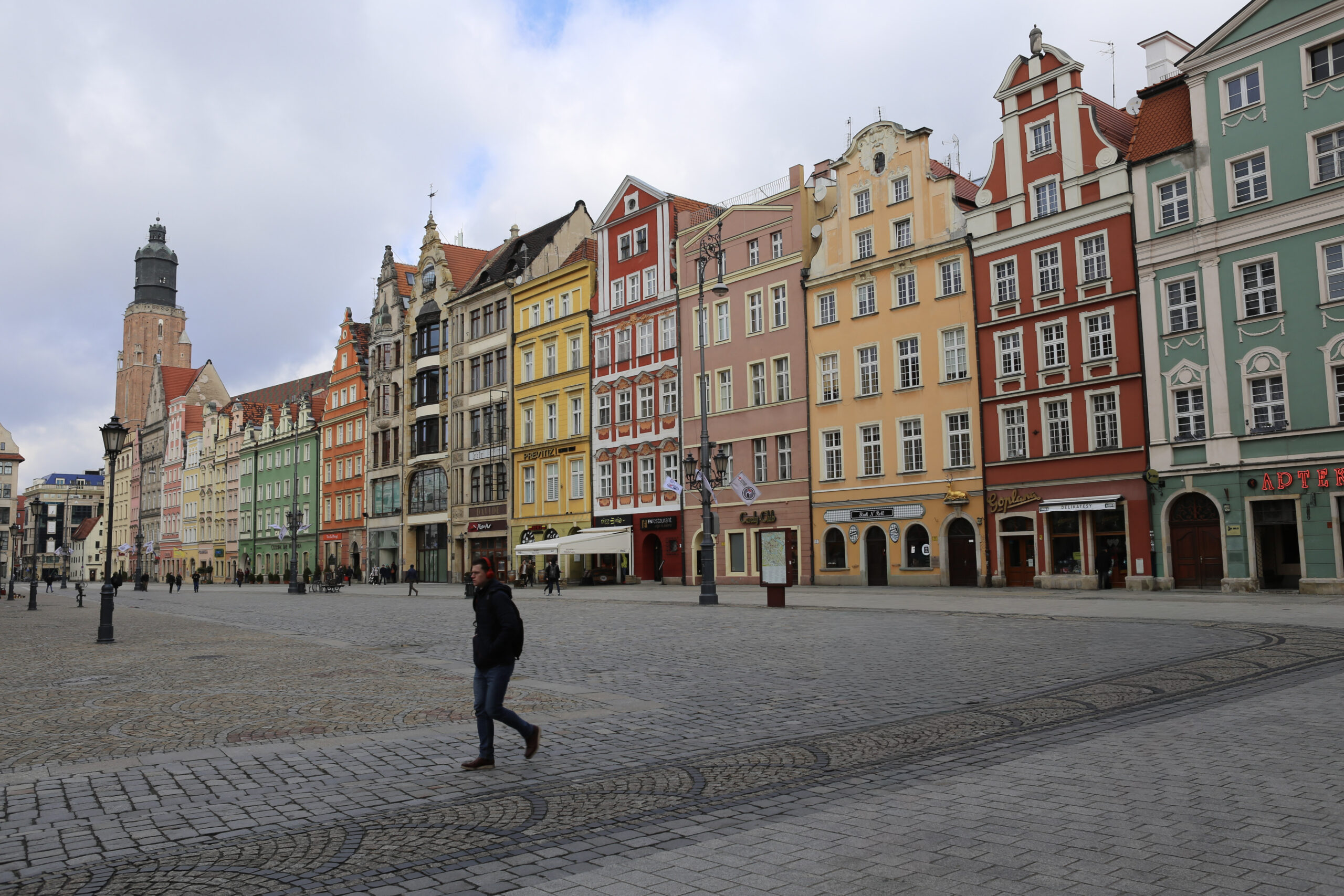
A man in a black jacket and red over-ear headphones strides across a cobbled square, mid-step, backpack on. Behind him a row of tall, narrow houses runs away to the left in green, orange, yellow, pink, red and pale peach, each with its own gable. At the far end a brick church tower with a dark domed cap rises over the roofs. It’s Wrocław’s Market Square on a cool, cloudy day, and there’s almost nobody else in the frame.
A row built one plot at a time
Nothing on this frontage matches. The houses are narrow because the plots were narrow; the square was laid out in the thirteenth century and divided into small plots, so each house is a tall front on a small width, and each one got its own colour. The gables tell you which century got its hands on which house. The red one at right has a stepped, scrolled Renaissance-style gable with a small figure on top. The peach house next to it swells into a curving Baroque outline. One dark facade in the middle, all glass bays and iron, looks like it dropped in from a much later decade and nobody minded.
The tower at the vanishing point
The whole row bends toward the brick tower at the left, and the picture is arranged to make that happen. The rooflines step down toward it, the lamp posts shrink toward it, and the tower is the darkest and tallest vertical in the scene. This is St Elizabeth’s, a brick Gothic church with a black dome and lantern on top. It stands just off the square’s corner, and from here it reads as the end of the street.
What was rebuilt
The city was Breslau until 1945, when it became Wrocław. The siege of that year wrecked much of the centre, and the old town came back through decades of reconstruction. That matters when you look at a row like this. The colours are cheerful, the gables are crisp and the plot widths are medieval, but much of what stands here was rebuilt after the war, on the old plots.
Signs and street furniture
The shopfronts add a second layer. A red neon APTEKA (pharmacy) glows at the far right, a DELIKATESY awning sits under the red house, and a gold script sign for Goplana, the Polish chocolate maker, hangs on its front. Further along there’s a Pizza Hut, a Candy Club and a place called Rock N Roll, all in a line of arched ground-floor doorways. A small gilt animal sits over the entrance of the peach house. In the middle of the square, a tourist map stands on a post by a cast-iron lamp with several globes, and white banners hang from the lamp posts.
The walker and the cobbles
The man is the only sharp, close subject and he’s in motion, which sets him apart from a set of buildings that haven’t moved in centuries. The red headphones are the one saturated spot on him, and they pick up the red of the houses behind. The pavement helps too. Curved bands of dark stone sweep across the pale cobbles in long arcs, and they lead the eye from the bottom edge toward the row.
Flat light, saturated colour
The sky is heavy but bright, with gaps in the cloud and no hard shadows, and that’s what lets the facades hold their colour. In direct sun the reds would burn and the yellows would wash out. Here every house keeps its shade. The camera stands low and roughly level, so the verticals stay upright, and the horizon sits about two-thirds of the way down, giving the buildings and the sky most of the picture.
The square is huge. He crosses it in a few strides.