An event media gallery should help someone who missed the occasion understand what happened, and give someone who attended something worth recognising. That sounds straightforward until the upload folder contains forty pictures of a stage, twelve views of the same handshake and almost nothing showing why anyone wanted to be there. I have a particular affection for the photographs made between the official moments. A conversation in a courtyard, a demonstration that draws a small crowd, a person checking a recording before moving on: these can tell us how the event was actually inhabited.
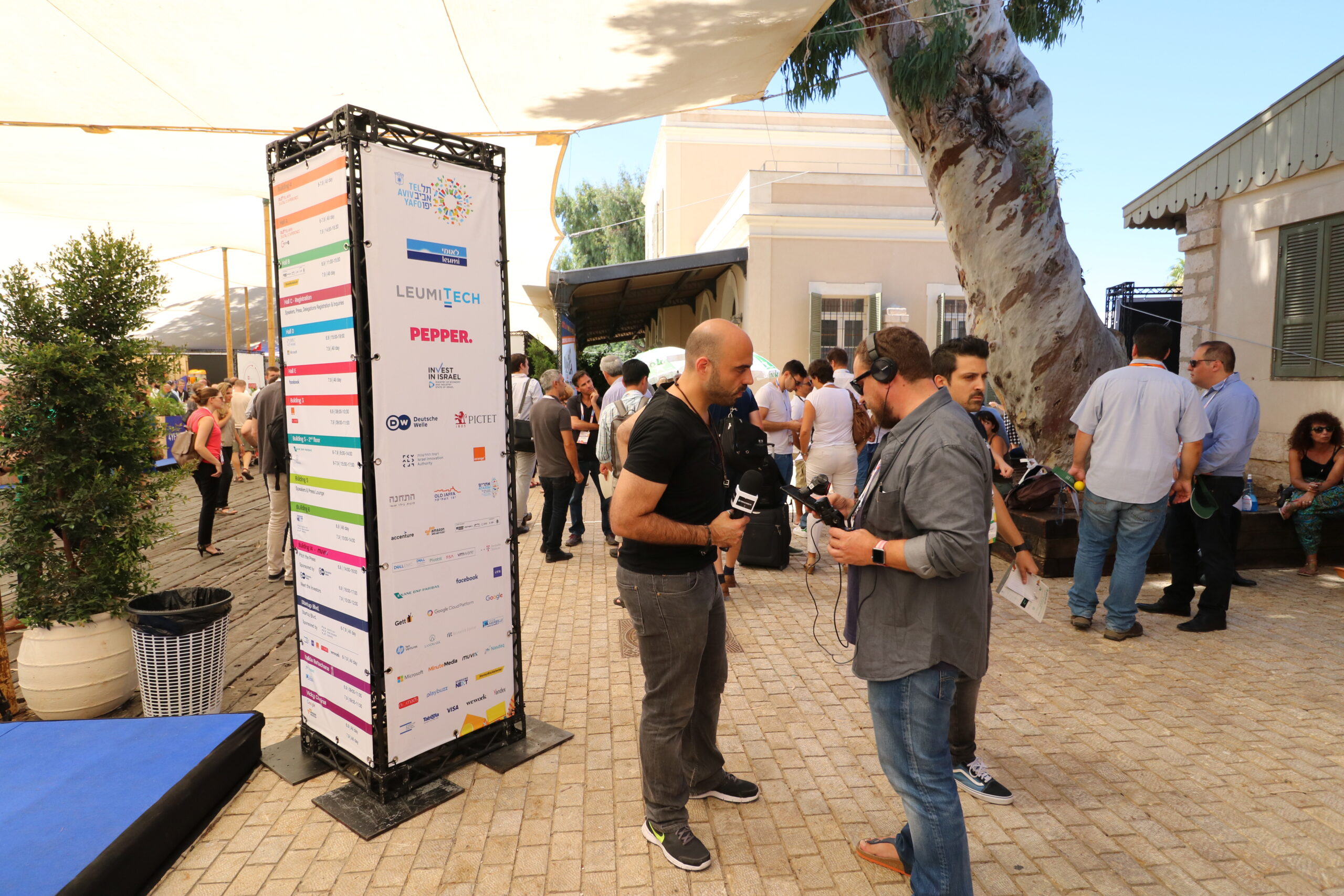
This photograph gives us that kind of interval. Two men stand on pale brick paving beside a tall, freestanding display built into a black metal frame. One face carries a colour-coded programme; the other is packed with sponsor logos, including LeumiTech and Pepper. A man in a black polo shirt holds a microphone, leaning towards another man who wears headphones and looks down at recording equipment. Cables hang between their hands. Behind them, people talk and move through a shaded courtyard. A large tree with mottled bark rises to the right, pale buildings have green shutters, and a cream canopy spreads across the top of the frame. At the left are a potted shrub, a bin and the blue edge of a platform. It is a busy photograph, but the activity has a clear centre: two people attending to the equipment in front of them.
I would include it in a gallery about the working life of a technology event. It supplies a setting, visible programme information, a sense of attendance and a glimpse of media work happening among the visitors. It does not tell us who the two men are or what they were recording. I would check those details before naming them or describing an interview. The photograph is useful without a manufactured account of the exchange. In fact, the uncertainty directs attention towards something quite ordinary and recognisable: public coverage depends on small practical tasks carried out in crowded places.
Before making a selection, decide who the gallery serves. Attendees may look for colleagues and sessions they remember. A prospective exhibitor may want to understand the space and the kinds of interaction it supports. A journalist may need accurately captioned, downloadable images. The organizer may need a lasting record of the programme. These interests overlap, but they are not identical. One page can offer a concise editorial selection, with clearly labelled collections for particular sessions or a separate press download area where needed. It need not make every visitor work through the entire photographic archive.
For an editorial gallery, I would establish the occasion early. Name the event, give its verified dates and location, and open with a photograph that helps people understand the setting. That might be a venue view, a busy entrance or a scene like this courtyard. A picture of a generic lectern provides little orientation unless the caption does the work. The opening does not have to be the most spectacular image. It needs to make the next photograph easier to understand.
Then show what people came to do. At a conference, that may include listening, asking questions, testing equipment, comparing ideas and meeting others. At a festival, the relevant activity will look different. The point is to choose evidence of the event’s particular purpose. In a technology collection, a demonstration can be more informative when the photograph includes the person using it and the object or screen they are responding to. A close-up of an inscrutable device may look impressive while leaving the viewer no wiser. If the important action cannot be photographed clearly, an accurate caption or a short, accessible recording may help.
Speakers and formal moments still belong. A clear view of a keynote speaker can identify an important participant, while a panel photograph records who shared a discussion. I would select frames that show a meaningful gesture or relationship and avoid filling the gallery with near-identical changes of expression. If several speakers need individual records, give those images an understandable grouping. There is little reason to ask a general reader to scroll through every frame from a long speech before reaching the rest of the event.
The gaps between sessions deserve attention because they show another part of the occasion. Our courtyard photograph includes people standing, talking, passing through and sitting at the side. It gives the event physical texture: shade, paving, a tree, a programme tower and limited places to pause. These details can help a future visitor imagine being there. But an image of a crowd does not establish that every conversation was productive, nor does a quiet corner prove disappointing attendance. Choose captions and surrounding claims with that limitation in mind. A photograph records a view at a moment, not the event’s final performance report.
Branding can locate a scene and explain the setting, as the programme tower does here. It can also dominate a collection if every image repeats a sponsor wall. I would give logos the space the editorial record requires and handle any specific sponsor-delivery commitments separately. An event gallery can meet practical needs while still giving its audience varied photographs. The bin at the edge of this frame is a useful reminder that real venues contain more than the objects someone paid to have photographed.
Sequence helps turn the selection into a visit. An arrival view can lead to the main activity, then into closer encounters and quieter observations. You can also group by session or theme when that is more useful. If photographs come from several days, make that clear rather than implying a continuous walk through one afternoon. A gallery arranged for visual rhythm should not accidentally falsify the chronology of an announcement, presentation or ceremony. When timing matters, state it. When it does not, a thematic arrangement may be easier to follow than the camera’s upload order.
For larger events, captions become part of the archive’s long-term value. Confirm names, job titles as relevant to the occasion, session titles and dates. Identify people by a clear position in the frame where necessary. If a name cannot be established, use an accurate description of the activity rather than guessing. Our guide to media gallery captions discusses that boundary between useful context and invented narrative. A year later, “a discussion at the event” may be far less useful than a properly identified session, even if both sounded adequate on publication day.
Mixed media can broaden the record when each item has a purpose. A short demonstration clip can show movement a still photograph cannot explain. A selected interview can preserve a participant’s actual words. A full session recording may be valuable as a separate resource, with a descriptive title, duration and captions or transcript as appropriate. Do not hide a lengthy recording behind a thumbnail that looks like another photograph. Let people know what they are opening. And check that recordings do not reveal material that was intended to remain private, such as a visible attendee list or a confidential screen.
Publication is another editorial stage, rather than the moment to stop looking. Check the mobile layout, enlarge several pictures, read captions beside the correct images and test any offered downloads. Confirm that credits and usage terms are available where needed. If identifying information changes after publication, correct the record. A carefully maintained selection is more useful than a large batch published quickly and abandoned. Our article on choosing photographs offers a practical way to judge duplicates and weaker additions before they reach the page.
There is already a broader technology conference photo gallery on this site, and the courtyard image also accompanies our account of covering a technology event as a solo publisher. Here, its value is especially clear as a piece of the event’s wider life. It gives the formal programme a human setting and makes room for the people producing the coverage. I would want that alongside the stage photographs. Someone had to step away from the presentation, check a cable and make sure the next recording would work. That belongs in the memory of the day too.