The orange shoes get me first. Before the motorcycle, before the smile, before the narrow Bordeaux street behind him, there are those wonderfully unapologetic shoes. A caption could mention them. It could also identify the city and the motorcycle, where that identification is established, and leave the reader to enjoy the rest. What it should resist is turning the rider into a local legend with a colourful history we have never heard. Writing media gallery captions is a small exercise in judgement: give people useful information, direct their attention when it helps, and know where your knowledge ends.
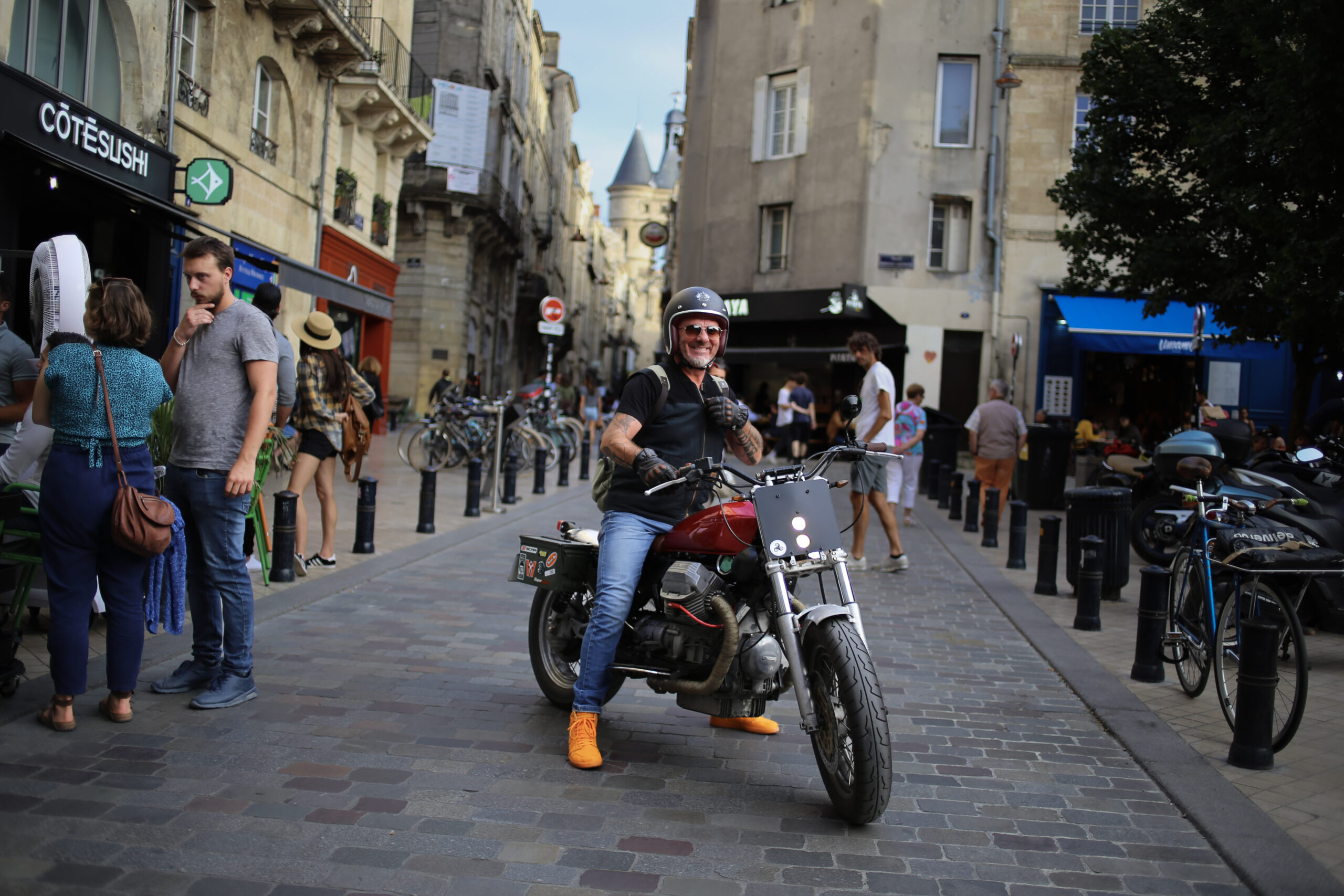
In this photograph, a smiling man sits astride a red motorcycle on a cobbled street. He wears a dark open-face helmet, sunglasses, a black shirt, fingerless gloves and blue jeans. Tattoos are visible on his arms. One gloved hand is raised near his chest; his bright orange footwear anchors the lower part of the picture. The bike’s exposed engine, thick front tyre and two small circular lights give it a distinctive presence. Around him, the street continues with no apparent obligation to become a backdrop: pedestrians pass, bicycles gather beside bollards, a white fan stands near a shopfront, and a blue awning occupies the right side. Pale stone buildings narrow towards a distant pointed roof. There is a lot to look at, and a caption does not need to compete with all of it.
The accompanying archive record identifies the scene as a custom Moto Guzzi in central Bordeaux. A concise caption could therefore read: “A rider on a custom Moto Guzzi in central Bordeaux.” That supplies a subject and location without pretending to identify the man. If the motorcycle’s make had not been established, I would use “motorcycle” until it could be checked. A modest description is preferable to an impressive technical identification that turns out to be wrong. The same rule applies to lenses, military aircraft, flowers and the names of architectural styles. Enthusiasm is welcome; confidence needs something underneath it.
For a more personal gallery, I might write: “A rider on a custom Moto Guzzi in central Bordeaux. The orange shoes make a surprisingly persuasive case for looking below the handlebars.” The second sentence is openly a response to the image. It adds a little voice without introducing a fact about the rider’s life. Whether it belongs depends on the collection. In an editorial photo essay, it may be exactly the right note. In a press archive supplying images for reuse, I would favour the straightforward identification and keep my footwear opinions elsewhere.
A weak caption often tells us what we have already registered: “A man on a motorcycle.” That is not false, but it misses an opportunity to locate the scene or explain why the frame is included. Another kind of weak caption reaches for atmosphere: “Freedom on two wheels in the heart of France.” It sounds pleasantly finished while telling us very little. The more troubling version invents an encounter: “A lifelong Bordeaux resident shows off the motorcycle he restored himself.” The photograph establishes none of that. It may feel human, but the humanity has been supplied by the writer rather than learned from the subject.
Useful information commonly includes a verified name, a location, a capture date and the circumstances of an event. You do not need all four beneath every photograph. A gallery titled “Bordeaux Street Scenes” can establish the city once, with individual captions naming more precise locations when known. A dated event collection may not need the same date repeated under every frame. Think about where the picture will appear, though. If an image can be opened on its own or downloaded for use elsewhere, its record should retain the context that the collection page supplies. A reader should not have to reverse-engineer the entire website to discover which city they are looking at.
Dates deserve particular care because websites produce so many of them. The date a photograph was uploaded is a publishing fact, not proof of when the shutter was released. A filename may provide a clue, but it needs checking before becoming a confident caption. If a precise date is important and unavailable, say what is known or leave the date out. “Undated photograph” can be useful in a historical collection. For a casual street gallery, no date at all may be perfectly adequate. Filling a blank with the wrong information makes the record look complete while making it less useful.
When several people appear in a photograph, identification needs to be unambiguous. “From left” is helpful only when the relevant group is clear, and a caption should distinguish someone in the foreground from a similar figure behind them where necessary. Never infer a relationship simply because two people are standing together. Likewise, describe a visible expression without diagnosing a private feeling. The rider here is smiling. That gives us a secure observation. Calling him delighted with a recent restoration would require knowledge from outside the frame.
Titles, captions and alternative text have related but distinct jobs. A title helps someone identify or find an item. A caption provides visible context alongside it. Alternative text gives a textual alternative to the image, particularly for people using screen readers. For this photograph, a useful description might be: “Smiling rider wearing a dark helmet and bright orange shoes on a red motorcycle in a cobbled Bordeaux street.” The exact wording should reflect the picture’s role on the page and any nearby text. It does not need to inventory every bicycle and window. Nor should it become a hiding place for the phrase “media gallery” repeated in six arrangements.
Credits and usage information deserve their own clarity. A caption can sit beside a credit, but naming a photographer does not by itself grant permission to republish the work. If a gallery supplies downloadable material, tell people where to find the applicable terms and preserve credit information with the record. Do not invent a photographer’s name because the file sits in a particular account or publication. A blank credit is a question to resolve, not a prompt for creative completion. This is especially important when a collection mixes commissioned work, supplied publicity photographs and material from an archive.
Length should follow the amount of useful context. A location and an identification may need only a sentence. An archival photograph may warrant a longer explanation of an event or an uncertainty. A personal essay may deliberately let the caption carry a small aside. What I would avoid is placing the entire article beneath every picture. On a phone, a caption can become a surprisingly substantial interruption. Read the page in sequence: image, caption, surrounding paragraph. If all three make the same point, decide which one should carry it.
There is a place for humour, but I prefer it directed at my own attention or the oddness of a composition rather than at a stranger’s appearance. The orange shoes are a joyful visual interruption; the caption need not make their wearer the butt of a joke. A photograph can outlive the casual tone in which it was posted, and a clever line can travel without the surrounding goodwill. The best personal captions sound like someone looking carefully and speaking honestly. They need not sound like someone auditioning to be the funniest person underneath a photograph.
Before publishing, I would check every name, place and date, then separate observation from interpretation. Ask which claims come from the image, which come from a reliable record, and which are merely plausible. Read the caption without the article around it to see whether it still makes sense. For larger collections, our guide to organizing a media gallery explains how consistent records make these details easier to maintain. When choosing among similar frames, the photo selection guide considers what each picture contributes before the caption is written.
For the Bordeaux rider, I would keep the published caption short and let the photograph provide the abundant detail. The smile, red tank, bright shoes and pedestrians already create an encounter worth pausing over. A caption can tell us where we are and what has been identified. It can offer a small, recognisably personal observation. Then it can get out of the way. Sometimes the most useful sentence beneath a picture is the one that knows it has finished.