I would keep this Bordeaux photograph. It is a little dark, the scene is busy, and there is no single person politely occupying the centre and explaining what the picture is about. Those are things to consider, but they are not my verdict. Across the frame, people are making their own pictures, walking through mist, turning towards one another and briefly borrowing a public space for private performances. The longer I look, the more there is to follow. Choosing photos for a media gallery means making this kind of judgement: deciding what a frame offers, whether that offer belongs in the collection, and whether a neighbouring photograph offers it better.
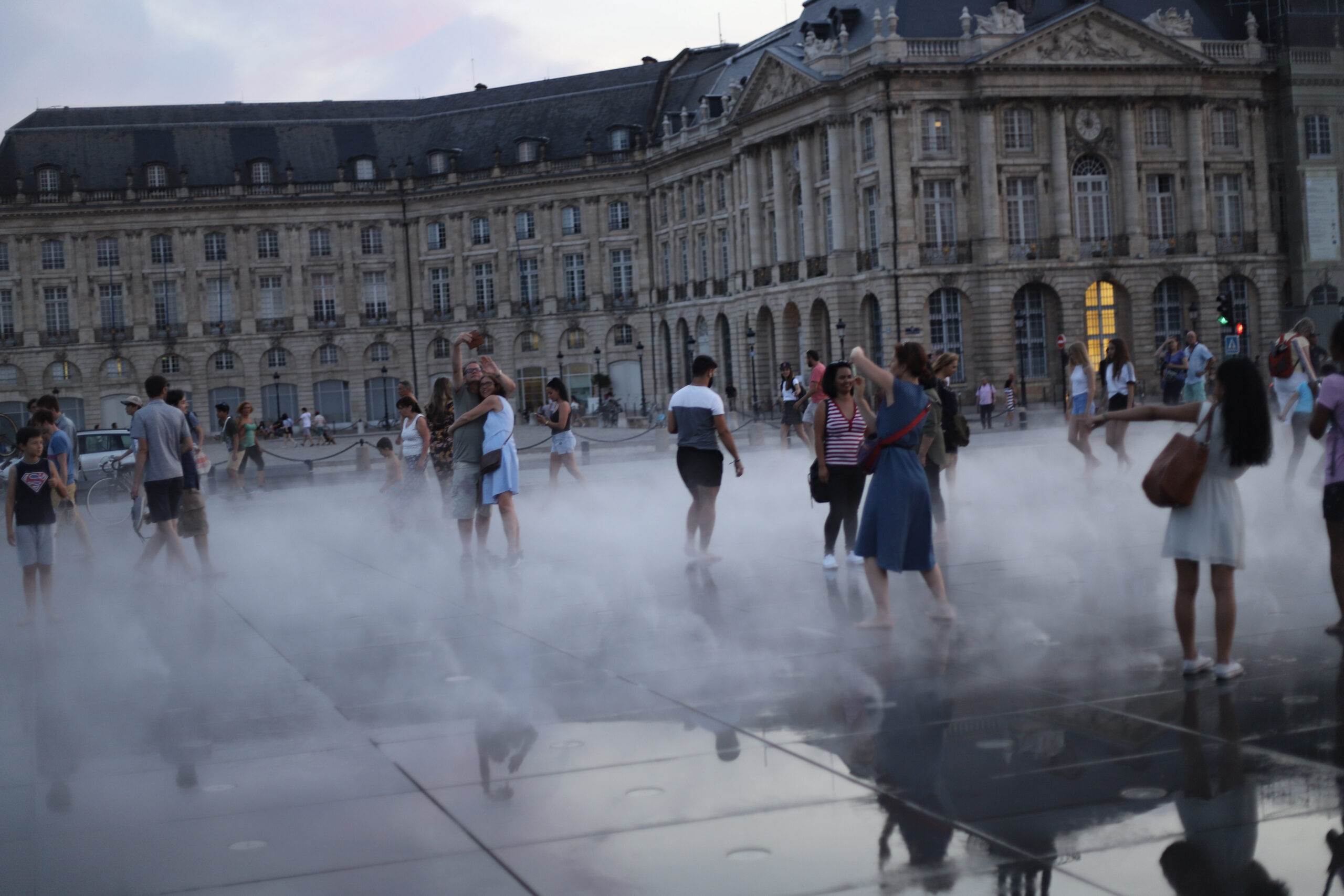
The setting is the Miroir d’eau in front of the Place de la Bourse. A long stone facade fills the upper part of the image, its repeated windows and arches rising towards a dark roof. One ground-floor window glows an unusually emphatic yellow. Beneath it, mist spreads across the wet paving, softening legs and interrupting reflections. Near the left of centre, two people lean together for a raised phone. Farther right, a barefoot woman in a blue dress lifts an arm beside a woman in a striped top. At the right edge, another woman, wearing a pale dress and carrying a brown bag, extends her arm across the scene. Children and other visitors occupy the remaining gaps. Dark reflections stretch towards the foreground. The building provides an orderly backdrop; the people have cheerfully declined to arrange themselves with equal precision.
That tension gives the picture its reason to stay. In a gallery about people enjoying public places, it could be a central image. In a precise architectural survey, it would be a poor substitute for a view that shows the building clearly. In a sequence about photographing and being photographed, the phones and gestures would matter more than the landmark. Selection begins with the job the collection is doing. “Is this a good photograph?” is a useful question, but “What does this photograph contribute here?” is usually easier to answer honestly.
I would first separate obvious failures from difficult choices. An accidental exposure of a bag, an unusably blurred frame with no meaningful subject, or a file too damaged to display can leave the working selection quickly. Even then, exclusion from the gallery need not mean immediate deletion from the archive. The purpose of this first pass is to make the remaining decisions manageable. It is not to punish a camera roll for containing evidence that a human operated the camera.
Next, compare frames that perform the same role. If there are several views of the same scene, open them together at a useful size. Look for differences in gesture, overlaps, expressions, light and the edges of the frame. In a scene like this one, a small change in position could separate two figures or hide one behind an arm. A moment later, the mist could conceal the reflections or clear enough to expose more paving. Those are possible variations, not alternate frames available for inspection here. The point is to compare what actually changes, rather than automatically choosing the newest file or the one with the most dramatic colour.
Technical quality belongs in that judgement, with a clear sense of purpose. For a product detail, softness that hides the feature being demonstrated can make a picture unusable. For an expressive street scene, slight movement may be acceptable if the relationships remain legible. I would examine the Bordeaux photograph at its intended display size and ask whether I can follow the gestures, faces and setting well enough for the story. Enlarging every file until it reveals a flaw is a reliable way to spend an evening. It is less reliable as a way to choose an engaging collection.
Exposure deserves the same measured attention. Here, the darker rendering helps the bright window, pale mist and reflections stand out, although some people merge into shadow. A restrained adjustment might make those figures easier to read. Before editing, decide what needs help and what already works. If lifting the shadows makes the mist seem flat and the evening lose its character, the improvement has a cost. Save an edited version separately and compare it with the original. There is no prize for moving every slider, and the photograph has not asked to look like midday.
Once individual choices are made, put the provisional gallery into order and look for repetition across different subjects. Three images can repeat the same compositional idea even when they show three different places. Several wide views with a landmark above a crowd may begin to feel interchangeable. A detail, a closer human encounter or a quieter frame could change the pace if suitable material exists. The Bordeaux scene is full of activity, so I would consider giving it a less crowded neighbour. That would make it easier to enter this picture’s small maze of gestures without arriving already tired.
A useful exercise is to remove one image and view the sequence again. If the collection loses a necessary location, an important change in mood or its clearest example of something, that is a strong argument for restoring it. If nothing much changes, the image may be surplus even if it is attractive on its own. This is the part of editing that can feel personally unreasonable. A perfectly decent photograph may simply have arrived at a page where its work is already being done. Keep it for another collection rather than forcing the current one to accommodate every success.
Personal attachment needs a fair hearing too. Sometimes a photograph matters because you know who is in it or remember what happened just outside the frame. A public viewer may need a caption to understand that significance. Ask whether a few honest sentences can make the connection available to someone else. If the feeling remains entirely private, the picture may belong in a personal album. Both uses are worthwhile. A public gallery and a private record serve different needs, and neither has to absorb the whole of the other.
The same care applies to people pictured incidentally. Look at expressions, vulnerable moments and potentially misleading juxtapositions before publishing. A photograph can catch a gesture that suggests something quite different from what was happening. Caption what you can establish, and avoid assigning motives to strangers. In the Bordeaux image, we can describe raised phones, poses, movement and the mist. We cannot tell from the frame whether everyone knew one another, what anyone said or why a particular person turned away. The visible activity is interesting enough without that extra invention.
Try the selection as a reader will encounter it. At thumbnail size, this image may first register as pale mist beneath a large building; at a larger size, the individual interactions become its attraction. That suggests giving it a full-frame view and enough room to reward attention. Our guide to media gallery layouts explains how previews and crops can affect such decisions. If an image only works when someone zooms into a tiny corner, consider whether that detail needs a separate presentation or whether the frame is better suited to another purpose.
Then write the captions and make a final pass. Captions often reveal gaps in the selection: several pictures may require the same explanation, while a crucial point has no visual support. They can also reveal a missing fact you need to verify. Give the chosen files useful titles and keep the unused alternatives findable, following the approach in our article on organizing a media gallery. Editing is easier when leaving something out today does not mean losing it forever.
There is no ideal number of photographs independent of the subject and the viewing experience. A short collection can feel repetitive; a longer one can sustain attention through genuine variety. I would stop when the next addition weakens the pace or repeats a contribution already made. If uncertainty remains, leave the selection alone for a while and return to it. Familiarity has a way of making mediocre frames comfortable and strong ones temporarily invisible.
For this picture, my decision comes back to the people in the mist. The two leaning towards a phone, the woman in blue with her arm raised, the reflections breaking across the paving: they give the frame a life that an empty architectural view would not have. A different gallery could reasonably make a different choice. Our guide to building a travel media gallery follows that question into a sequence. Here, I would keep the Bordeaux frame, give it space and choose its neighbours carefully. The camera brought back the whole crowded scene. The editor still has to decide where it belongs.