The McDonald’s sign is staying. It sits beyond a set of ornate arches, bright and familiar in a photograph otherwise occupied by weathered plaster, decorated columns and elaborate ironwork. I can imagine the temptation to crop it out. The picture would become more comfortably historic, less interrupted by the present. But the interruption is what makes me look twice. An image gallery becomes interesting when its selection reveals that kind of decision: someone noticed a relationship, chose to preserve it and gave us enough room to discover it ourselves.
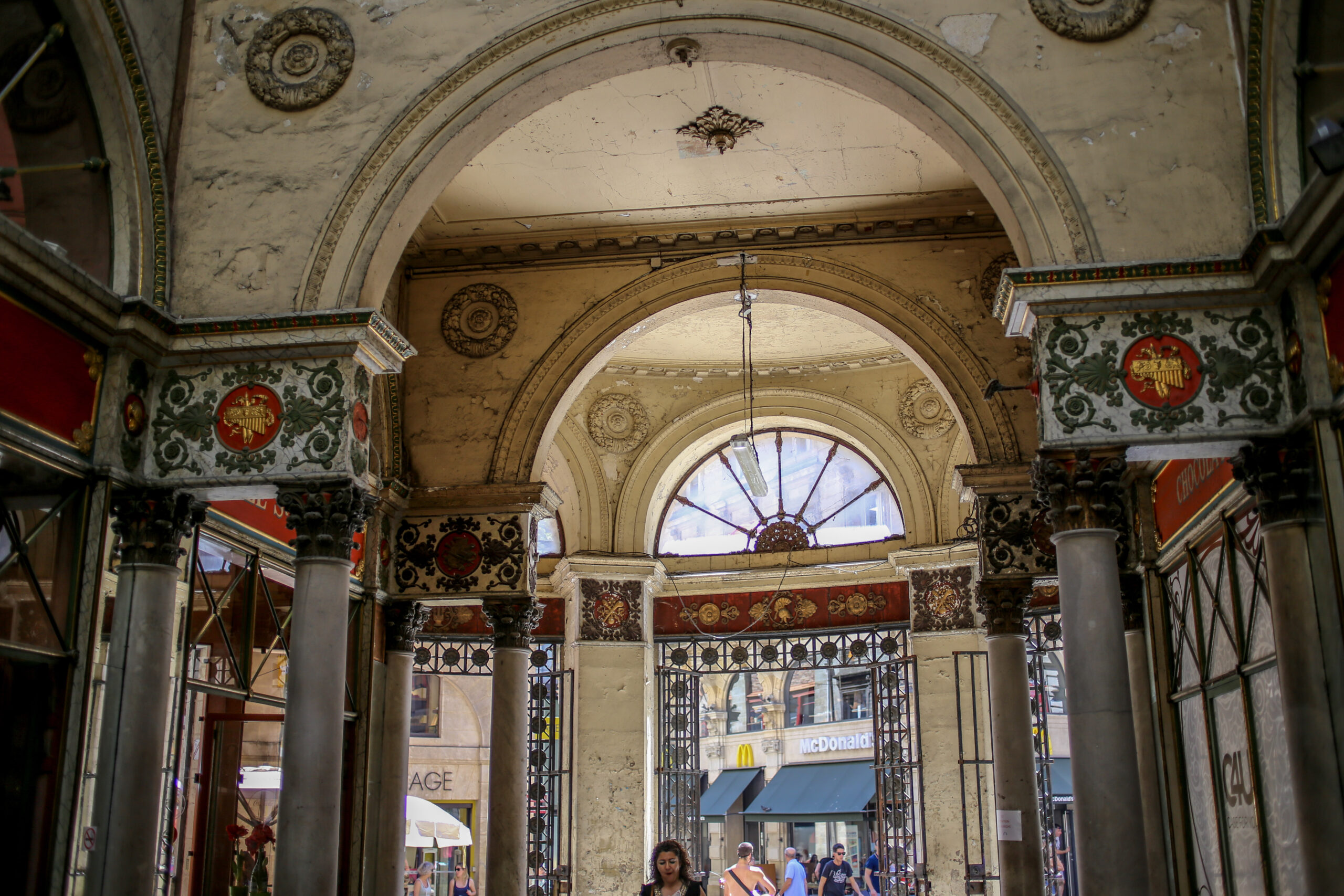
Inside the passage, pale columns support broad arches whose surfaces are cracked and peeling. Circular plaster ornaments punctuate the upper walls. The capitals and rectangular panels above the columns carry dark scrolling foliage, red medallions and gold-coloured emblems. Bands of red decoration run across the structure, echoing the shopfront panels at either side. A fan-shaped window admits a wash of light above the entrance, while a long fluorescent fitting hangs across part of the view. Below it, iron gates frame the street, where people pass beneath dark awnings. A woman appears near the bottom edge. The photograph has grandeur, wear, ordinary commerce and the slightly inconvenient geometry of a view taken while looking up.
That gives it several possible roles in an image gallery. In a collection about covered passages, it establishes an interior and a threshold. In a study of architectural detail, the ornament and damaged surfaces become more important. In an essay about old buildings in contemporary cities, the view through the gate supplies a useful conversation between inside and outside. None of those collections needs to pretend the picture illustrates everything about its subject. It needs to decide what this particular frame contributes and what another photograph might add.
I would begin a new gallery with a working sentence rather than a layout. “Old decorative interiors still connected to the everyday street” would be a promising starting point here. It is specific enough to guide selection and loose enough to permit surprises. A general label such as “Architecture” may be useful for a broad archive, but a smaller editorial collection benefits from a clearer invitation. Visitors should have some sense of why these photographs have been brought together. Otherwise, the page asks them to supply the connection you have not yet found.
Then gather a provisional group and examine it together. A strong opening image can establish the setting, but the next picture should offer a reason to continue. Perhaps it moves closer to a detail, changes the light or introduces a different kind of activity. With this passage, a close view of the ornament could reveal something the wider frame only suggests, if such a photograph is available. Another broad view of almost the same arches might add very little. The purpose of an image gallery is not to demonstrate that the shutter worked repeatedly.
Look for relationships that are more specific than matching colours. Red details can connect two frames, certainly, but so can a repeated gesture, a contrast in scale or a shared tension between decorative ambition and practical use. Here, the hanging light fitting interrupts the older ceiling, just as the fast-food sign interrupts a picturesque reading of the street beyond. A neighbouring photograph could develop that idea in another setting. I would want the connection to remain available to the viewer without requiring a paragraph of persuasion beneath every image.
Consistency helps, but a perfectly consistent selection can become strangely airless. If every photograph offers the same distance, the same symmetry and the same flattering light, the gallery may begin to feel like a demonstration of a formula. A more awkward frame can introduce a useful change. This photograph is not a neutral inventory of the interior. The arches climb and overlap; the foreground is dark; people are cut by the lower edge. Those qualities make the experience feel partial and encountered. Whether they belong depends on the collection, but I would consider them before reaching for a corrective crop.
A short introduction should give the viewer a way in, while captions supply the facts needed along the route. Name the place when its identity has been established. Add dates or circumstances where they are known and relevant. In this case, the image record describes a covered shopping passage but does not supply a verified name or location, so I would keep the caption at that level. The visible signs are details to examine, not permission to invent the building’s history. Personal commentary can still be vivid: I can say I like the collision between the ornament and the street beyond. That is my response, clearly offered as such.
Layout should make these decisions visible. An overview lets people see the collection’s range; a larger view lets them investigate individual frames. For the passage photograph, I would preserve enough of the full composition to keep the street connected to the ceiling. A preview focused entirely on the ornament would advertise one aspect of the picture and conceal another. That may be acceptable as an entry point, provided the complete view is easy to reach. Our guide to gallery layouts considers how grids, masonry and larger editorial presentations change this experience.
Navigation deserves plain language. A collection title should explain what opens when someone selects it, and the way back to the overview should be easy to find. If there are several related galleries, name the relationship rather than scattering unexplained “more” links around the page. I would rather see “More covered interiors” than a mysterious arrow leading somewhere new. There is pleasure in discovery, but the interface should not need solving before the photographs can be enjoyed.
As the gallery grows, keep the file records useful. A descriptive title, accurate alternative text and a stable relationship between the original and its display copies make later editing easier. Check those descriptions against the actual pictures. A copied caption or a description carried over from another file can quietly mislead someone who depends on the text. Descriptive fields need observation, too. A gallery should be reviewed through both its visible photographs and the information supplied about them.
The last editing pass is where I would remove pictures. View the sequence, take one out and ask whether something meaningful has disappeared. If the page loses its clearest transition, its sense of place or a necessary contrast, restore it. If the collection simply becomes more focused, the photograph can wait for another use. Our article on choosing photographs explores that judgement, while the organization guide explains how to keep the unused material findable. Leaving an image out of one gallery should not require losing it.
I would also resist treating every collection as permanently finished. A newly found frame may improve an old sequence; a more accurate identification may improve a caption. Make those changes because they help the visitor, rather than continually adding material simply to make the page longer. An image gallery develops a recognisable character through the quality of its choices. More photographs can broaden it, or blur it. The number alone tells us very little.
For this particular image, the choice I keep returning to is the view through the gate. The plaster is beautiful, the wear is visible, and the arches offer an immediate visual rhythm. Then the familiar restaurant sign brings the scene back into the same commercial world as the viewer. I would keep all of that together. A gallery built around such photographs could offer more than a succession of attractive interiors: it could show how places accumulate uses, repairs and interruptions. The fluorescent light gets to stay as well. It appears to have been doing a job.